THE CLASSIC COLLECTION✦Wild life under the equatorCLASSIC FREE BOOKS
Wild life under the equator
Paul B. (Paul Belloni) Du Chaillu
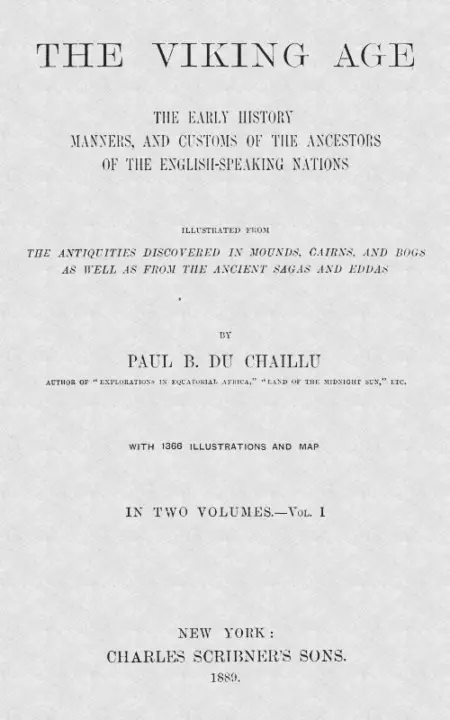
THE CLASSIC COLLECTION · 1889
"The Viking Age. Volume 1" by Paul B. Du Chaillu is a historical account written in the late 19th century. The book explores the early history, manners, and customs of the ancestors of the English-speaking nations, drawing from antiquities uncovered in various burial sites, as well as from ancient sagas and Eddas. It primarily focuses on the Viking civilization and its influence on the lands they settled, particularly in Britain. The opening of the volume sets the stage for an in-depth exploration of Norse civilization, emphasizing the wealth of archaeological evidence that paints a vivid picture of their social, political, and religious life. Du Chaillu discusses the motivations and characteristics of the Norse people, whom he describes as warlike, adventurous, and energetic, attributing their maritime prowess to their ancestry. He hints at the transformation of Britain through Viking influence, foreshadowing an extensive examination of their customs, literature, and mythology, which will be traced throughout the chapters.
Introduction adapted from the source catalogue; source summaries may be automatically generated.
Free to read · English · 172,836 words · No account needed
MAKE TIME FOR A GOOD BOOK
On by default. Untick to stop anonymous reading totals. Each page counts after 10 seconds in view. How this works.
Anonymous counting is on unless you have switched it off.
The mead of kings (blood of warriors slain by the host of kings).
Footnote 430:
Shield is called here the plain of the ring. The tree of the shield is
the warrior.
Footnote 431:
I make ready for the sound of Ilm—take my weapon for battle, as the sound of Ilm is = noise made by weapons.
Footnote 432:
A Valkyrja.
Footnote 433:
Hedin’s cloth = armour. The dyed wand is the sword dripping with
blood.
Footnote 434:
In Helgakvida Hundingsbana, sleep is called draum-thing
(dream-meeting).
Footnote 435:
Halfdan dreamt of the greatness of his family, Halfdan the Black, c. 7. Sometimes there were different explanations of the same dream (Vatnsdæla, 42).
Footnote 436:
Laxdæla, 33; Atlamál, 14–25.
Footnote 437:
See Vol. II., p. 142.
Footnote 438:
See Vol. II., Frontispiece.
Footnote 439:
There was no little hard pushing—meaning that there was a fight between the men and the bears jostling against each other.
Footnote 440:
One of Atli’s shapes, which he could change himself into.
Footnote 441:
Her husband.
Footnote 442:
Summon to join the dead.
Footnote 443:
Guardian spirits; Disir, the shapes of dead women. Cf. Gisli
Súrsson.
Footnote 444:
Dreamstolen, meaning, that the ability of dreaming had been taken away
from him.
Footnote 445:
Cf. also Sigrdrifumal.
Footnote 446:
Sacrifice to.
Footnote 447:
This passage seems to imply that those who believed in their own strength only made the sign of Thor.
Footnote 448:
Athletic and mental exercises. See vol. ii., p. 369.
Footnote 449:
Cf. also Gulathing’s Law, c. 29.
Footnote 450:
This refers to stealing the mead.
Footnote 451:
Frey and Freyja.
Footnote 452:
Olaf Tryggvason.
Footnote 453:
Buandi, plural buendr; bondi, plural bendr; bóandi, plural bóendr. These are different forms of the same name; the transition from buandi to bóandi and then to bondi is easily traced. The form to-day is bonde. The original meaning is a dweller; the verb to dwell is búa—bjó—búid.
Footnote 454:
Indemnity, see p. 544.
Footnote 455:
The Frostathing’s Law says nothing about the deduction of one-fifth from the appraised value.
A new law enacted that the odalsman, in order to keep his right open, should make the usual announcement every tenth year; and the king was subject to the same regulations as other people.
Footnote 456:
Cf. also earlier Gulathing’s Law, 267; earlier Frostathing’s Law, vi.
4.
Footnote 457:
Baugryg means a woman who, being a single daughter, could pay and
receive wergild.
Footnote 458:
A chalet.
Footnote 459:
All that was thrown up by the sea, whales, wreck, &c., belonged to the
king (Gulath., 145).
Footnote 460:
Some great fishing-place in Hálogaland.
Footnote 461:
Cfr. also Heimskringla, 51, 52.
Footnote 462:
See p. 491.
Footnote 463:
So named probably because accustomed to walk much.
Footnote 464:
Bond-woman.
Footnote 465:
In later times we see that the fire-place was in the middle of the
floor.
Footnote 466:
Kind of head-dress.
Footnote 467:
Your reading position is saved on this browser. Take it to another device with a library code. Reading pages adapt to text, rather than matching a printed edition.
Paul B. (Paul Belloni) Du Chaillu
Paul B. (Paul Belloni) Du Chaillu
Paul B. (Paul Belloni) Du Chaillu
BEHIND THE BOOK
This eBook is for the use of anyone anywhere in the United States and most other parts of the world at no cost and with almost no restrictions whatsoever. You may copy it, give it away or re-use it under the terms of the Project Gutenberg License included with this eBook or online at www.gutenberg.org. If you are not located in the United States, you will have to check the laws of the country where you are located before using this eBook. Read the source licence.
The original source file, including credits and licence, is retained by this library. Request an original-format copy at no charge. Please include the book title and Project Gutenberg identifier #56167.
KEEP YOUR CURIOSITY GOING
Cécile Tormay

Moritz Busch
John L. Ransom

Maurice Baring
Frances Wright
Cécile Tormay