THE CLASSIC COLLECTION✦Wild life under the equatorCLASSIC FREE BOOKS
Wild life under the equator
Paul B. (Paul Belloni) Du Chaillu
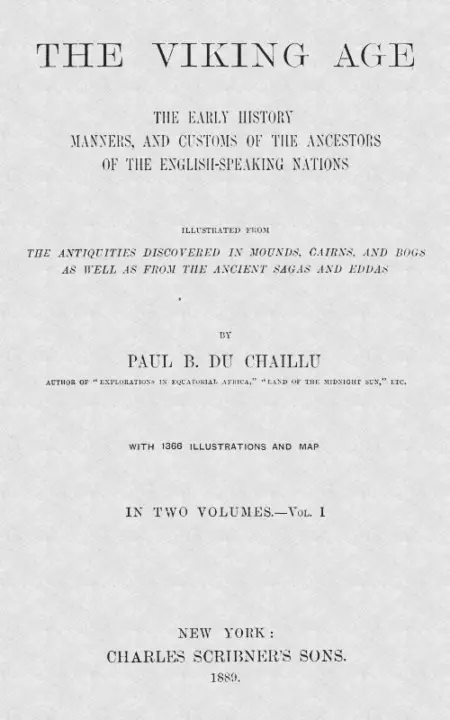
THE CLASSIC COLLECTION · 1889
"The Viking Age. Volume 1" by Paul B. Du Chaillu is a historical account written in the late 19th century. The book explores the early history, manners, and customs of the ancestors of the English-speaking nations, drawing from antiquities uncovered in various burial sites, as well as from ancient sagas and Eddas. It primarily focuses on the Viking civilization and its influence on the lands they settled, particularly in Britain. The opening of the volume sets the stage for an in-depth exploration of Norse civilization, emphasizing the wealth of archaeological evidence that paints a vivid picture of their social, political, and religious life. Du Chaillu discusses the motivations and characteristics of the Norse people, whom he describes as warlike, adventurous, and energetic, attributing their maritime prowess to their ancestry. He hints at the transformation of Britain through Viking influence, foreshadowing an extensive examination of their customs, literature, and mythology, which will be traced throughout the chapters.
Introduction adapted from the source catalogue; source summaries may be automatically generated.
Free to read · English · 172,836 words · No account needed
MAKE TIME FOR A GOOD BOOK
On by default. Untick to stop anonymous reading totals. Each page counts after 10 seconds in view. How this works.
Anonymous counting is on unless you have switched it off.
See Exposure of Children, Vol. II., p. 39.
Footnote 344:
Cf. also Orvar Odd’s Saga, c. 4.
Footnote 345:
This dream seems to have had the power to make the first man who heard
it death-fated.
Footnote 346:
Cf. Olaf Tryggvason’s Saga, p. 37.
Footnote 347:
Gladsheim = Home of the glad.
Footnote 348:
Men slain by weapons.
Footnote 349:
Coats of mail or chain armour.
Footnote 350:
The word in the text means “hangs,” and it is impossible to tell if the wolf is living or dead; it may mean that the wolf is ready to pounce.
Footnote 351:
Odin’s warriors. In Ragnarök these Einherjar fight with Odin against
the Fenri wolf.
Footnote 352:
Voluspa, 24; Hervarar Saga, 5; Eyrbyggja, 44; Fornmanna Sögur, v. 250. Harald Hilditönn was given to Odin at his birth (cf. Saxo). He was victorious all his life till his last battle.
Footnote 353:
Cf. also Gautrek’s Saga, c. 7.
Footnote 354:
One of the goddesses is also called Snotra.
Footnote 355:
From this we learn that a serf must be in company with some one freeborn in order to go to Odin.
Footnote 356:
Fagrskinna.
Footnote 357:
Two Valkyrjas.
Footnote 358:
Gautatýr = the god of the Gautar = Odin.
Footnote 359:
Yngvi’s kin = the Ynglings descended from Odin.
Footnote 360:
The brother of Björn, who was one of Harald Fairhair’s sons, is Hakon.
Footnote 361:
Battle-oars = sword-blades; a fine simile.
Footnote 362:
Hakon.
Footnote 363:
We see from the last line of stanza 4 that Hakon wore a gold helmet. It is also said in the prose that he was conspicuous by it in the battle.
Footnote 364:
Battle is often called play or game; cf. the synonyms for battle.
Footnote 365:
Gram.
Footnote 366:
Váfad = Odin; Odin’s cloth = armour.
Footnote 367:
The hard feet of the hilt = sword-blades.
Footnote 368:
Weapons.
Footnote 369:
Wound-drop = blood.
Footnote 370:
Cape of swords = armour.
Footnote 371:
Tempest of Odin = battle, which can also be called the storm of any Valkyrja, and has many other names.
Footnote 372:
Hropt or Hroptatýr = the shouting god = Odin.
Footnote 373:
Hakon.
Footnote 374:
Eight brothers, that is half-brothers, Harald Fairhair being the
father of them all.
Footnote 375:
By this is meant end of the world.
Footnote 376:
Einherjar is plural, and is a compound. Ein = only, single; and herjar, from the verb herja = make warfare. Thus it means the only fighters, the only champions, being the warriors chosen by Odin to dwell in Valhalla with him, while Freyja lodged one-half of the slain.
Footnote 377:
Chief meal, corresponding in time to breakfast.
Footnote 378:
Cf. also Vafthrudnismal, 41.
Footnote 379:
Cf. also Grimnismál, 19:—
“Geri and Freki
Does the battle-tamer feed,
The famous Herjafödr (father of hosts of Odin);
But by wine only
The weapon-famous
Odin always lives.”
Footnote 380:
Some under-king, or host-kings, probably from Norway.
Footnote 381:
Your reading position is saved on this browser. Take it to another device with a library code. Reading pages adapt to text, rather than matching a printed edition.
Paul B. (Paul Belloni) Du Chaillu
Paul B. (Paul Belloni) Du Chaillu
Paul B. (Paul Belloni) Du Chaillu
BEHIND THE BOOK
This eBook is for the use of anyone anywhere in the United States and most other parts of the world at no cost and with almost no restrictions whatsoever. You may copy it, give it away or re-use it under the terms of the Project Gutenberg License included with this eBook or online at www.gutenberg.org. If you are not located in the United States, you will have to check the laws of the country where you are located before using this eBook. Read the source licence.
The original source file, including credits and licence, is retained by this library. Request an original-format copy at no charge. Please include the book title and Project Gutenberg identifier #56167.
KEEP YOUR CURIOSITY GOING
Cécile Tormay

Moritz Busch
John L. Ransom

Maurice Baring
Frances Wright
Cécile Tormay