
Letters to a Friend, Written to Mrs. Ezra S. Carr, 1866-1879
John Muir
THE CLASSIC COLLECTION · 1878
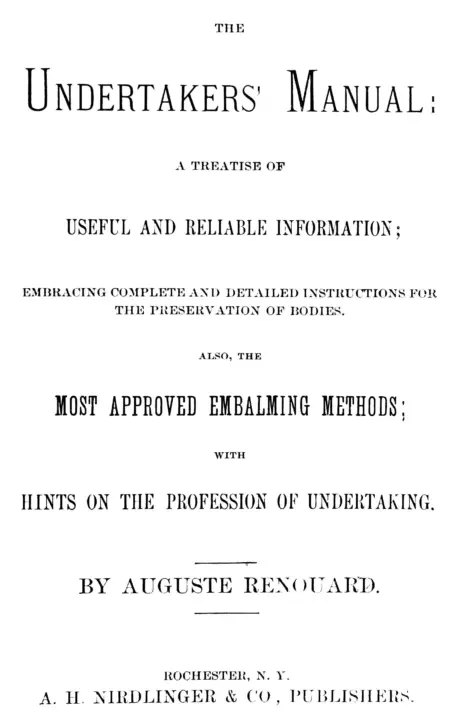
"The Undertakers' Manual" by Auguste Renouard is a treatise on the profession of undertaking, written in the late 19th century. This comprehensive text provides detailed instructions for embalming and body preservation, illuminating the scientific practices behind these procedures while addressing the important role that undertakers play in society. Renouard aims to elevate the profession by offering valuable insights into both the technical and human aspects of undertaking. The opening of the manual introduces the purpose and significance of the work, emphasizing the lack of prior comprehensive resources for undertakers in America. It discusses the need for a sound understanding of anatomy and physiological chemistry as vital for successful embalming practices. Through an introduction by Thomas Gliddon, the author sets a tone of professionalism and responsibility, suggesting that knowledge and skill will enable undertakers to manage their responsibilities with care and respect for the deceased and their families. Renouard outlines the necessity for a detailed grasp of the processes and conditions involved in preserving bodies, foreshadowing a meticulous and enlightening discussion in the subsequent chapters.
Introduction adapted from the source catalogue; source summaries may be automatically generated.
Free to read · English · 53,720 words · No account needed
MAKE TIME FOR A GOOD BOOK
On by default. Untick to stop anonymous reading totals. Each page counts after 10 seconds in view. How this works.
Anonymous counting is on unless you have switched it off.
After the solution on the body has become sufficiently dry and has penetrated the pores of the skin, the excess of moisture must be wiped off with a clean towel.
The nostrils should be hermetically sealed, by introducing into them some cotton, well saturated with gum shellac dissolved in alcohol.
The eyes must be well closed, and, if no other means at hand, the lids must be sewn together with a small circular needle, and some silk, saturated in spirits of turpentine.
The body is then saturated with a thin coating of turpentine; and after the turpentine is dry, the clothing can be put on, and the body is then ready for interment.
As shown by the preceding, this process is very simple, and has given satisfactory results in all cases, although the amount of embalming liquid and the composition thereof vary in all cases, and according to the temperature of the season and country.
For instance, if the body to be embalmed is that of a very fleshy person, and it be in the summer season, when animal substances are more prone to putrefy than at other seasons, the embalming fluid must be altered as follows, in its quantitative composition:
Sulphate of alumina, 6 pounds.
Arsenious acid, transparent, 4 ounces.
Creasote, 6 ounces.
Water, 1 gallon.
For the minor parts of this process, as, for instance, the closing of the eyes, mouth, etc., the reader is referred to previous processes already given in former chapters.
The most reliable composition yet found for embalming purposes,
and the one which has given the most satisfactory results, is the
following:
Alcohol, one gallon; dissolve into it eight ounces of corrosive sublimate, and, after complete solution, add two pounds of creasote. This solution, for injecting purposes, has never failed to accomplish the purpose, and has given the most astonishing results. The only objection to its use, but one which does not in reality carry any weight with it, is the fact that the solution will produce a white scar on the skin of the body wherever it may be dropped; but a very moderate amount of care in the use of it will preclude the possibility of such an accident.
The embalming of bodies by injection has so far occupied our attention. We will hereafter pass briefly in review the process of maceration employed in the preservation of bodies.
The process of embalming bodies, as at first practised, was founded on the principle of complete immersion of the body into some bath composed of antiseptics, which, by being absorbed by the system, rendered the tissues imputrescible, much in the same way as we now preserve anatomical preparations by immersing in alcohol.
Your reading position is saved on this browser. Take it to another device with a library code. Reading pages adapt to text, rather than matching a printed edition.
BEHIND THE BOOK
This eBook is for the use of anyone anywhere in the United States and most other parts of the world at no cost and with almost no restrictions whatsoever. You may copy it, give it away or re-use it under the terms of the Project Gutenberg License included with this eBook or online at www.gutenberg.org. If you are not located in the United States, you will have to check the laws of the country where you are located before using this eBook. Read the source licence.
The original source file, including credits and licence, is retained by this library. Request an original-format copy at no charge. Please include the book title and Project Gutenberg identifier #70908.
KEEP YOUR CURIOSITY GOING
John Muir

Asa Gray
Asa Gray

Florence Nightingale
Elizabeth Robins Pennell
Denison Olmsted