
Letters to a Friend, Written to Mrs. Ezra S. Carr, 1866-1879
John Muir
THE CLASSIC COLLECTION · 1878
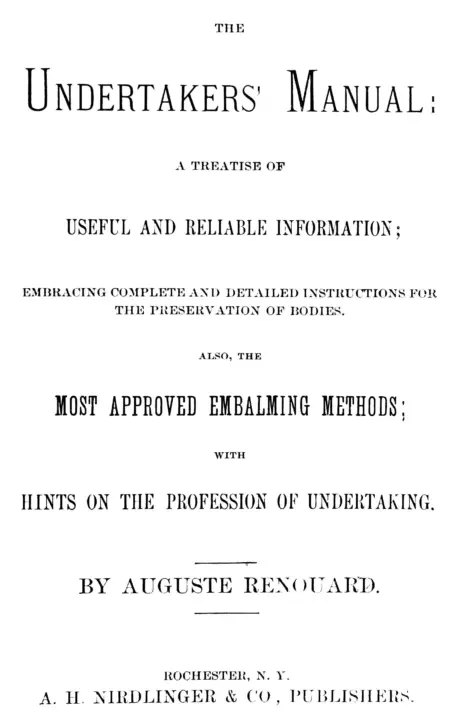
"The Undertakers' Manual" by Auguste Renouard is a treatise on the profession of undertaking, written in the late 19th century. This comprehensive text provides detailed instructions for embalming and body preservation, illuminating the scientific practices behind these procedures while addressing the important role that undertakers play in society. Renouard aims to elevate the profession by offering valuable insights into both the technical and human aspects of undertaking. The opening of the manual introduces the purpose and significance of the work, emphasizing the lack of prior comprehensive resources for undertakers in America. It discusses the need for a sound understanding of anatomy and physiological chemistry as vital for successful embalming practices. Through an introduction by Thomas Gliddon, the author sets a tone of professionalism and responsibility, suggesting that knowledge and skill will enable undertakers to manage their responsibilities with care and respect for the deceased and their families. Renouard outlines the necessity for a detailed grasp of the processes and conditions involved in preserving bodies, foreshadowing a meticulous and enlightening discussion in the subsequent chapters.
Introduction adapted from the source catalogue; source summaries may be automatically generated.
Free to read · English · 53,720 words · No account needed
MAKE TIME FOR A GOOD BOOK
On by default. Untick to stop anonymous reading totals. Each page counts after 10 seconds in view. How this works.
Anonymous counting is on unless you have switched it off.
Vegetable Irritants.—Aloes, colocynth, jalap, gamboge, scammony, savin, croton oil, colchicum, veratria, turpentine; all these drugs produce congestion and inflammation of the stomach and bowels.
Sulphate of Copper—Verdigris.—The post mortem appearances have only been observed in a moderate number of cases; the stomach may be unchanged, or there may be patches of gangrene and inflammation, and even perforation.
Tartar Emetic.—In this instance the lesions are not constant, but the lungs may be engorged with blood.
Opium.—The post mortem appearances of persons who have been killed by the preparations of opium, are negative. Intense congestion of the brain and lungs are spoken of by most authors, but they seem to depend chiefly on the way in which the patient dies, rather than on any specific action of the drug.
Prussic Acid.—The skin is usually livid, and the muscles contracted; the stomach is congested, and the veinous system unusually full of blood. The most characteristic condition, when this acid is present, is the odor of bitter almonds exhaled from the stomach and tissues.
Alcohol.—The different preparations of alcohol may, when taken in large quantities, produce sudden coma and death. The bodies are said to resist decomposition for an unusual length of time. There is congestion, and sometimes extravasation of the blood in the brain; the veins everywhere are full of blood, and the bladder distended with urine. Chronic alcoholic poisoning is of a different nature; in this latter case the brain appears normal, but the lungs are usually congested.
Strychnia—Nux Vomica.—In cases of poisoning from these, the cramping and contraction of the muscles relax after death, but the brain is always congested with blood.
Corium, Aconite, Belladona, Lobelia, Digitalis, Stramonium,
Veratrum.—All these poisons produce congestion of the brain, lungs
and stomach.
Carbonic Oxide.—This gas is produced from burning charcoal, and forms the poisonous ingredient of illuminating gas. For post mortem appearances, see death from suffocation.
Carbolic Acid.—A number of deaths from this poison have been reported in the last few years. In this case, the stomach, lungs and intestines are intensely congested.
From Lightning.—In persons killed by lightning the internal viscera may be so lacerated and disorganized that the injection of the embalming fluid may be rendered impossible.
Drowning.—Persons who have been drowned usually die from asphyxia. The lungs are generally congested, the stomach contains some of the fluid in which the person may have been drowned, and must be emptied. The abdominal viscera may also be congested, but the blood generally remains fluid throughout the body, and is easily removed.
Your reading position is saved on this browser. Take it to another device with a library code. Reading pages adapt to text, rather than matching a printed edition.
BEHIND THE BOOK
This eBook is for the use of anyone anywhere in the United States and most other parts of the world at no cost and with almost no restrictions whatsoever. You may copy it, give it away or re-use it under the terms of the Project Gutenberg License included with this eBook or online at www.gutenberg.org. If you are not located in the United States, you will have to check the laws of the country where you are located before using this eBook. Read the source licence.
The original source file, including credits and licence, is retained by this library. Request an original-format copy at no charge. Please include the book title and Project Gutenberg identifier #70908.
KEEP YOUR CURIOSITY GOING
John Muir

Asa Gray
Asa Gray

Florence Nightingale
Elizabeth Robins Pennell
Denison Olmsted