
Letters to a Friend, Written to Mrs. Ezra S. Carr, 1866-1879
John Muir
THE CLASSIC COLLECTION · 1878
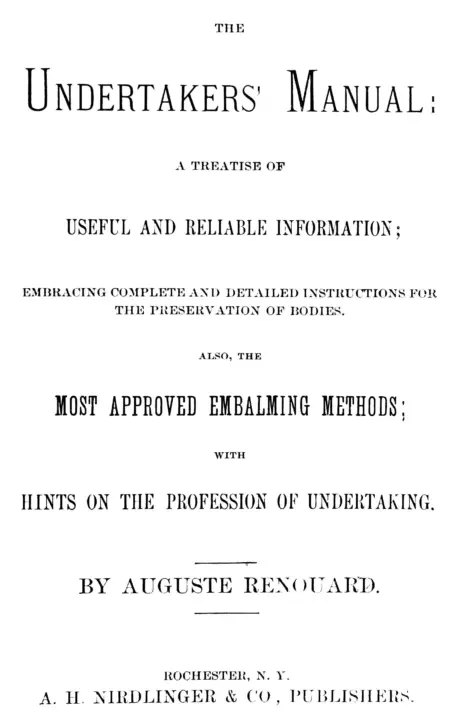
"The Undertakers' Manual" by Auguste Renouard is a treatise on the profession of undertaking, written in the late 19th century. This comprehensive text provides detailed instructions for embalming and body preservation, illuminating the scientific practices behind these procedures while addressing the important role that undertakers play in society. Renouard aims to elevate the profession by offering valuable insights into both the technical and human aspects of undertaking. The opening of the manual introduces the purpose and significance of the work, emphasizing the lack of prior comprehensive resources for undertakers in America. It discusses the need for a sound understanding of anatomy and physiological chemistry as vital for successful embalming practices. Through an introduction by Thomas Gliddon, the author sets a tone of professionalism and responsibility, suggesting that knowledge and skill will enable undertakers to manage their responsibilities with care and respect for the deceased and their families. Renouard outlines the necessity for a detailed grasp of the processes and conditions involved in preserving bodies, foreshadowing a meticulous and enlightening discussion in the subsequent chapters.
Introduction adapted from the source catalogue; source summaries may be automatically generated.
Free to read · English · 53,720 words · No account needed
MAKE TIME FOR A GOOD BOOK
On by default. Untick to stop anonymous reading totals. Each page counts after 10 seconds in view. How this works.
Anonymous counting is on unless you have switched it off.
PHRENES (Gr. the mind). The diaphragm; so called because the ancients supposed it to be the seat of the mind. Hence the term Phrenic, a designation of the internal respiratory nerve, which goes to the diaphragm.
PHRENOLOGY (Gr. an account). A description of the mind; a science, introduced by Gall and Spurzheim, by which particular characters and propensities are indicated by the conformation and protuberances of the skull.
PHYSIOLOGY (Gr. phusis, nature, logos, an account). The science which treats of the properties of organic bodies, animal and vegetable, of the phenomena which they present, and of the laws which govern their actions.
PIA MATER. A vascular membrane, investing the whole surface
of the brain.
PITUITARY MEMBRANE. A designation of the Schneiderian membrane, which lines the cavities of the nose.
PLEXUS (L. plecto, to weave). A kind of net-work of blood-vessels
or nerves.
PNEUMO-GASTRIC NERVES (Gr. pneumon, the lung, gastér, the stomach). The par vagnum, nervi vagi, or eighth pair of nerves, distributed to the stomach.
PORTAL CIRCULATION. A subordinate part of the venous circulation, in which the blood makes an additional circuit before it joins the rest of the venous blood.
PORTAL VEIN (L. vena portæ). A vein originating from the
organs within the abdomen.
POTASSIUM. The metallic base of the well known alkaline substance,
potassa.
PROCESS. Apophysis. A process or eminence of a bone. Also, a
lobe or portion of the brain.
PRONATION (L. pronus, bending downward). The act of turning the palm of the hand downwards, by rotating the radius upon the ulna by means of the pronator muscles.
PRONATOR (L. pronus, bending downward). The name of two muscles which turn the radius and the hand inwards and downwards.
PROXIMATE PRINCIPLE. A term applied, in analyzing any body, to the principle which is nearest to the natural constitution of the body, and more immediately the object of sense, as distinguished from intermediate or ultimate principles. Ultimate principles are the elements of which proximate principles are composed.
PULMONARY, pulmonic (L. pulmo, the lungs). Relating or belonging
to the lungs.
PULSE (L. pulsus, a stroke). A beating or striking; and hence, the stroke or beat of an artery.
PUNCTA LACHRYMALIA. The external commencements of the
lacrymal ducts.
PUPILA (L. dim. of pupa, a puppet). The pupil, or the round aperture in the center of the iris of the eye.
PYLORUS (Gr. púle, a gate, ora, care). Literally a gate-keeper. The lower and contracted orifice of the stomach, guarding the entrance into the bowels.
QUARTZ. A species of silicious minerals.
RAMIFICATION (L. ramus, a branch, fio, to become). The issuing of a small branch from a large one, as of the minute branches from the larger arteries.
Your reading position is saved on this browser. Take it to another device with a library code. Reading pages adapt to text, rather than matching a printed edition.
BEHIND THE BOOK
This eBook is for the use of anyone anywhere in the United States and most other parts of the world at no cost and with almost no restrictions whatsoever. You may copy it, give it away or re-use it under the terms of the Project Gutenberg License included with this eBook or online at www.gutenberg.org. If you are not located in the United States, you will have to check the laws of the country where you are located before using this eBook. Read the source licence.
The original source file, including credits and licence, is retained by this library. Request an original-format copy at no charge. Please include the book title and Project Gutenberg identifier #70908.
KEEP YOUR CURIOSITY GOING
John Muir

Asa Gray
Asa Gray

Florence Nightingale
Elizabeth Robins Pennell
Denison Olmsted