
Letters to a Friend, Written to Mrs. Ezra S. Carr, 1866-1879
John Muir
THE CLASSIC COLLECTION · 1878
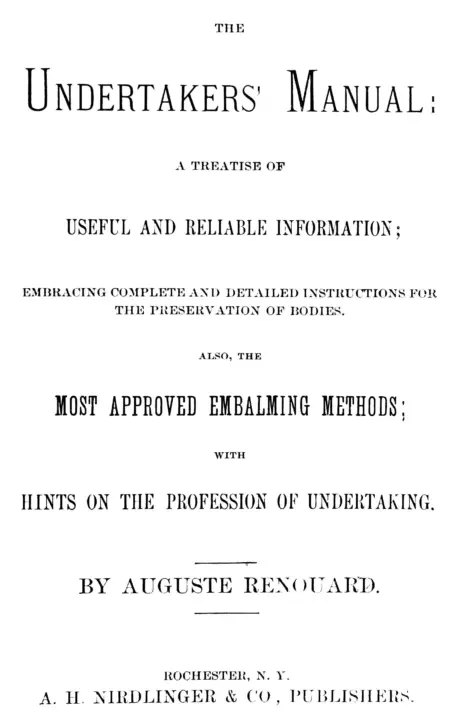
"The Undertakers' Manual" by Auguste Renouard is a treatise on the profession of undertaking, written in the late 19th century. This comprehensive text provides detailed instructions for embalming and body preservation, illuminating the scientific practices behind these procedures while addressing the important role that undertakers play in society. Renouard aims to elevate the profession by offering valuable insights into both the technical and human aspects of undertaking. The opening of the manual introduces the purpose and significance of the work, emphasizing the lack of prior comprehensive resources for undertakers in America. It discusses the need for a sound understanding of anatomy and physiological chemistry as vital for successful embalming practices. Through an introduction by Thomas Gliddon, the author sets a tone of professionalism and responsibility, suggesting that knowledge and skill will enable undertakers to manage their responsibilities with care and respect for the deceased and their families. Renouard outlines the necessity for a detailed grasp of the processes and conditions involved in preserving bodies, foreshadowing a meticulous and enlightening discussion in the subsequent chapters.
Introduction adapted from the source catalogue; source summaries may be automatically generated.
Free to read · English · 53,720 words · No account needed
MAKE TIME FOR A GOOD BOOK
On by default. Untick to stop anonymous reading totals. Each page counts after 10 seconds in view. How this works.
Anonymous counting is on unless you have switched it off.
FIGURE 2.—Back View of the Heart and Lungs.—a, Larynx. b, Trachea. c, Right bronchus. d, Left bronchus. e, Left auricle of the heart. f, Left ventricle. g, Right pulmonary veins. h, Left pulmonary veins. i, Left pulmonary artery. j, Section of the aorta. k, Trunks of the brachio-cephalic veins (those which belong to the arms and head). l, The opening of the inferior vena cava.—The sub-divisions of the pulmonary arteries and veins, and of the air-tubes or bronchi, are seen accompanying each other in the left lung in both figures.
ABDOMEN (L. abdo, to hide). So called from its containing the
intestines, &c.
ABDUCTOR (L. abduco, to draw from). Abducent. A muscle whose office is to draw one part of the body away from another.
ABSORPTION. The act or process of imbibing or swallowing.
ABSORBENTS. Vessels which imbibe, as lymphatics and lacteals.
ALBUMEN (L. albus, white). Albumen is of two kinds, animal and vegetable: 1. Animal albumen exists in two forms, the liquid and the solid. In the liquid state, it is a thick, glairy fluid, constituting the principal part of the white of egg. In the solid state, it is contained in several of the textures of the body, as the cellular membrane, the skin, glands and vessels.—2. Vegetable albumen closely resembles animal albumen, and has been found in wheat, rye, barley, peas and beans.
ANASTOMOSIS (Gr. aná, through, and stoma, a mouth). The communication of vessels with each other, as of the arteries with the veins, which, by touching at numerous points, form a net-work or reticulation. See Inosculation.
ANATOMY (Gr. anatémnō, to cut up). The science of organization; the science whose object is the examination of the organs or instruments of life. Animal anatomy is divided into human anatomy and comparative anatomy, according as it treats of the organization of the human body, or of that of other animals.
AORTA (Gr. aèr, air, teréō, to keep; as having been formerly supposed to contain only air). The great artery of the heart. It is distinguished into the ascending and descending.
AQUEOUS. Watery.
ARACANOID MEMBRANE (Gr. arachnē, a spider, and eīdos, likeness). The fine cobweb-like membrane situated between the dura and pia mater. It is the serous membrane of the cerebro-spinal centers.
ARBOR VITÆ. Literally, tree of life. A term applied to the
arborescent appearance presented by the cerebellum, when cut
into vertically.
ARTERY (Gr. aèr, air, and teréō, to hold). A vessel which carries the blood from the heart; formerly supposed, from its being found empty after death, to contain only air.
Your reading position is saved on this browser. Take it to another device with a library code. Reading pages adapt to text, rather than matching a printed edition.
BEHIND THE BOOK
This eBook is for the use of anyone anywhere in the United States and most other parts of the world at no cost and with almost no restrictions whatsoever. You may copy it, give it away or re-use it under the terms of the Project Gutenberg License included with this eBook or online at www.gutenberg.org. If you are not located in the United States, you will have to check the laws of the country where you are located before using this eBook. Read the source licence.
The original source file, including credits and licence, is retained by this library. Request an original-format copy at no charge. Please include the book title and Project Gutenberg identifier #70908.
KEEP YOUR CURIOSITY GOING
John Muir

Asa Gray
Asa Gray

Florence Nightingale
Elizabeth Robins Pennell
Denison Olmsted