THE CLASSIC COLLECTION✦Search-Light LettersCLASSIC FREE BOOKS
Search-Light Letters
Robert Grant

THE CLASSIC COLLECTION · 1904
"The Undercurrent" by Robert Grant is a novel written in the early 20th century. The book explores the complexities of love, ambition, and societal expectations through the story of Constance Forbes, a young woman who marries Emil Stuart, a man striving for success in a rapidly growing city. As they navigate their relationship and their individual ambitions, the story delves into themes of disillusionment and the challenges faced in a changing societal landscape. The opening of the narrative presents the wedding of Constance and Emil, highlighting Constance's mixed feelings about her choice to marry, reflecting on the sacrifices she makes for love and her aspirations in the field of education. The couple's dynamic is established through their conversation and interactions, revealing Emil's ambition and Constance's support as they settle into married life. However, as Emil confronts the harsh realities of business and eventually faces failure, the strain on their relationship becomes apparent, setting the stage for deeper conflicts around personal aspirations and societal pressures. This beginning hints at the tumultuous journey the couple will face as they grapple with their dreams and the realities of life together.
Introduction adapted from the source catalogue; source summaries may be automatically generated.
Free to read · English · 127,500 words · No account needed
MAKE TIME FOR A GOOD BOOK
On by default. Untick to stop anonymous reading totals. Each page counts after 10 seconds in view. How this works.
Anonymous counting is on unless you have switched it off.
Undoubtedly the chief purpose of Mrs. Wilson's stay in New York was to see her daughter. After a three months' residence in South Dakota, Lucille had obtained a divorce on the ground of cruelty, and had promptly married her admirer, Bradbury Nicholson, son of the president of the Chemical Trust. Mrs. Wilson had declined to attend the wedding, which took place in Sioux City three days after the final decree had been entered--a very quiet affair. Lucille had notified her mother that it was to occur, but was not surprised that she did not take the journey. She and her husband had spent four months in Europe to let people get accustomed to the idea that she was no longer Mrs. Clarence Waldo, and recently they had taken up their residence in New York. Her new husband had three millions of his own, and, as Lucille complacently expressed the situation to her mother, society had received them exactly as if nothing had happened.
"I told you how it would be, Mamma," she said. "Everybody understands that Clarence and I were mismated. I am radiantly happy, and, as for your granddaughter, she could not be fonder of Bradbury if he were her own father. He has bought a thousand dollar pony for her. All the Nicholson connection and my old friends have been giving us dinners, which shows that we can't be disapproved of very strongly."
Lucille certainly looked in the best spirits when she came to see her mother. She was exquisitely dressed, and her equipage, which stood at the door during her visit, was in the height of fastidious fashion. So far as externals were concerned, it was manifest that she was making good her promise to be more conservative and decorous. Mrs. Wilson saw fit to mark her abhorrence of her daughter's course by going to a hotel instead of to Lucille's large house on Fifth Avenue. She was not willing to stay under her new son-in-law's roof, but how could she avoid making his acquaintance and dining with him? A definite breach with her only child was out of the question, as she had previously realized; besides her grand-daughter demanded now more than ever her oversight and affection. Consequently on the second day she dined at the new establishment, and consented later to attend a dinner party which was given in her honor, though Lucille kept that compliment from her mother's knowledge until the evening arrived. She had taken pains to secure the most socially distinguished and interesting people of her acquaintance, and the affair was alluded to in the newspapers as one of the most brilliant festivities of the winter. A leopard cannot altogether change its spots, and Lucille's ruling passion was still horses, but she desired to show her mother that she had genuinely improved; so it happened that after the guests had returned to the drawing-room an organ-grinder accompanied by a pleasing black-eyed young woman, both in fresh, picturesque Italian attire, were ushered in. They proved to be no less than two high-priced artists from the grand opera, who, after a few preliminary capers to keep up the illusion, sang thrilling duets and solos. When they had finished came an additional surprise in that the organ was shown to be partially hollow and to contain a collection of enamelled bonbonières which were passed on trays by the servants among the delighted guests. After the company had gone mother and daughter had an intimate talk, in the course of which Lucille, though making no apologies, volunteered the statement that she in common with half a dozen other women of her acquaintance had decided to go into retirement in one of the church sisterhoods during the period of Lent. She explained that the sisters of her new husband, who had high church sympathies, were preparing to do the same and that the project appealed to her. Mrs. Wilson was electrified. It was on her lips to ask Lucille how she could reconcile this new departure with her hasty second marriage, but she shrank from seeming to discourage what might be an awakening of faith or even of æsthetic vitality in her daughter's heart. Still, though she rejoiced in Lucille's apparent happiness and prosperity, she felt stunned at the failure of Providence to vindicate its own just workings. Much as she desired in the abstract that her daughter should be blessed, how was it that so flagrant a violation of the eternal proprieties could result not merely in worldly advancement, but an attractive home? For there was no denying that Bradbury Nicholson was a far more engaging man than his predecessor, and that he and Lucille were at present highly sympathetic in their relations. Would the harmony last? It ought not to, according to spiritual reasoning. And yet on the surface the dire experiment had proved a success and there were indications that permanent domestic joys and stability were likely to be the outcome of what she considered disgrace.
Your reading position is saved on this browser. Take it to another device with a library code. Reading pages adapt to text, rather than matching a printed edition.
Robert Grant
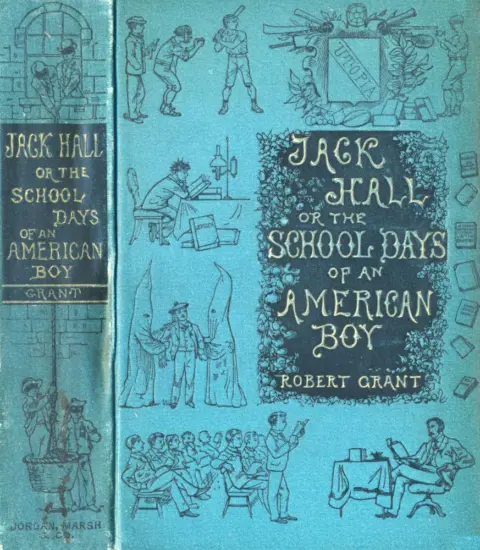
Robert Grant

Robert Grant
Robert Grant
BEHIND THE BOOK
This eBook is for the use of anyone anywhere in the United States and most other parts of the world at no cost and with almost no restrictions whatsoever. You may copy it, give it away or re-use it under the terms of the Project Gutenberg License included with this eBook or online at www.gutenberg.org. If you are not located in the United States, you will have to check the laws of the country where you are located before using this eBook. Read the source licence.
The original source file, including credits and licence, is retained by this library. Request an original-format copy at no charge. Please include the book title and Project Gutenberg identifier #56310.
KEEP YOUR CURIOSITY GOING
Coulson Kernahan

Maurice Baring
Frances Wright
Cécile Tormay

Frederic Jesup Stimson

W. H. P. (William Henry Pope) Jarvis