THE CLASSIC COLLECTION✦Search-Light LettersCLASSIC FREE BOOKS
Search-Light Letters
Robert Grant

THE CLASSIC COLLECTION · 1904
"The Undercurrent" by Robert Grant is a novel written in the early 20th century. The book explores the complexities of love, ambition, and societal expectations through the story of Constance Forbes, a young woman who marries Emil Stuart, a man striving for success in a rapidly growing city. As they navigate their relationship and their individual ambitions, the story delves into themes of disillusionment and the challenges faced in a changing societal landscape. The opening of the narrative presents the wedding of Constance and Emil, highlighting Constance's mixed feelings about her choice to marry, reflecting on the sacrifices she makes for love and her aspirations in the field of education. The couple's dynamic is established through their conversation and interactions, revealing Emil's ambition and Constance's support as they settle into married life. However, as Emil confronts the harsh realities of business and eventually faces failure, the strain on their relationship becomes apparent, setting the stage for deeper conflicts around personal aspirations and societal pressures. This beginning hints at the tumultuous journey the couple will face as they grapple with their dreams and the realities of life together.
Introduction adapted from the source catalogue; source summaries may be automatically generated.
Free to read · English · 127,500 words · No account needed
MAKE TIME FOR A GOOD BOOK
On by default. Untick to stop anonymous reading totals. Each page counts after 10 seconds in view. How this works.
Anonymous counting is on unless you have switched it off.
The zest of existence must be largely ethical and subjective for the majority of us or we should speedily become despondent or bored. Contact with life is necessarily so commonplace for the mass of humanity, that, were we dependent on personal participation in large events and dramatic, splendid experiences for inspiration and content, few would not find themselves restless and in the mental doldrums. Fortunately for our peace of mind, most of us not only appreciate that pictorial and world-stirring, or even exciting, affairs can be the lot of only a fraction of mankind, but, by virtue of the imagination, manage to impart to our more or less humble vicissitudes the aspect of an engrossing situation. We recognize the relative insignificance of the individual drama, but its reality holds us. Its characters may be few, its scenery bare, its action trite and simple to other eyes, yet each of us, as the leading actor, finds in the development of a human soul a part which fascinates him, and lends itself to the finest shades of expression. Whether it be a king on his throne, or a cripple in his cot, the essential matter to the world is the nice interpretation. So, as the true artist in a subordinate rôle forgets for the time that he is not the leading actor, we refuse to be depressed by the unimportance of our theatricals and are absorbed by the unfolding perplexities of our own soul play.
It is every American woman's privilege, according to her tastes, to dream that she may become the wife of the President of the United States, or wield a powerful influence as a poetess, humanitarian educator, or other exponent of modern feminine usefulness. In marrying Emil Stuart, Constance had renounced the latter in favor of the former possibility. She had sacrificed all hopes of personal public distinction, but there still had remained the vision of becoming famous by proxy, through her husband. If this had never appeared to her happy eyes as a bride more than an iridescent dream, the idea that she would presently be working in a lawyer's office would have seemed utterly inconsistent with her scheme of life, and a violation of her horoscope. Yet, now that she was established in this position, she found the experience not only satisfactory, as a means of subsistence, but interesting. In the first place, it stirred her to be down-town in the swift current of affairs and a part of the busy crowd which peopled the huge office-buildings and swept to and from its work with the regularity and rhythmic force of the tide. Through this daily contact she discerned, as never before, the dignity and the pathos of labor, and gained both courage and exhilaration from the thought that, though there were generals and captains, and she was in the rear rank of privates, the real strength of the army lay in the faithful performance by the individual of that portion of the world's toil entrusted to himself or herself. There was attraction, too, in her employment, though her task was but to register and reproduce with despatch the thoughts of others. The occupation tested her accuracy, patience, tact, and diligence. She must avoid blunders and be swift to comprehend. There were secrets in her keeping; affairs upon the issue of which hinged large sums of money, and often the happiness of leading citizens, who were clients of the office; close legal battles between mind and mind; domestic difficulties settled out of court; and suits for injuries, where the price of a life or of a limb were at stake. Her lips must be sealed, and she must seem unaware of the tragedies which passed beneath her observation. Yet the human element became a constant, vivid interest to her, and now and then it happened, as, for instance, when a forlorn hope brought liberal damages to the wronged or the afflicted, that she was taken into the secret by the exultant plaintiff, and was able to rejoice openly. There was, finally, her association with her employer. From this she had not expected much. She was there to execute his instructions without superfluous words or the obtrusion of her own personality. She knew, instinctively, that he would not treat her merely as a machine, but she took for granted that their relations would be formal. It pleased her that, though this was the case, there were moments, even from the first, when he let her perceive that he regarded her as a social companion. To evince a kindly interest in her personal affairs was simply human; anyone might show this; but to talk with her on the topics of the day, to call her attention to a book or an article, or, as presently happened, to invite her opinion on a question of legal ethics, was a flattering indication that he considered their point of view the same. A difference in point of view is the most insurmountable, because the most intangible, barrier to the free play of human sympathy and the social instinct. It is the last great fortress in the pathway of democracy; one which the besiegers will be able to carry only by learning the password. A free-masonry exists, from the cut of the mind to that of the hair and coat, between those who recognize each other, and not to speak the same language palsies the best intentions. Modest as her introduction to Mrs. Randolph Wilson had made her, Constance in her heart believed that she spoke the same mental language as Mr. Perry. But would he recognize it? That he did so not only increased her interest in serving him, but held out the promise of a new friend. He might so easily have passed her over, he who was so busy and had so many acquaintances. Yet it was plain that he liked to talk to her, and that he availed himself of opportunities for conversation. At the end of a year it happened that the other stenographer, her predecessor, left Mr. Perry's employment in order to marry. As a consequence, Constance became the senior clerk, and was given formal charge of the office with a slight increase in pay.
Your reading position is saved on this browser. Take it to another device with a library code. Reading pages adapt to text, rather than matching a printed edition.
Robert Grant

Robert Grant

Robert Grant
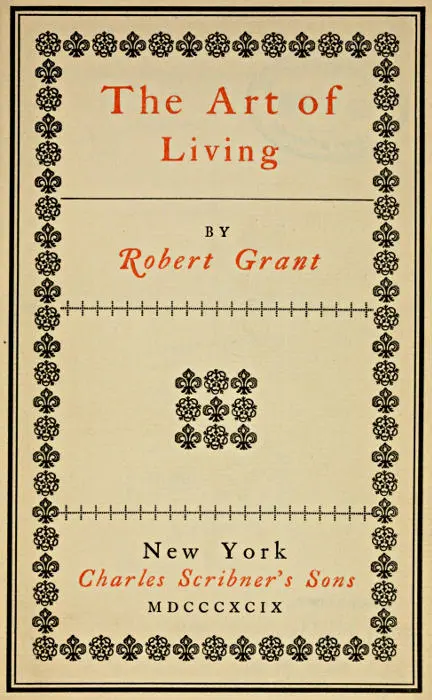
Robert Grant
BEHIND THE BOOK
This eBook is for the use of anyone anywhere in the United States and most other parts of the world at no cost and with almost no restrictions whatsoever. You may copy it, give it away or re-use it under the terms of the Project Gutenberg License included with this eBook or online at www.gutenberg.org. If you are not located in the United States, you will have to check the laws of the country where you are located before using this eBook. Read the source licence.
The original source file, including credits and licence, is retained by this library. Request an original-format copy at no charge. Please include the book title and Project Gutenberg identifier #56310.
KEEP YOUR CURIOSITY GOING
Coulson Kernahan

Maurice Baring
Frances Wright
Cécile Tormay

Frederic Jesup Stimson

W. H. P. (William Henry Pope) Jarvis