
The Writing of News A Handbook with Chapters on Newspaper Correspondence and Copy Reading
Charles G. (Charles Griffith) Ross
THE CLASSIC COLLECTION · 1914
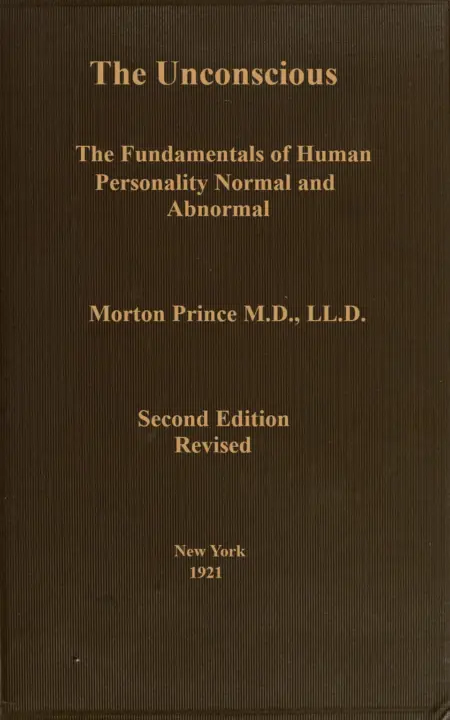
"The Unconscious: The Fundamentals of Human Personality, Normal and Abnormal" by Morton Prince, M.D., LL.D. is a scientific publication written in the early 20th century. This work serves as an introduction to abnormal psychology and discusses the mechanisms of human personality, focusing on both normal and pathological aspects. The author employs the inductive method to gather existing knowledge on the subconscious and aims to clarify foundational concepts for understanding psychological phenomena. The opening portion of the text establishes the groundwork for a thorough exploration of memory and its processes as fundamental to the understanding of the unconscious. Prince outlines the theory of memory not just as conscious recall but as a complex process involving registration, conservation, and reproduction of experiences. He emphasizes the significance of subconscious processes, suggesting that many aspects of human behavior and personality are influenced by elements of past experiences that may not be consciously remembered. Through various examples, including hypnosis and automatic writing, Prince illustrates how forgotten memories can be conserved and subsequently accessed, setting the stage for deeper discussions on the dynamics of human personality in later chapters.
Introduction adapted from the source catalogue; source summaries may be automatically generated.
Free to read · English · 165,396 words · No account needed
MAKE TIME FOR A GOOD BOOK
On by default. Untick to stop anonymous reading totals. Each page counts after 10 seconds in view. How this works.
Anonymous counting is on unless you have switched it off.
=McDougall, Wm.=, 538, 602, 625.
=Mental Conflicts=, mechanisms of, 582.
=Multiple personality=, the psychogenesis of, 545;
product of two processes and secondary growth, 546.
Case of B. C. A., 551;
autobiography, 556;
conflicts between sentiments and rebellious thoughts, 567, 579,
583;
growth of rebellious thoughts into the larger B complex and the
later B personality, 569, 577–579, 584, 587, 596–598;
unification of the same in the second ego, 570.
The B complex, 584, 587;
manifestations of the B complex in alterations of character and
conduct, 587–592, 616.
The B personality, 593;
the eruption of the B personality from “shock” (conflict), 593,
601;
the evolution of the B personality, 596–598, 601;
“shock” as a defense reaction, 599;
analysis of the “shock” 601;
the B personality as a reversion to youth, 602–612;
characteristics of the B personality, 603.
The A personality, 614;
eruption of the same by “shock,” 614;
characteristics of the A personality, 612, 614, 619–621;
mechanisms of the “shock” reaction, 621–624.
Dissociation and repression of emotional instincts from the A and B
personalities, 624–627.
Reintegration of the two personalities into one normal whole, 632.
=Personality=, structure and dynamic elements of, 529;
definition of, 532;
primary and secondary units of its structure, 535.
=Self=, the conception of, 541.
=Sentiments=, structure of, 537;
the self-regarding sentiments, 538;
conflicts between sentiments in the case of B. C. A., 583.
=Shand, Alexander F.=, 535, 602.
Transcriber’s Note
The unmatched ‘)’ at 95.1 ‘recorded subconsciously, coconsciously).’, has no simple resolution, based on the grammar and punctuation, and has been left as-is.
There appears to be a confusion of quotation marks at 282.15. The final phrase contains an opening double quote, which is belied by a short single-quoted phrase just above, and the final footnote referring to Janet’s text.
The labels on the two graphs in the image on p. 425 were chopped and
have been added.
Errors deemed most likely to be the printer’s have been corrected, and are noted here. The references are to the page and line in the original.
xvii.31 The B Personal[l/it]y Replaced. 56.28 [(]tactile, visual, etc.) Added. 97.23 to say that it[ is] plain Inserted. 138.30 process is conserved and rep[r]oduced Inserted. 150.12 out of the unconscious.[”] Removed. 155.1 devoid of ab[s]truseness, Inserted. 187.8 post[ /-]hypnotic Replaced. 210.13 coconscious or un[con]conscious Removed. 214.10 is apt to meet with difficulties[.] Added. 223.27 and His Times[,] Sir Horace Rumbold Added. 231.21 that various co[o/ö]perative movements Replaced. 258.19 [o/a]bnormal mental conditions Replaced. 280.10 [5/4]. Hysterical attacks. Misnumbered. 436.23 che[x/z] les mélancoliques Replaced. 470.19 inhibition of consciousnes[s] Added. 504.18 to the subconsc[i]ous conflicts Inserted. 525.3 deposited in the uncon[s]cious Inserted. 598.24 particularly anger and disgust[;/,] Replaced. 600.11 whether the “shock[”] was a defense Added. 649.29 [con-]considered as a subconscious zone Removed.
Your reading position is saved on this browser. Take it to another device with a library code. Reading pages adapt to text, rather than matching a printed edition.
BEHIND THE BOOK
This eBook is for the use of anyone anywhere in the United States and most other parts of the world at no cost and with almost no restrictions whatsoever. You may copy it, give it away or re-use it under the terms of the Project Gutenberg License included with this eBook or online at www.gutenberg.org. If you are not located in the United States, you will have to check the laws of the country where you are located before using this eBook. Read the source licence.
The original source file, including credits and licence, is retained by this library. Request an original-format copy at no charge. Please include the book title and Project Gutenberg identifier #69930.
KEEP YOUR CURIOSITY GOING
Charles G. (Charles Griffith) Ross
Hannah Webster Foster

Emily Lawless
Edwin Hamlin Carr

Charles De Lano Hine
Andrew Ure