
The Writing of News A Handbook with Chapters on Newspaper Correspondence and Copy Reading
Charles G. (Charles Griffith) Ross
THE CLASSIC COLLECTION · 1914
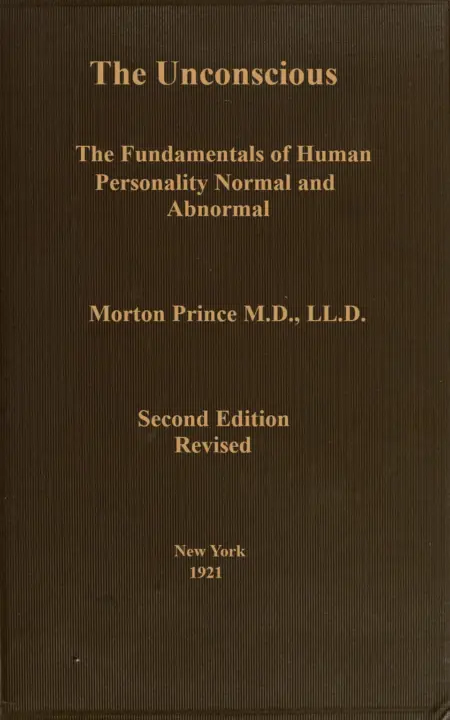
"The Unconscious: The Fundamentals of Human Personality, Normal and Abnormal" by Morton Prince, M.D., LL.D. is a scientific publication written in the early 20th century. This work serves as an introduction to abnormal psychology and discusses the mechanisms of human personality, focusing on both normal and pathological aspects. The author employs the inductive method to gather existing knowledge on the subconscious and aims to clarify foundational concepts for understanding psychological phenomena. The opening portion of the text establishes the groundwork for a thorough exploration of memory and its processes as fundamental to the understanding of the unconscious. Prince outlines the theory of memory not just as conscious recall but as a complex process involving registration, conservation, and reproduction of experiences. He emphasizes the significance of subconscious processes, suggesting that many aspects of human behavior and personality are influenced by elements of past experiences that may not be consciously remembered. Through various examples, including hypnosis and automatic writing, Prince illustrates how forgotten memories can be conserved and subsequently accessed, setting the stage for deeper discussions on the dynamics of human personality in later chapters.
Introduction adapted from the source catalogue; source summaries may be automatically generated.
Free to read · English · 165,396 words · No account needed
MAKE TIME FOR A GOOD BOOK
On by default. Untick to stop anonymous reading totals. Each page counts after 10 seconds in view. How this works.
Anonymous counting is on unless you have switched it off.
2. A given experience is conserved through the medium of some kind of residuum of that experience. This residuum must have a specific existence independent of consciousness, in that it is capable of specific and independent functioning, coincidentally with and outside of the consciousness of any given moment. Its nature must be such that it can incite through specific processes the following phenomena in none of which the conscious processes of the moment take part as factors:
(a) Specific memory for the given experience expressed through the established physiological mechanisms of external expression (speech, writing, gestures) after the manner of a mnesic process.
(b) A mnesic hallucination which is a representation of the antecedent perceptual experience but after having undergone translation into terms of another sense.
(c) A mnesic hallucination in which the original experience appears synthesized with various other experiences into an elaborate representation of a complex experience, or secondarily elaborated into a symbolism, allegory or other fabrication.
(d) Mnesic phenomena which are a logical continuation of the antecedent conscious experiences and such as ordinarily are produced by conscious processes of thought—reasoning, imagination, volition (mathematical calculations, versification, fabrication, etc.).
(e) Physical phenomena (paralyses contractures, vasomotor disturbances,
etc.).
In other words a specific experience while in a state of conservation and without being reproduced in consciousness can incite or induce processes which incite these and similar phenomena.
Footnote 45:
Lecture III, p. 58.
Footnote 46:
For specific instances, see Lecture VII.
Footnote 47:
Morton Prince: Experimental Evidence for Coconscious Ideation, Journal of Abnormal Psychology, April-May, 1908.
Footnote 48:
For further details, see Lecture VI, p. 169.
Footnote 49:
Prince: Mechanism and Interpretation of Dreams, Jour. of Abn. Psych., October-November, 1910.
Footnote 50:
If, lacking this knowledge of the data, any one chooses to insist that it was not the conserved residua of previous thoughts, but of the dream itself (the only alternative entertainable explanation) which induced, after waking, the hallucinatory phenomena and blindness, we still fall back upon the same principle, namely, that of the subconscious functioning of conserved residua of a conscious experience producing a physiological (and psychological) effect.
Footnote 51:
According to recent researches of Sidis in conjunction with Kalmus, and later with Nelson (The Nature and Causation of the Galvanic Phenomenon, Psychological Review, March, 1910) similar galvanic phenomena under similar conditions may be caused by the generation of an electric current within the body.
Footnote 52:
The test word (e. g., boat, stone, hat, etc.) of course represents an idea which may have various associations in the mind of the subject.
Footnote 53:
Morton Prince and Frederick Peterson: Experiments in Psycho-Galvanic Reactions from Coconscious (Subconscious) Ideas in a Case of Multiple Personality, Journal of Abnormal Psychology, April-May, 1908.
Your reading position is saved on this browser. Take it to another device with a library code. Reading pages adapt to text, rather than matching a printed edition.
BEHIND THE BOOK
This eBook is for the use of anyone anywhere in the United States and most other parts of the world at no cost and with almost no restrictions whatsoever. You may copy it, give it away or re-use it under the terms of the Project Gutenberg License included with this eBook or online at www.gutenberg.org. If you are not located in the United States, you will have to check the laws of the country where you are located before using this eBook. Read the source licence.
The original source file, including credits and licence, is retained by this library. Request an original-format copy at no charge. Please include the book title and Project Gutenberg identifier #69930.
KEEP YOUR CURIOSITY GOING
Charles G. (Charles Griffith) Ross
Hannah Webster Foster

Emily Lawless
Edwin Hamlin Carr

Charles De Lano Hine
Andrew Ure