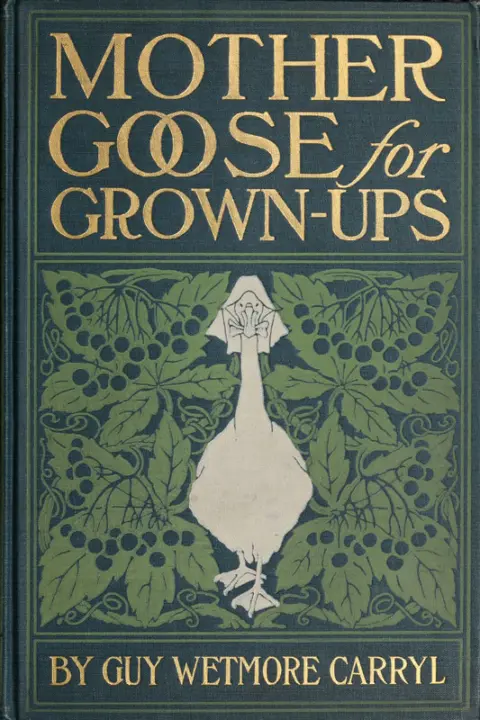
Mother Goose for Grown-ups
Guy Wetmore Carryl
THE CLASSIC COLLECTION · 1904
"The Transgression of Andrew Vane" by Guy Wetmore Carryl is a novel written in the early 20th century. The book explores themes of love, despair, and human relationships, primarily focusing on Andrew Vane, a young man navigating the complexities of life, love, and societal expectations, especially as he grapples with the aftermath of his family's struggles and personal failures. The narrative promises to delve into the contrast between idealism and reality, particularly through Andrew's interactions and evolving dynamics with other characters. At the start of the story, readers are introduced to Helen Sterling, who reflects on her deteriorating marriage with John Vane, Andrew's father. Helen's life embodies a difficult journey filled with disillusionment and heartbreak as she waits for her husband, consumed by his failures and alcoholism. As she grapples with the drastic change in her circumstances, a chance encounter with a stranger hints at potential companionship and change. Meanwhile, Andrew Vane arrives in Paris, freshly released from his past and in search of direction, underscoring the generational and existential conflicts that permeate the narrative. The opening sets a tone of melancholy mixed with hope, positioning both Helen and Andrew at crossroads in their lives.
Introduction adapted from the source catalogue; source summaries may be automatically generated.
Free to read · English · 76,615 words · No account needed
MAKE TIME FOR A GOOD BOOK
On by default. Untick to stop anonymous reading totals. Each page counts after 10 seconds in view. How this works.
Anonymous counting is on unless you have switched it off.
For a moment the girl made no reply. Her questioning look had observably become more keen, and with one finger she picked at the turquoise matrix in the handle of her parasol.
"Well?" she said finally.
"Galetteux," said Radwalader. "Go softly, my friend."
Mademoiselle Tremonceau bowed with ineffable dignity.
"You have my gracious permission to present him," she said.
Whistling softly, as was his habit when pleased, the air of "Au Clair de la Lune," Radwalader observed their meeting from the corners of his eyes, and was struck, as Mrs. Carnby had been, by Andrew's perfect repose. They spoke in English, of trivialities--Paris, the weather, the crowd, and the victory of Mathias--and, as the saddling-bell rang for the fifth race, all walked out together to the trackside. Here Radwalader left them, to place his bet, and Andrew found two little wooden chairs on which they seated themselves to await his return.
"You and Mr. Radwalader are old friends?" asked the girl.
"On the contrary," said Andrew, "we met for the first time only this
morning."
"Oh! And what do you think of him?"
"I find him very agreeable," said Andrew; "a little cynical, perhaps, but clever--and cleverness, to twist an English saying, covers a multitude of sins."
"Yes, he's clever," answered Mademoiselle Tremonceau. "There are the horses. Are you coming to tea?" she added, after a silence, as Radwalader rejoined them.
Radwalader turned to Andrew.
"The poet says that opportunity has no back hair," he observed. "I think we might grasp at this forelock, don't you?"
"Since Mademoiselle Tremonceau is so kind, I should say, by all means."
They watched the race in silence, and then:
"I can find room for you both in the victoria," suggested the girl.
"Better yet!" said Radwalader with alacrity, "provided Vane takes the strapontin. The only place where I feel my age is in my knees. Since you've never occupied Mademoiselle Tremonceau's strapontin, my dear Vane, you can have no idea of the physical discomfort attendant upon being a little lower than an angel. Think of my having won--even a place! Shall we go now? I abhor the crush at the end. Give me a minute to cash my ticket, and then we'll look up the carriage."
"Do you speak French?" said Mademoiselle Tremonceau to Andrew, as Radwalader strolled off in the direction of the caisse.
Your reading position is saved on this browser. Take it to another device with a library code. Reading pages adapt to text, rather than matching a printed edition.
Guy Wetmore Carryl
Guy Wetmore Carryl
Guy Wetmore Carryl
Guy Wetmore Carryl
BEHIND THE BOOK
This eBook is for the use of anyone anywhere in the United States and most other parts of the world at no cost and with almost no restrictions whatsoever. You may copy it, give it away or re-use it under the terms of the Project Gutenberg License included with this eBook or online at www.gutenberg.org. If you are not located in the United States, you will have to check the laws of the country where you are located before using this eBook. Read the source licence.
The original source file, including credits and licence, is retained by this library. Request an original-format copy at no charge. Please include the book title and Project Gutenberg identifier #38020.
KEEP YOUR CURIOSITY GOING
Coulson Kernahan

Maurice Baring
Frances Wright
Cécile Tormay

Frederic Jesup Stimson

W. H. P. (William Henry Pope) Jarvis