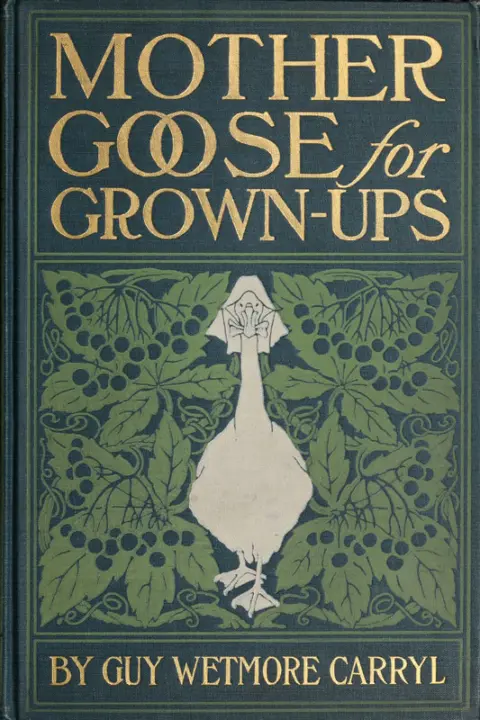
Mother Goose for Grown-ups
Guy Wetmore Carryl
THE CLASSIC COLLECTION · 1904
"The Transgression of Andrew Vane" by Guy Wetmore Carryl is a novel written in the early 20th century. The book explores themes of love, despair, and human relationships, primarily focusing on Andrew Vane, a young man navigating the complexities of life, love, and societal expectations, especially as he grapples with the aftermath of his family's struggles and personal failures. The narrative promises to delve into the contrast between idealism and reality, particularly through Andrew's interactions and evolving dynamics with other characters. At the start of the story, readers are introduced to Helen Sterling, who reflects on her deteriorating marriage with John Vane, Andrew's father. Helen's life embodies a difficult journey filled with disillusionment and heartbreak as she waits for her husband, consumed by his failures and alcoholism. As she grapples with the drastic change in her circumstances, a chance encounter with a stranger hints at potential companionship and change. Meanwhile, Andrew Vane arrives in Paris, freshly released from his past and in search of direction, underscoring the generational and existential conflicts that permeate the narrative. The opening sets a tone of melancholy mixed with hope, positioning both Helen and Andrew at crossroads in their lives.
Introduction adapted from the source catalogue; source summaries may be automatically generated.
Free to read · English · 76,615 words · No account needed
MAKE TIME FOR A GOOD BOOK
On by default. Untick to stop anonymous reading totals. Each page counts after 10 seconds in view. How this works.
Anonymous counting is on unless you have switched it off.
Noon of the following day found Andrew once more in the Rue Boissiere. He had not seen Margery from the moment when he had left her in the arbour. She had come in while the men were playing billiards, and gone directly to her room, pleading a headache, an excuse which was also made to cover her non-appearance in the morning. The two hours immediately following breakfast passed laboriously, the whole party hanging together with that kind of helpless attraction which characterizes the bubbles in a cup of tea. There was a general sense of relief when the big Panhard purred up the driveway, and Andrew, Radwalader, and Kennedy whirled off in it to Paris. Monsieur and Madame Palffy and the Listers were to follow almost immediately by train, and Mrs. Carnby was talking a continuous stream of the most unmitigated gossip.
"If I had stopped to think that in an hour they would all be gone," she told Jeremy, that night, "I would first have screamed the General Thanksgiving at the top of my lungs, and then had the vapours--whatever they may be!"
It was something the same feeling which had prompted Radwalader to remark, as they rolled away from the villa:
"I wonder if General Sherman had ever been to a house-party with the Listers when he made that remark about war."
Then, as Andrew made no reply, he relapsed into silence. He possessed that most precious gift of the Gods--the knowledge of when not to talk.
But it was when Andrew was once more alone in his familiar quarters, and had flung himself moodily into a chair, that the full force of his situation returned upon him. In twelve hours the whole world had changed. He realized for the first time that, as a matter of fact, there had never been in his mind the shadow of a doubt that the way lay clear before him, that the attainment of his wishes had been, in his calculations, no more than a matter of time. He had relied upon Margery's constancy like a mariner upon that of the North Star, and it was as if that luminary had suddenly flung away from him into some new and wholly unfamiliar constellation. The man who offers his hand in friendship and is stabbed in reply is not more aghast than was he. He was bitterly hurt, bitterly resentful. He had taken Mrs. Carnby's reprimand as something to which, if it was not wholly deserved, he had at least laid himself open: but that was a very different matter from the scornful and passionate rebuff which he had received from Margery herself. The first had almost afforded him a sense of relief. Like a child who is conscious of some slight transgression, the rebuke had seemed to set things square, to wipe out his fault, and give him absolution and a chance for a fresh start. But what followed, so wholly out of proportion to his knowledge of the truth, left him only conscious of a monstrous and unpardonable injustice. Complete innocence is never so jealous or so resentful as is the half-innocence in which lurks a hint of self-accusation, a suspicion of actual guilt. He had stood ready, with a kind of fierce and proud submission, to accept such blame as could be rightly laid at his door, but this very attitude of partial contrition flamed into anger the moment the scale was tipped too far in his disfavour. He did not see that the main factor in his revolt was the same as that in his acceptance of Mrs. Carnby's words--a sense of disloyalty, that is, to what he knew in his heart to be the true and manly course. He was very young, and moreover he had fallen, to at least an appreciable extent, from the high estate of his best ideals. Conscience impelled him to accept with humility as much of censure as he conceived that he deserved, but the savage pride of youth commanded him not to yield a single foot of ground beyond that which, by his folly, he had forfeited. He had been wrong; that he was willing to acknowledge: but his punishment had fallen too suddenly and too hard. Other men had done worse--infinitely worse--and had prospered. As for him, it was already too late to turn back. He was learning, albeit rebelliously, that standards of conduct are the boomerangs of the moral armament. The expert may juggle with them with comparative security; but the novice who recklessly flings them into space and then seeks to resume his hold upon them is apt to suffer a rude blow in the attempt. Facilis descensus--but the way of retreat is choked with briers and strewn with boulders, and never wholly retraceable.
Your reading position is saved on this browser. Take it to another device with a library code. Reading pages adapt to text, rather than matching a printed edition.
Guy Wetmore Carryl
Guy Wetmore Carryl
Guy Wetmore Carryl
Guy Wetmore Carryl
BEHIND THE BOOK
This eBook is for the use of anyone anywhere in the United States and most other parts of the world at no cost and with almost no restrictions whatsoever. You may copy it, give it away or re-use it under the terms of the Project Gutenberg License included with this eBook or online at www.gutenberg.org. If you are not located in the United States, you will have to check the laws of the country where you are located before using this eBook. Read the source licence.
The original source file, including credits and licence, is retained by this library. Request an original-format copy at no charge. Please include the book title and Project Gutenberg identifier #38020.
KEEP YOUR CURIOSITY GOING
Coulson Kernahan

Maurice Baring
Frances Wright
Cécile Tormay

Frederic Jesup Stimson

W. H. P. (William Henry Pope) Jarvis