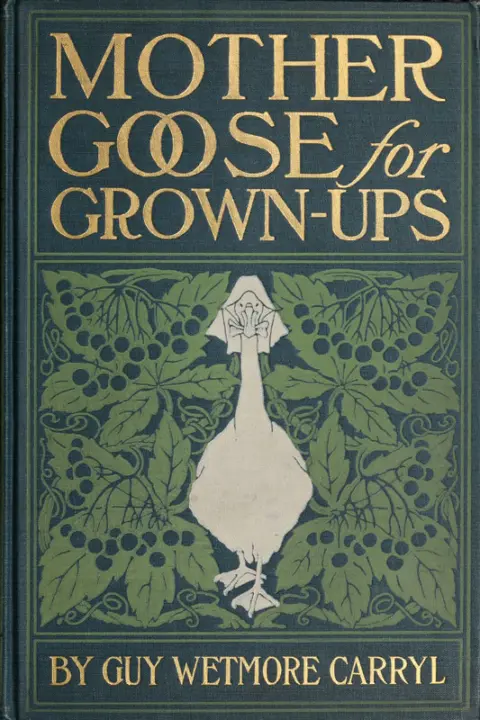
Mother Goose for Grown-ups
Guy Wetmore Carryl
THE CLASSIC COLLECTION · 1904
"The Transgression of Andrew Vane" by Guy Wetmore Carryl is a novel written in the early 20th century. The book explores themes of love, despair, and human relationships, primarily focusing on Andrew Vane, a young man navigating the complexities of life, love, and societal expectations, especially as he grapples with the aftermath of his family's struggles and personal failures. The narrative promises to delve into the contrast between idealism and reality, particularly through Andrew's interactions and evolving dynamics with other characters. At the start of the story, readers are introduced to Helen Sterling, who reflects on her deteriorating marriage with John Vane, Andrew's father. Helen's life embodies a difficult journey filled with disillusionment and heartbreak as she waits for her husband, consumed by his failures and alcoholism. As she grapples with the drastic change in her circumstances, a chance encounter with a stranger hints at potential companionship and change. Meanwhile, Andrew Vane arrives in Paris, freshly released from his past and in search of direction, underscoring the generational and existential conflicts that permeate the narrative. The opening sets a tone of melancholy mixed with hope, positioning both Helen and Andrew at crossroads in their lives.
Introduction adapted from the source catalogue; source summaries may be automatically generated.
Free to read · English · 76,615 words · No account needed
MAKE TIME FOR A GOOD BOOK
On by default. Untick to stop anonymous reading totals. Each page counts after 10 seconds in view. How this works.
Anonymous counting is on unless you have switched it off.
"We'll not have much difficulty," said Andrew, as they turned. "There she is now. Do you see? By the tree--in red."
"Oh," answered Radwalader, "oh, yes. That's Mirabelle Tremonceau. Your 'red' is cerise, as a matter of fact, but that's as near as the average man comes to the colour of a woman's gown."
"I can't imagine one spending much time in learning such things."
"Anywhere but in Paris, perhaps not. Here the knowledge is vital. It's part of one's education--like being able to distinguish a Louis Quatorze chair from a Louis Quinze, or a Fragonard from a Boucher ten feet away. If you want to meet Mademoiselle Tremonceau, I'll be very glad to present you."
"I might wait here while you ask her," suggested Andrew.
"Eh?" said Radwalader. "Oh, yes--by all means."
The girl was talking with an officer of chasseurs, on the turf, a short distance away. She was tall and slender, very pale, with magnificent violet eyes and golden-bronze hair. From the gauze aigrettes on her hat to the tips of her patent-leather shoes, her costume was absolutely flawless. Her gown, of cherry-coloured crepe de Chine, paillete with silver, breathed from its every fold the talismanic word "Paquin," and the Lalique ornament of emeralds and ruddy gold which swung at her throat by a slender chain said as plainly "Charlier." There was not a dot missing from her veil, not the suggestion of a wrinkle in her white gloves, and not a displeasing note in the harmony of the whole.
"There's nothing wrong about the boy's judgment," was Radwalader's mental comment. "He's picked out the prettiest and best gowned woman in Paris. And it couldn't be better," he added, with an odd little smile.
Mademoiselle Tremonceau greeted him with a nod, a gloved hand, and a
"Comment vas-tu?"
"B'en, pas mal, merci," answered Radwalader. With his left hand he caressed his chin reflectively, and, as if this had been a signal--which indeed it was--the girl turned to the young chasseur, who was staring at the intruder out of round, resentful eyes, and dismissed him with a hint.
"You've had fifteen minutes of my time, mon cher."
Then, as he retired, discomfited, she faced Radwalader again, and seemed to search his face for the answer to some unspoken question.
"I want to present one of my friends," he said, as if replying. "Mr. Andrew Vane--an American who has been in Paris three days. We'll have to speak English. Have I your permission?"
"You're strangely ceremonious of a sudden," answered Mademoiselle Tremonceau. "I don't seem to remember your asking permission before."
"It was his suggestion," observed Radwalader laconically.
Your reading position is saved on this browser. Take it to another device with a library code. Reading pages adapt to text, rather than matching a printed edition.
Guy Wetmore Carryl
Guy Wetmore Carryl
Guy Wetmore Carryl
Guy Wetmore Carryl
BEHIND THE BOOK
This eBook is for the use of anyone anywhere in the United States and most other parts of the world at no cost and with almost no restrictions whatsoever. You may copy it, give it away or re-use it under the terms of the Project Gutenberg License included with this eBook or online at www.gutenberg.org. If you are not located in the United States, you will have to check the laws of the country where you are located before using this eBook. Read the source licence.
The original source file, including credits and licence, is retained by this library. Request an original-format copy at no charge. Please include the book title and Project Gutenberg identifier #38020.
KEEP YOUR CURIOSITY GOING
Coulson Kernahan

Maurice Baring
Frances Wright
Cécile Tormay

Frederic Jesup Stimson

W. H. P. (William Henry Pope) Jarvis