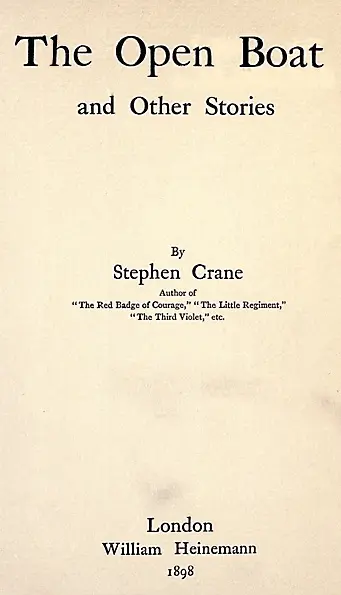
The Open Boat and Other Stories
Stephen Crane
THE CLASSIC COLLECTION · 1897
"The Third Violet" by Stephen Crane is a novel written in the late 19th century. The story follows the main character, Will Hawker, a painter who returns to his family home in the countryside after time spent in the city. As he settles back into rural life, he encounters romantic interests and aspirations within a social setting filled with families vacationing at the nearby Hemlock Inn. At the start of the narrative, we are introduced to the bustling scene at a mountain train station, where Will disembarks, feeling an immediate sense of nostalgia and longing as he navigates the chaos of arriving guests. Hawker quickly becomes captivated by a young woman named Miss Fanhall, whose presence sparks both admiration and insecurity within him. As he meets his family and reflects on his artistic aspirations, tension builds both within him and in the competitive dynamics presented by the arrival of a wealthy rival, Oglethorpe. The opening chapters set the stage for exploring themes of love, aspiration, and social class amidst the backdrop of a vibrant summer in the country.
Introduction adapted from the source catalogue; source summaries may be automatically generated.
Free to read · English · 31,435 words · No account needed
MAKE TIME FOR A GOOD BOOK
On by default. Untick to stop anonymous reading totals. Each page counts after 10 seconds in view. How this works.
Anonymous counting is on unless you have switched it off.
"John," said the old mother, from the profound mufflings of the pillow
and quilts.
"What?" said the old man. He was tugging at his right boot, and his tone
was very irascible.
"I think William's changed a good deal."
"Well, what if he has?" replied the father, in another burst of ill-temper. He was then tugging at his left boot.
"Yes, I'm afraid he's changed a good deal," said the muffled voice from the bed. "He's got a good many fine friends, now, John--folks what put on a good many airs; and he don't care for his home like he did."
"Oh, well, I don't guess he's changed very much," said the old man cheerfully. He was now free of both boots.
She raised herself on an elbow and looked out with a troubled face. "John, I think he likes that girl."
"What girl?" said he.
"What girl? Why, that awful handsome girl you see around--of course."
"Do you think he likes 'er?"
"I'm afraid so--I'm afraid so," murmured the mother mournfully.
"Oh, well," said the old man, without alarm, or grief, or pleasure in
his tone.
He turned the lamp's wick very low and carried the lamp to the head of the stairs, where he perched it on the step. When he returned he said, "She's mighty good-look-in'!"
"Well, that ain't everything," she snapped. "How do we know she ain't proud, and selfish, and--everything?"
"How do you know she is?" returned the old man.
"And she may just be leading him on."
"Do him good, then," said he, with impregnable serenity. "Next time
he'll know better."
"Well, I'm worried about it," she said, as she sank back on the pillow again. "I think William's changed a good deal. He don't seem to care about--us--like he did."
"Oh, go to sleep!" said the father drowsily.
She was silent for a time, and then she said, "John?"
"What?"
"Do you think I better speak to him about that girl?"
"No."
She grew silent again, but at last she demanded, "Why not?"
"'Cause it's none of your business. Go to sleep, will you?" And
presently he did, but the old mother lay blinking wild-eyed into the
darkness.
In the morning Hawker did not appear at the early breakfast, eaten when the blue glow of dawn shed its ghostly lights upon the valley. The old mother placed various dishes on the back part of the stove. At ten o'clock he came downstairs. His mother was sweeping busily in the parlour at the time, but she saw him and ran to the back part of the stove. She slid the various dishes on to the table. "Did you oversleep?" she asked.
Your reading position is saved on this browser. Take it to another device with a library code. Reading pages adapt to text, rather than matching a printed edition.
BEHIND THE BOOK
This eBook is for the use of anyone anywhere in the United States and most other parts of the world at no cost and with almost no restrictions whatsoever. You may copy it, give it away or re-use it under the terms of the Project Gutenberg License included with this eBook or online at www.gutenberg.org. If you are not located in the United States, you will have to check the laws of the country where you are located before using this eBook. Read the source licence.
The original source file, including credits and licence, is retained by this library. Request an original-format copy at no charge. Please include the book title and Project Gutenberg identifier #19593.
KEEP YOUR CURIOSITY GOING
Coulson Kernahan

Maurice Baring
Frances Wright
Cécile Tormay

Frederic Jesup Stimson

W. H. P. (William Henry Pope) Jarvis