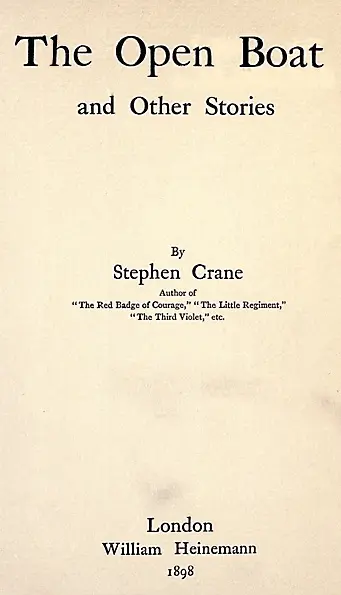
The Open Boat and Other Stories
Stephen Crane
THE CLASSIC COLLECTION · 1897
"The Third Violet" by Stephen Crane is a novel written in the late 19th century. The story follows the main character, Will Hawker, a painter who returns to his family home in the countryside after time spent in the city. As he settles back into rural life, he encounters romantic interests and aspirations within a social setting filled with families vacationing at the nearby Hemlock Inn. At the start of the narrative, we are introduced to the bustling scene at a mountain train station, where Will disembarks, feeling an immediate sense of nostalgia and longing as he navigates the chaos of arriving guests. Hawker quickly becomes captivated by a young woman named Miss Fanhall, whose presence sparks both admiration and insecurity within him. As he meets his family and reflects on his artistic aspirations, tension builds both within him and in the competitive dynamics presented by the arrival of a wealthy rival, Oglethorpe. The opening chapters set the stage for exploring themes of love, aspiration, and social class amidst the backdrop of a vibrant summer in the country.
Introduction adapted from the source catalogue; source summaries may be automatically generated.
Free to read · English · 31,435 words · No account needed
MAKE TIME FOR A GOOD BOOK
On by default. Untick to stop anonymous reading totals. Each page counts after 10 seconds in view. How this works.
Anonymous counting is on unless you have switched it off.
Stanley, the setter, walked to the edge of the precipice and, looking over at the falls, wagged his tail in friendly greeting. He was braced warily, so that if this howling white animal should reach up a hand for him he could flee in time.
The girl stared dreamily at the red-stained crags that projected from the pines of the hill across the stream. Hawker lazily aimed bits of moss at the oblivious dog and missed him.
"It must be fine to have something to think of beyond just living," said
the girl to the crags.
"I suppose you mean art?" said Hawker.
"Yes, of course. It must be finer, at any rate, than the ordinary
thing."
He mused for a time. "Yes. It is--it must be," he said. "But then--I'd
rather just lie here."
The girl seemed aggrieved. "Oh, no, you wouldn't. You couldn't stop. It's dreadful to talk like that, isn't it? I always thought that painters were----"
"Of course. They should be. Maybe they are. I don't know. Sometimes I
am. But not to-day."
"Well, I should think you ought to be so much more contented than just ordinary people. Now, I----"
"You!" he cried--"you are not 'just ordinary people.'"
"Well, but when I try to recall what I have thought about in my life, I can't remember, you know. That's what I mean."
"You shouldn't talk that way," he told her.
"But why do you insist that life should be so highly absorbing for me?"
"You have everything you wish for," he answered, in a voice of deep
gloom.
"Certainly not. I am a woman."
"But----"
"A woman, to have everything she wishes for, would have to be Providence. There are some things that are not in the world."
"Well, what are they?" he asked of her.
"That's just it," she said, nodding her head, "no one knows. That's
what makes the trouble."
"Well, you are very unreasonable."
"What?"
"You are very unreasonable. If I were you--an heiress----"
The girl flushed and turned upon him angrily.
"Well!" he glowered back at her. "You are, you know. You can't deny it."
She looked at the red-stained crags. At last she said, "You seemed
really contemptuous."
"Well, I assure you that I do not feel contemptuous. On the contrary, I am filled with admiration. Thank Heaven, I am a man of the world. Whenever I meet heiresses I always have the deepest admiration." As he said this he wore a brave hang-dog expression. The girl surveyed him coldly from his chin to his eyebrows. "You have a handsome audacity, too."
He lay back in the long grass and contemplated the clouds.
Your reading position is saved on this browser. Take it to another device with a library code. Reading pages adapt to text, rather than matching a printed edition.
BEHIND THE BOOK
This eBook is for the use of anyone anywhere in the United States and most other parts of the world at no cost and with almost no restrictions whatsoever. You may copy it, give it away or re-use it under the terms of the Project Gutenberg License included with this eBook or online at www.gutenberg.org. If you are not located in the United States, you will have to check the laws of the country where you are located before using this eBook. Read the source licence.
The original source file, including credits and licence, is retained by this library. Request an original-format copy at no charge. Please include the book title and Project Gutenberg identifier #19593.
KEEP YOUR CURIOSITY GOING
Coulson Kernahan

Maurice Baring
Frances Wright
Cécile Tormay

Frederic Jesup Stimson

W. H. P. (William Henry Pope) Jarvis