
Last letters from the living dead man
David Patterson (Spirit) Hatch
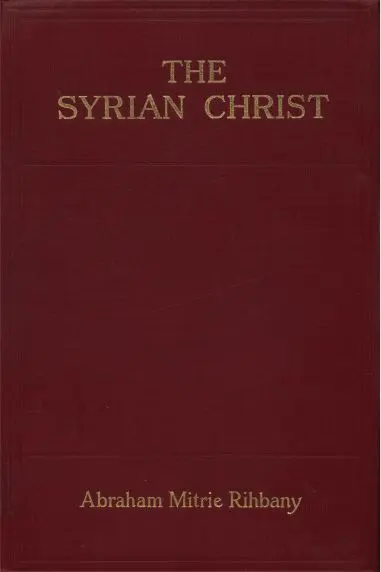
THE CLASSIC COLLECTION · 1916
"The Syrian Christ" by Abraham Mitrie Rihbany is a reflective work written in the early 20th century. This book explores the life and teachings of Jesus Christ from an Oriental perspective, aiming to provide readers, particularly those in the West, with insights into the cultural and social contexts of his time. It endeavors to bridge the gap between Eastern and Western understandings of spirituality, emphasizing the richness of the Oriental background that shaped many biblical narratives. The opening of the text introduces the author's intentions and background, as he seeks to offer an intimate view of Christ's life, explaining that his insights are drawn from personal experience as a Syrian born in close proximity to Jesus' birthplace. Rihbany reflects on how the customs, language, and social values of contemporary Syria illuminate biblical stories, presenting the idea that understanding these elements is crucial to truly grasping the spiritual teachings of Christ. The initial chapters set the stage for a nuanced discussion, leading the reader through culturally specific interpretations of familiar Biblical narratives while highlighting the enduring significance of these stories.
Introduction adapted from the source catalogue; source summaries may be automatically generated.
Free to read · English · 73,596 words · No account needed
MAKE TIME FOR A GOOD BOOK
On by default. Untick to stop anonymous reading totals. Each page counts after 10 seconds in view. How this works.
Anonymous counting is on unless you have switched it off.
Timepieces in Syria, 277 n.
Touch, divine power imparted by, 393-95.
Tourists, books by, 8, 10.
Traitors, 67.
Traveling, in America, 246; in the East, 247-58.
Treading, the grapes, 283, 377; the grain, 290, 378.
Treasure hid in a field, parable of, 161-66.
"Treating, " 62.
Unleavened bread, 150.
Unrighteous judge, parable of the, 179, 180.
Unveracity of the Oriental, 107-14.
Vengeance, Oriental idea of, 91.
Vine, and the fig tree, the Oriental's chief joys, 280; symbol of spiritual as well as physical family unity, 280; the church as a, 281; the family as a, 281.
Vineyard, blessings for the increase of, 25.
Vows, 16-18, 49.
Wakefield, Mr., quoted, 162.
Wallet, the, 250.
Washing the feet, 226-28.
Watching for the dawn, 387-89.
Wedding songs, 247.
Weddings, 221.
Wheat, measuring, 265-67; plucking and eating, 291; threshing, 377-80; miraculous increase of, 384; the grinding of, 400-03.
Wild beasts, 307-09.
Wills, 155.
Wine, the method of making, in the East, 282-84, 377; sweet and bitter,
284.
Wine cup, the mystery of, 280.
Wine-drinking, 15, 237.
Wine press, 282, 283, 377.
Wise Men, the, 27, 37, 44.
Wolves, 307.
Woman, with child, 26; East and West differ greatly in status of, 313, 314; Anglo-Saxon regard for, 313; reputed Occidental contempt for, 314, 315; culture and privileges of the American, 316; the Oriental indifferent to fine points of behavior toward, 316, 317; the Oriental does not consider man superior to, 317-19; Christian and Mohammedan, in Syria, 318 n., 331; explanation of the Oriental's attitude toward, 318, 319, 322; in home of cultivated Syrian, 323, 324; Syrian attitude toward, according to St. Paul, 325-33; of Syria, not always submissive, 329; her social privileges in the East limited because of fear for her, 330, 331, 349; a reason for veiling, in the East, 332; modesty the chief charm of Oriental, 332; why called hûrmat, 333; the harem, 333, 334; reason for man's precedence of, in social affairs, 334, 335; her place is in the home, 348; classified with reference to virtue and its opposite, 351; the Oriental's descriptions of, 351-55; the virtuous, description of, 355-64.
Woman, as a term of address, 340-45.
Woman-stealing, 330, 331.
Wrestling in prayer, 12.
Yusuf Balua', 305-09.
Zad, 249-51.
Zeara, the (pilgrimage to a shrine), 12-17, 47-48.
Zûkreh (remembrance), 63, 65.
The Riverside Press
End of Project Gutenberg's The Syrian Christ, by Abraham Mitrie Rihbany
Your reading position is saved on this browser. Take it to another device with a library code. Reading pages adapt to text, rather than matching a printed edition.
BEHIND THE BOOK
This eBook is for the use of anyone anywhere in the United States and most other parts of the world at no cost and with almost no restrictions whatsoever. You may copy it, give it away or re-use it under the terms of the Project Gutenberg License included with this eBook or online at www.gutenberg.org. If you are not located in the United States, you will have to check the laws of the country where you are located before using this eBook. Read the source licence.
The original source file, including credits and licence, is retained by this library. Request an original-format copy at no charge. Please include the book title and Project Gutenberg identifier #40285.
KEEP YOUR CURIOSITY GOING
David Patterson (Spirit) Hatch

David Patterson (Spirit) Hatch

David Patterson (Spirit) Hatch
John L. Ransom

Herman W. Mudgett

Harriet Monroe