
Last letters from the living dead man
David Patterson (Spirit) Hatch
THE CLASSIC COLLECTION · 1916
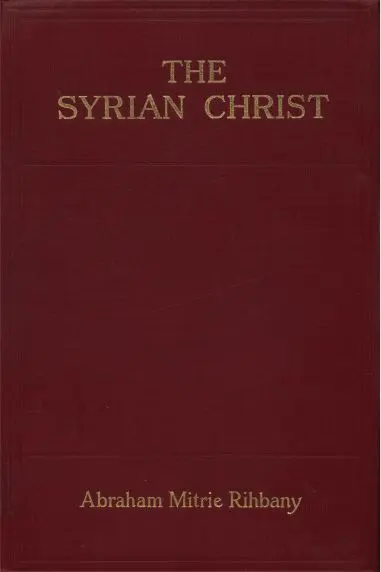
"The Syrian Christ" by Abraham Mitrie Rihbany is a reflective work written in the early 20th century. This book explores the life and teachings of Jesus Christ from an Oriental perspective, aiming to provide readers, particularly those in the West, with insights into the cultural and social contexts of his time. It endeavors to bridge the gap between Eastern and Western understandings of spirituality, emphasizing the richness of the Oriental background that shaped many biblical narratives. The opening of the text introduces the author's intentions and background, as he seeks to offer an intimate view of Christ's life, explaining that his insights are drawn from personal experience as a Syrian born in close proximity to Jesus' birthplace. Rihbany reflects on how the customs, language, and social values of contemporary Syria illuminate biblical stories, presenting the idea that understanding these elements is crucial to truly grasping the spiritual teachings of Christ. The initial chapters set the stage for a nuanced discussion, leading the reader through culturally specific interpretations of familiar Biblical narratives while highlighting the enduring significance of these stories.
Introduction adapted from the source catalogue; source summaries may be automatically generated.
Free to read · English · 73,596 words · No account needed
MAKE TIME FOR A GOOD BOOK
On by default. Untick to stop anonymous reading totals. Each page counts after 10 seconds in view. How this works.
Anonymous counting is on unless you have switched it off.
Oven, of the Bible, 200-02.
Overcautiousness in the pulpit, 186, 187.
Palestine, 405.
Parable, of the prodigal son, 142; 152, 155-61, 206, 207; to picture demoralization beyond redemption, 143, 144; on partiality, 144, 145; of the wheat and the tares, 146-49; of the leaven, 149, 199; of the lost sheep, 152, 308; of the lost coin, 152-55; of the treasure hid in the field, 161-66; of the unrighteous judge, 179, 180; of the three loaves, 214-17.
Parables, speaking in, 140-66; and proverbs, Oriental makes no distinction between, 140; fondness of Oriental for, 140, 141; sociableness of, 142.
Parents, honoring and obeying, 51-55, 335, 336.
Passover, feast of the, 49.
Path, the beaten, 301, 302.
Patron saints as heavenly messengers, 12.
Paul, his statements concerning the Syrian attitude toward women,
325-33.
Pebble, the covering of the, 203, 204.
Personality, secret of, an impenetrable mystery, 4.
Pessimism, 45.
Peter, his experience in the palace of the high priest, 177, 178; Jesus and, 183; his vision, 276-79.
Pilgrimage, meaning, to a Syrian, 13, 14; the zeara, 13-17, 47, 48; of Jesus to Jerusalem, 47-51; still common in Syria, 47; occasion of union among the common people, 221.
Place of residence, the term, 243.
Plough, the Syrian, 286-88.
Poetry, dominant feature of Oriental speech, 108; description of feminine loveliness in, 354, 355.
Porter, in translation of the Bible, 298.
Positiveness of speech, Oriental fondness for, 118, 132, 183-88.
Prayer, 15; the Lord's, 196.
Prayers of the Scriptures, due to persistence in petitioning, 180.
Praying on the housetop, 275-79.
Presentation of child at temple, 37.
Prodigal son, parable of the, 142, 152, 155-61, 206, 207.
Pronunciation of the Syrians, 176-78.
Protestantism, 409.
Proverbs, use of, an Oriental characteristic, 140; and parables, Oriental makes no distinction between, 140.
Psalms due to persistence in petitioning, 180.
Purification period, 38.
Purse, the, 252.
Rada' (cloak), 121, 122.
Radha (good pleasure), 335-39.
Rag trees, 376.
Rationalism, modern, 19.
Rebecca, 23, 26.
Reclining at meals, 224-30.
Refuge, use of the term, 241, 244.
Religion, gives life and beauty to culture, 85; the course of, has been from the East to the West, 405.
Religions, the three greatest, have originated in Syria, 86.
Remembrance, 63-65.
Reproduction, attitude of Eastern peoples toward, 25, 26; attitude of
Anglo-Saxons toward, 26.
Retribution, 133-39.
Revenge, idea of, lies deep in Oriental nature, 91.
Rome, 405, 407.
Roof. See Housetop.
St. John's Gospel, the purpose of, 343-45.
Sacrament, feasts and, 56-71.
Salt, used at births, in Syria, 28; bread and, 191-95, 238.
"Salted, " 28-30.
Salutation, the Oriental method of, 255-58.
Sarah, 26.
Scribes and pharisees, rebuke of, 132, 133.
Scrip, the, 250.
Scriptures, spring from soil whose life is active sympathy of religion,
85.
Scriptures, the. See Bible.
Sermon on the Mount, the, 97.
"Seventy times seven, " 133-39.
Sheep, lost, parable of the, 152, 206-08; the killing of the, 231-33; the calling of, by name, 299; the return of, at evening, 300; guided by the shepherd, 301, 302; the gathering of, 303; their trust in their shepherd, 307.
Sheepfolds, 295-98.
Shelter, use of the term, 241, 244.
Shepherd, solicitous watchfulness of, 296, 297, 299; his tent and dog, 298; going before the flock, 299, 300; the guidance of, 301, 302; the good, 304, 305; carrying newly born lambs, 306, 307; rescuing from wild beasts, 307-09.
Shepherd life in Syria, 295-309.
Shoes, 228 n., 292.
Your reading position is saved on this browser. Take it to another device with a library code. Reading pages adapt to text, rather than matching a printed edition.
BEHIND THE BOOK
This eBook is for the use of anyone anywhere in the United States and most other parts of the world at no cost and with almost no restrictions whatsoever. You may copy it, give it away or re-use it under the terms of the Project Gutenberg License included with this eBook or online at www.gutenberg.org. If you are not located in the United States, you will have to check the laws of the country where you are located before using this eBook. Read the source licence.
The original source file, including credits and licence, is retained by this library. Request an original-format copy at no charge. Please include the book title and Project Gutenberg identifier #40285.
KEEP YOUR CURIOSITY GOING
David Patterson (Spirit) Hatch

David Patterson (Spirit) Hatch

David Patterson (Spirit) Hatch
John L. Ransom

Herman W. Mudgett

Harriet Monroe