
Last letters from the living dead man
David Patterson (Spirit) Hatch
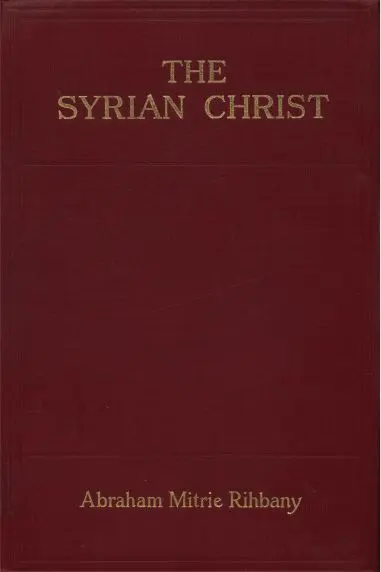
THE CLASSIC COLLECTION · 1916
"The Syrian Christ" by Abraham Mitrie Rihbany is a reflective work written in the early 20th century. This book explores the life and teachings of Jesus Christ from an Oriental perspective, aiming to provide readers, particularly those in the West, with insights into the cultural and social contexts of his time. It endeavors to bridge the gap between Eastern and Western understandings of spirituality, emphasizing the richness of the Oriental background that shaped many biblical narratives. The opening of the text introduces the author's intentions and background, as he seeks to offer an intimate view of Christ's life, explaining that his insights are drawn from personal experience as a Syrian born in close proximity to Jesus' birthplace. Rihbany reflects on how the customs, language, and social values of contemporary Syria illuminate biblical stories, presenting the idea that understanding these elements is crucial to truly grasping the spiritual teachings of Christ. The initial chapters set the stage for a nuanced discussion, leading the reader through culturally specific interpretations of familiar Biblical narratives while highlighting the enduring significance of these stories.
Introduction adapted from the source catalogue; source summaries may be automatically generated.
Free to read · English · 73,596 words · No account needed
MAKE TIME FOR A GOOD BOOK
On by default. Untick to stop anonymous reading totals. Each page counts after 10 seconds in view. How this works.
Anonymous counting is on unless you have switched it off.
Life, of a people, cannot be studied from the outside, 7-11; to the Oriental an inheritance, 242.
Like ("to be favorably inclined toward"), not in the Bible or the Arabic tongue, 98; in English version of the Bible, 98.
Literature, difficult to understand if it has not sprung from the people's racial life, 6; the Bible as, 7.
Loaves, parable of the three, 214-17.
Locusts, 292-94.
Lord's Prayer, the, 196.
Love, of enemies, 96-106; not of our own making, 97; meaning of, in the West, 98; meaning of, in the East, 98-102; speaks of the greatest thing in the world, 103; and hatred, 104-06; assurances of, 182.
Man-child, birth of, 27-29.
Marafeh, feast of the, 233-37.
Market-place, Syrian, and the caravan, 259; a place of sociability as well as business, 263, 264; measuring grain in, 265-68.
Marriage in the East, 348-50.
Marriage wishes, 23, 24.
Martha, not at the Last Supper, 207, 208, 335.
Mary, not at the Last Supper, 207, 208, 335; Jesus and, 340-45.
Maternity, pilgrimage for, 12-16.
Mathel, meaning of, 140.
Mattresses, 216.
Measure, the generous, 265-68.
Measurer, the, 265-68.
Mecca, 47.
Melleh (cakes), 374, 375.
Merchants, muleteer, 269, 273.
Metaphor, Oriental fondness for, 118.
Midd (a wooden measure), 265, 266.
Miracles, 20, 21, 384-87.
Mocking of the afflicted, 381-83.
Modesty the chief charm of the Oriental woman, 332.
Mohammedans, pilgrimages of, 47; oaths of, 169, 170; position of women
among, 318 n., 331.
Molasses, the method of making, in the East, 285.
Money-lenders, 123-25.
Mortar, 379.
Mother, claiming same obedience as father, 335, 336; Jesus and his, 340-45; the mother's milk, 345-47.
Mouldy, in translation of the Bible, 251.
Mount Zion, meeting in the upper room on, 56-69.
Muleteer, merchants, 269, 273.
Mustache, swearing by, 171-73.
Mysticism, 41, 42.
Nativity, narrative of the, 37, 41-44.
Nazarite (nedher), 16, 18.
Nezel, 62.
Oaks, 376.
Oaths. See Imprecations, Swearing.
Obedience, filial, 51-55, 335, 336.
Oil, miraculous increase of, 384-86.
Open space, the, in Syrian villages, 210.
Optimism, 45.
Oriental, the, and the Anglo-Saxon, in each other's eyes, 57; not afraid to "let himself go, " 57, 72; dependence of, 72, 73; craves sympathy, 73; the vision of, 77; his manner of speech, 81; has not achieved much in the material world, 83; his supreme choice has been religion, 84; always conscious of God and the soul, 84; does not know of atheism, 84, 85; has always lived in a world of spiritual mysteries, 86; his imprecations, 91-95; considers his personal enemies to be the enemies of God, 93; more cruel in words than in deeds, 95; the unveracious, 107-14; intellectual inaccuracy of, 108; expects to be judged by what he means, not by what he says, 115, 125; his speech is always illustrated, 115; fond of metaphor and exaggeration, 118; does not maliciously misrepresent, 126; use of parables and proverbs, a characteristic of, 140; makes no distinction between a parable and a proverb, 140; his contempt for swineherds, 157, 158; his tendency to swear, 167-74; the dialects of his speech, 175-88; his habit of imploring, 178-81; the intimacy and unreserve of his speech, 181-83; the unqualified positiveness of his speech, 183-88; bread and salt to, 191-95; his understanding of the prayer "Give us our daily bread, " 196, 197; religious attitude of, toward bread, 197; bread-making of, 198-204; hospitality of, 205-17; his table appointments, 222, 320; life is an inheritance to, 242; the word house precious to, 244; his method of salutation, 255-58; knows no business without sociability, 263; his reputed lack of regard for women, 314, 315; gives man the precedence, 316, 317; his manner rather than intentions toward woman at fault, 318, 319, 322, 323; has only comparatively slight acquaintance with the art of living, 319; his life simple and without exacting standards, 319, 320; his social activities simple, 321; hates to be standardized, 321; abhors formalities in the family circle, 321, 322; the family system of, patriarchal, 323, 328; his attitude toward woman according to St. Paul, 325-33; limits woman's social privileges because of fear for her, 330, 331; his descriptions of feminine loveliness, 351-55; his description of the virtuous woman, 355-64; example of courtesy of, 370-73; his belief that all good comes from God, 386, 387; his belief in the efficacy of touch to impart divine power, 394; has been a leader in religion and a borrower in theology, 405. See Syria, Syrians.
Your reading position is saved on this browser. Take it to another device with a library code. Reading pages adapt to text, rather than matching a printed edition.
BEHIND THE BOOK
This eBook is for the use of anyone anywhere in the United States and most other parts of the world at no cost and with almost no restrictions whatsoever. You may copy it, give it away or re-use it under the terms of the Project Gutenberg License included with this eBook or online at www.gutenberg.org. If you are not located in the United States, you will have to check the laws of the country where you are located before using this eBook. Read the source licence.
The original source file, including credits and licence, is retained by this library. Request an original-format copy at no charge. Please include the book title and Project Gutenberg identifier #40285.
KEEP YOUR CURIOSITY GOING
David Patterson (Spirit) Hatch

David Patterson (Spirit) Hatch

David Patterson (Spirit) Hatch
John L. Ransom

Herman W. Mudgett

Harriet Monroe