THE CLASSIC COLLECTION✦The story of Keedon BluffsCLASSIC FREE BOOKS
The story of Keedon Bluffs
Charles Egbert Craddock
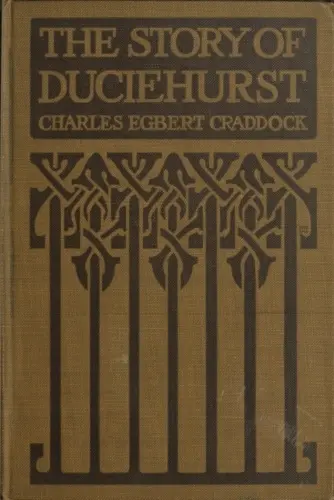
THE CLASSIC COLLECTION · 1914
"The Story of Duciehurst: A Tale of the Mississippi" by Charles Egbert Craddock is a historical novel written in the early 20th century. The narrative is set against the backdrop of the Mississippi River and revolves around the stranded steamboat "Cherokee Rose" and the lives of several passengers, particularly focusing on the complicated relationships and tensions among them. The central characters presented include the affluent but discontented Mr. Floyd-Rosney, his wife, and the Ducie brothers, with themes of wealth, social status, and hidden pasts beginning to unfold. At the start of the novel, the "Cherokee Rose" finds itself stuck on a sand-bar in the Mississippi River, creating an atmosphere of tension and uncertainty among the passengers. The scene introduces Mr. Floyd-Rosney, whose discontent with the situation reflects deeper issues within his marriage as his wife, Mrs. Floyd-Rosney, reveals hints of a complicated backstory involving the Ducies. The young man, Adrian Ducie, encounters an old acquaintance across the deck as the conversations bring in light unexpected connections and tensions, particularly when the subject of past relationships and fortunes comes to the forefront. As passengers engage in spirited discussions amid their predicament, the stage is set for unraveling not just the physical challenges posed by the river but also the emotional and social dynamics among the characters.
Introduction adapted from the source catalogue; source summaries may be automatically generated.
Free to read · English · 119,640 words · No account needed
MAKE TIME FOR A GOOD BOOK
On by default. Untick to stop anonymous reading totals. Each page counts after 10 seconds in view. How this works.
Anonymous counting is on unless you have switched it off.
In his inexorable view of the sanctity of his promise Colonel Kenwynton had no impulse to confide the details of the revelation he had received or to take counsel thereon. Still, he could but look with an accession of interest at Adrian Ducie when he met him at the breakfast table, the passengers of the Cherokee Rose dallying over the meal, prolonging it to the utmost in the dearth of other interest or occupation.
Although Ducie seemed to have mustered the philosophy to ignore the serious aspects of this most irksome and dolorous detention, it had darkened all the horizon to Floyd-Rosney’s exacting and censorious mood. “I can’t imagine, Captain, how you should not have been on the lookout for the formation of an obstruction capable of grounding the boat,” was his cheerful matutinal greeting.
“Oh, Miss Dean says he knew it was there all the time, and only wished to entertain us,” his wife interposed, with a view of toning down her lord’s displeasure, but her sarcastic chin was in the air, and her clipped, quick enunciation gave token only of one of her ironic pleasantries.
“Well, I intend to eat him out of house and home while I am about it,” said Ducie, with an affectation of roughness. “This table is not run à la carte. You can’t charge more than the passage-money, Captain, no matter how long we abide with you in this pleasance of a sand-bar--and I really think, waiter, I can get away with the other wing of that fried chicken.”
“You think you can get away; can you?” Mrs. Floyd-Rosney fleered.
The queer little roughness he affected was incongruous with the delicate elegance of Mrs. Floyd-Rosney’s presence. The polish of his own appearance and ordinary manner warranted it as little, and the contrariety of his mental attitude was like that of a bad child “showing off” in the reverse of expectation or desire. Between the heavy sulking of her husband in the troublous contretemps of the detention of the boat, and the peculiar tone that Adrian Ducie had taken, in which, however, offense was at once untenable and inexplicable, it might seem that Mrs. Floyd-Rosney had much ado to preserve her airy placidity and maintain the poise of the delicate irony of her manner. This became more practicable when Ducie’s attention was diverted to a little girl of twelve who had boarded the packet with her father at the landing of a fashionable suburban school some distance up the river, evidently designing to spend the week-end at home. She was a bouncing little girl, with liquid black eyes, and dark red hair, long and abundant, plaited on either side of her head and tied up with black ribbon bows of preposterously wide loops. While she was as noisy and as active as a boy, she was evidently constantly beset with the realization that her lot in life was of feminine restrictions, and miserably repented of every alert caper. Her memory, however, was short, as short, one might say, as her very abbreviated skirts, and the monition of the staid gait, appropriate to her sex, always struck her after the fantastic gallopade or muscular skip on her long, handsome, black-stockinged legs, and never by any chance earlier. She had a most Briarean and centipedal consciousness in Mrs. Floyd-Rosney’s presence, which she instinctively appraised as critical, and she was covered with confusion as she came flustering out of her stateroom to the breakfast table to realize that she had banged the door behind her. By way of disposing of one superfluous foot at least she crooked her leg deftly at the knee, placed its foot in the chair and sat down upon it, turning scarlet as she did so, realizing all too late that the maneuver was perfectly obvious, and wondering what Mrs. Floyd-Rosney must think of a girl who sat on her foot. For the opinion of the score of other persons at the tables she had not a thought or a care, doubtless relying on their good nature to condone the attitude, curiously affected and prized by persons of her age and sex. An agile twist had got the foot down to the floor again, and now with restored composure and rebounding spirits her gushing loquacity was reasserted, and she was exchanging matutinal greetings with her traveling companions; her father, a tall, lean, quiet man, who had marked her entrance with raised eyebrows and a concerned air, having resumed his talk on the tariff with his next neighbor at table.
Your reading position is saved on this browser. Take it to another device with a library code. Reading pages adapt to text, rather than matching a printed edition.
Charles Egbert Craddock
Charles Egbert Craddock
Charles Egbert Craddock
Charles Egbert Craddock
BEHIND THE BOOK
This eBook is for the use of anyone anywhere in the United States and most other parts of the world at no cost and with almost no restrictions whatsoever. You may copy it, give it away or re-use it under the terms of the Project Gutenberg License included with this eBook or online at www.gutenberg.org. If you are not located in the United States, you will have to check the laws of the country where you are located before using this eBook. Read the source licence.
The original source file, including credits and licence, is retained by this library. Request an original-format copy at no charge. Please include the book title and Project Gutenberg identifier #56046.
KEEP YOUR CURIOSITY GOING
Cécile Tormay

Moritz Busch
Coulson Kernahan
John L. Ransom

Maurice Baring
Frances Wright