THE CLASSIC COLLECTION✦The story of Keedon BluffsCLASSIC FREE BOOKS
The story of Keedon Bluffs
Charles Egbert Craddock
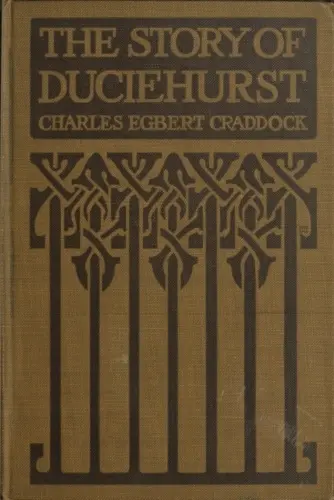
THE CLASSIC COLLECTION · 1914
"The Story of Duciehurst: A Tale of the Mississippi" by Charles Egbert Craddock is a historical novel written in the early 20th century. The narrative is set against the backdrop of the Mississippi River and revolves around the stranded steamboat "Cherokee Rose" and the lives of several passengers, particularly focusing on the complicated relationships and tensions among them. The central characters presented include the affluent but discontented Mr. Floyd-Rosney, his wife, and the Ducie brothers, with themes of wealth, social status, and hidden pasts beginning to unfold. At the start of the novel, the "Cherokee Rose" finds itself stuck on a sand-bar in the Mississippi River, creating an atmosphere of tension and uncertainty among the passengers. The scene introduces Mr. Floyd-Rosney, whose discontent with the situation reflects deeper issues within his marriage as his wife, Mrs. Floyd-Rosney, reveals hints of a complicated backstory involving the Ducies. The young man, Adrian Ducie, encounters an old acquaintance across the deck as the conversations bring in light unexpected connections and tensions, particularly when the subject of past relationships and fortunes comes to the forefront. As passengers engage in spirited discussions amid their predicament, the stage is set for unraveling not just the physical challenges posed by the river but also the emotional and social dynamics among the characters.
Introduction adapted from the source catalogue; source summaries may be automatically generated.
Free to read · English · 119,640 words · No account needed
MAKE TIME FOR A GOOD BOOK
On by default. Untick to stop anonymous reading totals. Each page counts after 10 seconds in view. How this works.
Anonymous counting is on unless you have switched it off.
“Have compassion on our dullness, Miss Marjorie,” said Adrian Ducie, suavely smiling at her from across the board. In his contrariety he seemed to have divined Mrs. Floyd-Rosney’s covert disapproval and made a point of according his own favor. Marjorie’s heart, however, was in no danger from his fascinations. To her he seemed a man well advanced in years, quite an old bachelor, indeed. “Tell us your dreams.”
“Dreams? oh, mercy!” How often had she been warned against rising inflections and interjections? “My dreams are all mixed up. I don’t know now what they were.”
“I will disentangle them for you,” he said, blandly; then in parenthesis to the waiter, “Give the cook my compliments and tell him to send up another omelette, which I will share with Miss Ashley.”
“Oh, I don’t like eggs,” Marjorie blurted out, then stopped short. How often had she been admonished never to say at table that she disliked any article of diet. Mrs. Floyd-Rosney, she was sure, must have noticed that lapse.
“Then I will eat it all by myself--mark me now, Captain! While awaiting its construction I will tell your dreams, and interpret their mystery.”
“Oh, oh,” gurgled Marjorie. What a nice old man was this Mr. Adrian Ducie! Her blithe young eyes were liquid and brilliant with expectation.
“You dreamed that you and I went hunting, with some others who don’t matter and who shall be nameless,” he glanced slightingly up and down the row of passengers at the table. “We went ashore in the yawl, and I borrowed the Captain’s rifle, and----”
“No, you didn’t,” said the Captain, from the next table, “for I haven’t
got one.”
“You don’t mean it?” said Ducie, stopping short. “Then what would become of us if pirates should board this gallant craft of ours? Depend wholly on the pistol pockets of the passengers?”
“Oh, oh, Mr. Ducie,” cried Marjorie, quite losing her hold on herself, “you are so funny!”
“Thank you, oh, very much, I can be funnier than that when I try.”
Mrs. Floyd-Rosney’s unseeing eyes perceived no interest apparently in this conversation. Now and then, with an absorbed air, she recurred to her tea and toast as if naught were going forward, while her husband ate his breakfast as silently and with as much gruff concentration as a hound with a bone.
Their persistent expression of a lack of interest seemed to stimulate Mr. Ducie to a further absorption of the attention of the company. “Are there really no shot-guns, no fowling-pieces aboard, nothing to shoot with deadlier than the darts of Miss Marjorie’s bright eyes?”
Your reading position is saved on this browser. Take it to another device with a library code. Reading pages adapt to text, rather than matching a printed edition.
Charles Egbert Craddock
Charles Egbert Craddock
Charles Egbert Craddock
Charles Egbert Craddock
BEHIND THE BOOK
This eBook is for the use of anyone anywhere in the United States and most other parts of the world at no cost and with almost no restrictions whatsoever. You may copy it, give it away or re-use it under the terms of the Project Gutenberg License included with this eBook or online at www.gutenberg.org. If you are not located in the United States, you will have to check the laws of the country where you are located before using this eBook. Read the source licence.
The original source file, including credits and licence, is retained by this library. Request an original-format copy at no charge. Please include the book title and Project Gutenberg identifier #56046.
KEEP YOUR CURIOSITY GOING
Cécile Tormay

Moritz Busch
Coulson Kernahan
John L. Ransom

Maurice Baring
Frances Wright