THE CLASSIC COLLECTION✦An outlaw’s diary: the CommuneCLASSIC FREE BOOKS
An outlaw’s diary: the Commune
Cécile Tormay
THE CLASSIC COLLECTION · 1914
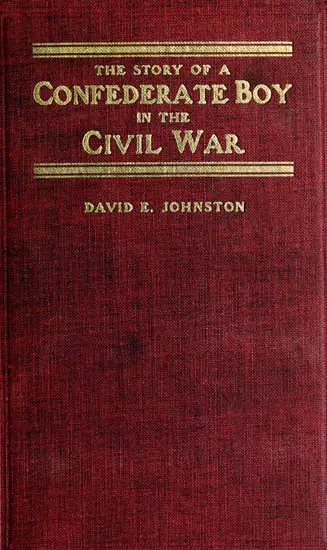
"The Story of a Confederate Boy in the Civil War" by David E. Johnston is a historical account written in the early 20th century. The narrative is based on the author's personal experiences as a young soldier in the 7th Virginia Infantry during the American Civil War. It focuses on the dynamics of a Confederate soldier's life, detailing the socio-political climate of the time, particularly the Southern perspective on secession and the war, as well as the relationships and camaraderie among the soldiers. The opening portion of the book introduces us to the author as a boy of just fifteen, navigating the political tumult surrounding Lincoln's election and Virginia's subsequent discussions on secession. It captures his youthful aspirations to become a soldier and details his education amidst the fervent debates around the impending war. There are vivid descriptions of his early impressions and tumultuous feelings regarding the war, as well as interactions with locals as opinions about the conflict begin to polarize. This groundwork sets the stage for the detailed recounting of Johnston's military life and the realities of the Civil War that he and his fellow soldiers would soon face.
Introduction adapted from the source catalogue; source summaries may be automatically generated.
Free to read · English · 65,670 words · No account needed
MAKE TIME FOR A GOOD BOOK
On by default. Untick to stop anonymous reading totals. Each page counts after 10 seconds in view. How this works.
Anonymous counting is on unless you have switched it off.
Finishing Roll Call.
March to the Field.
Inspection of Arms.
Fearful Artillery Duel.
The Charge.
Killed and Wounded.
Army Retires.
Crosses the Potomac.
Proceeding with the roll call, the officers and men of Company D were: Captain R. H. Bane, Lieutenants E. M. Stone, John W. Mullins and E. R. Walker; non-commissioned, Sergeants T. S. Taylor, W. H. H. Snidow, the writer; Corporals A. J. Thompson, Daniel Bish, George C. Mullins, J. B. Young; Privates Akers, Barrett, Crawford, Darr, Fortner (J. H.), Fortner (W. C.), Hight, Hurt (J. J.), Jones, Lewy (Jo), Meadows (Anderson), Meadows (John), Minnich, Munsey, Peters, Sarver (D. L.), Sublett, Stafford, Wilburn (G. L.) and Wilburn (W. I.). Total, 31, being all of Company D present that I recall. I believe this to be correct.
James B. Croy had been detailed to drive beef cattle; Alexander Bolton belonged to the ambulance corps, and Charles A. Hale was company cook. During the terrific artillery duel, which followed, Captain Bane and Lieutenant Mullins were prostrated by heat, from which they did not recover for some days. Lieutenant Stone had been assigned to the command of Company E of the regiment, which had no commissioned officer present. Lieutenant Walker was left in command of our company, and just as the artillery duel was about closing, and but a few minutes before the general advance began, I was knocked out of ranks by a bursting shell, of which more later. The company therefore went into the charge with but 28 men, counting Lieutenant Stone leading Company E, and Young, color guard. The three brigades of Pickett's division present were Garnett's, Kemper's and Armistead's, composed of fifteen Virginia regiments, numbering in the aggregate that morning about 4,700 men, which included the General's staff, and regimental officers, of which there was the full complement; Colonel W. Tazewell Patton, commanding the 7th Virginia regiment, being the only field officer of the regiment then present. The division, from the major-general down, was composed of Virginians, many of them mere boys, and the probability is that the average age of the men in the ranks, including the line officers, did not exceed 19 years. I had just passed my eighteenth birthday. In the division were companies from the counties of Bedford, Campbell, Franklin, Patrick, Henry, Floyd, Montgomery, Pulaski, Giles, Craig, Mercer, Madison, Orange, Culpeper, Rappahannock, Greene, Albemarle, Carroll, Appomattox, Pittsylvania, Prince Edward, Norfolk, Nansemond, and others; and from the cities of Richmond, Lynchburg, Norfolk and Portsmouth--volunteers all, many of them school boys who had entered the service at the commencement of the war, and becoming fully inured to the service.
Your reading position is saved on this browser. Take it to another device with a library code. Reading pages adapt to text, rather than matching a printed edition.
BEHIND THE BOOK
This eBook is for the use of anyone anywhere in the United States and most other parts of the world at no cost and with almost no restrictions whatsoever. You may copy it, give it away or re-use it under the terms of the Project Gutenberg License included with this eBook or online at www.gutenberg.org. If you are not located in the United States, you will have to check the laws of the country where you are located before using this eBook. Read the source licence.
The original source file, including credits and licence, is retained by this library. Request an original-format copy at no charge. Please include the book title and Project Gutenberg identifier #44889.
KEEP YOUR CURIOSITY GOING
Cécile Tormay

Moritz Busch
John L. Ransom
Frances Wright
Cécile Tormay

Mabel Potter Daggett