THE CLASSIC COLLECTION✦An outlaw’s diary: the CommuneCLASSIC FREE BOOKS
An outlaw’s diary: the Commune
Cécile Tormay
THE CLASSIC COLLECTION · 1914
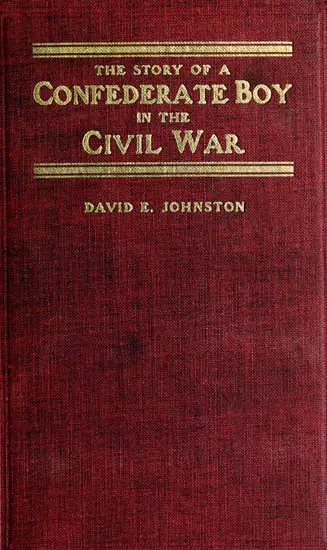
"The Story of a Confederate Boy in the Civil War" by David E. Johnston is a historical account written in the early 20th century. The narrative is based on the author's personal experiences as a young soldier in the 7th Virginia Infantry during the American Civil War. It focuses on the dynamics of a Confederate soldier's life, detailing the socio-political climate of the time, particularly the Southern perspective on secession and the war, as well as the relationships and camaraderie among the soldiers. The opening portion of the book introduces us to the author as a boy of just fifteen, navigating the political tumult surrounding Lincoln's election and Virginia's subsequent discussions on secession. It captures his youthful aspirations to become a soldier and details his education amidst the fervent debates around the impending war. There are vivid descriptions of his early impressions and tumultuous feelings regarding the war, as well as interactions with locals as opinions about the conflict begin to polarize. This groundwork sets the stage for the detailed recounting of Johnston's military life and the realities of the Civil War that he and his fellow soldiers would soon face.
Introduction adapted from the source catalogue; source summaries may be automatically generated.
Free to read · English · 65,670 words · No account needed
MAKE TIME FOR A GOOD BOOK
On by default. Untick to stop anonymous reading totals. Each page counts after 10 seconds in view. How this works.
Anonymous counting is on unless you have switched it off.
From Winchester to Culpeper.
Reorganization of the Army.
What Happened at Culpeper.
To Fredericksburg and Battle There.
In Winter Quarters.
Incidents of the Camp.
Longstreet's command left the vicinity of Winchester the latter part of October, 1862, crossing the Shenandoah river, Blue Ridge, and reaching Culpeper the early part of the first week in November, going into camp a short distance southeast of the court house. Several companies of the 7th regiment were from Orange, Culpeper, Madison and Rappahannock, and while in this camp the friends of these men came with wagons loaded with provisions and clothing, supplying many of their needs, and relieving much of their suffering.
Here the reorganization of the army was effected into two army corps, the first commanded by General James Longstreet, the second by General Thomas J. (Stonewall) Jackson. Later a third corps was organized, of which Lieutenant General A. P. Hill was appointed commander. Pickett's division was also organized, composed of five brigades, as follows:
First brigade, General James L. Kemper: regiments 1st, 3d, 7th,
11th and 24th Virginia.
Second brigade, General R. B. Garnett: regiments 8th, 18th, 19th,
28th and 56th Virginia.
Third brigade, General Lewis A. Armistead: regiments 9th, 14th,
38th, 53d and 57th Virginia.
Fourth brigade, General M. D. Corse: regiments 15th, 17th, 29th,
30th and 32d Virginia.
These four Virginia brigades were composed of the flower of the
state.
Jenkins' South Carolina brigade--General M. Jenkins: regiments Palmetto sharpshooters, 1st, 2d, 3d, 4th, 5th and 6th South Carolina, and 4th battalion.
To which was attached the following Virginia artillery: Major Dearing's 38th battalion, with Caskie's, Stribling's and Latham's batteries.
Many additions were made to the ranks at Culpeper, greatly increasing our strength; the organization now being better as to numbers and discipline than at any previous period. The health of the soldiers was also much improved; the entire army, however, still being deficient in equipment, especially shoes, overcoats and blankets, and the chilly November winds, the precursor of that fearfully cold winter just ahead, causing suffering among the men, who bore the same without murmuring--such was their metal. The weather by this time had become quite cold, the men building strong fires, and to keep off the cold ground at night they procured, when possible, two or three flat fence rails, placing them near the fire, lying down upon them. Such was their feather bed, covering themselves with a blanket if they chanced to have one.
Here the writer was appointed Sergeant-Major of the regiment, succeeding Sergeant-Major Park, disabled in the second battle of Manassas--an honor as proud as anything that has come to him since.
Your reading position is saved on this browser. Take it to another device with a library code. Reading pages adapt to text, rather than matching a printed edition.
BEHIND THE BOOK
This eBook is for the use of anyone anywhere in the United States and most other parts of the world at no cost and with almost no restrictions whatsoever. You may copy it, give it away or re-use it under the terms of the Project Gutenberg License included with this eBook or online at www.gutenberg.org. If you are not located in the United States, you will have to check the laws of the country where you are located before using this eBook. Read the source licence.
The original source file, including credits and licence, is retained by this library. Request an original-format copy at no charge. Please include the book title and Project Gutenberg identifier #44889.
KEEP YOUR CURIOSITY GOING
Cécile Tormay

Moritz Busch
John L. Ransom
Frances Wright
Cécile Tormay

Mabel Potter Daggett