THE CLASSIC COLLECTION✦An outlaw’s diary: the CommuneCLASSIC FREE BOOKS
An outlaw’s diary: the Commune
Cécile Tormay
THE CLASSIC COLLECTION · 1914
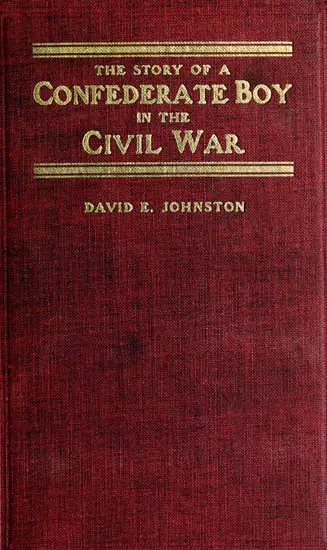
"The Story of a Confederate Boy in the Civil War" by David E. Johnston is a historical account written in the early 20th century. The narrative is based on the author's personal experiences as a young soldier in the 7th Virginia Infantry during the American Civil War. It focuses on the dynamics of a Confederate soldier's life, detailing the socio-political climate of the time, particularly the Southern perspective on secession and the war, as well as the relationships and camaraderie among the soldiers. The opening portion of the book introduces us to the author as a boy of just fifteen, navigating the political tumult surrounding Lincoln's election and Virginia's subsequent discussions on secession. It captures his youthful aspirations to become a soldier and details his education amidst the fervent debates around the impending war. There are vivid descriptions of his early impressions and tumultuous feelings regarding the war, as well as interactions with locals as opinions about the conflict begin to polarize. This groundwork sets the stage for the detailed recounting of Johnston's military life and the realities of the Civil War that he and his fellow soldiers would soon face.
Introduction adapted from the source catalogue; source summaries may be automatically generated.
Free to read · English · 65,670 words · No account needed
MAKE TIME FOR A GOOD BOOK
On by default. Untick to stop anonymous reading totals. Each page counts after 10 seconds in view. How this works.
Anonymous counting is on unless you have switched it off.
Pushing forward from this point some two hundred yards, we halted on the left of the road under cover of a belt of pines, which sheltered us from the view of the enemy. Soon came the boom of a cannon, the ball whizzing and buzzing over our heads. All eyes turned in the direction of the noise of the ball, which struck the house near where General Beauregard was standing. A second shot came, the ball cutting away an apple tree near the house referred to, causing a team of horses to take fright and run away, as well as the colored man, Bob, who, musket in hand, had halted at the house, and the last seen of him that day he was making rapid speed for Manassas. Bob never expressed any regret for the run he had made, satisfied with his experience. The rattle of musketry in our front made strange music, affecting some of the men very peculiarly, especially John W. East, of our company, who, on account of a severe pain in the region of his stomach, clasped both hands across that locality, becoming almost doubled, which wholly disabled him for the fight.
The order for the advance came, and forward we went along the narrow country road, through the pines, with a wild yell, and at double quick, accompanied by a section of the Washington (Louisiana) artillery, commanded by Lieutenant Squires. Meeting on the way some wounded men of the 1st Virginia regiment, pale and bleeding, had any other than a pleasant and happy effect upon our nervous systems, tending somewhat to dampen the ardor.
Emerging into an open field two hundred yards from Bull Run, by a movement by the right flank, we were in line advancing towards the stream, the banks of which were covered with timber, the opposite bank sloping from the stream, high and precipitous. Within one hundred yards of the stream, from the opposite bank the enemy poured into our ranks, or rather at us, a volley of musketry, which, thanks to his bad marksmanship, went high, doing little or no damage, but causing us, by common impulse, as is usual with soldiers in their first battle, to fall flat on the ground, and down we went. On the side next the enemy, in front of Isaac Hare, was John Q. Martin, who sprang over Ike, leaving him next the enemy. Ike, with a curse and threatening gesture, compelled Martin to resume his former position. The men of the regiment were immediately upon their feet. As they rose, Lieutenant Squires, whose section of artillery had unlimbered immediately in our rear, gave the command, "Fire!" which command, being mistaken by our men for that of our own officer, caused us to let fly, a terrific volley at the enemy in the woods in our front, and this was followed by a rush with fixed bayonets for the stream, behind which the enemy was posted, forcing him to retreat in confusion, leaving his dead and wounded, knapsacks, haversacks, hats and part of his small arms. Reaching the bank of the stream, the regiment lay down, and there followed for more than an hour a fierce artillery duel between the Federal batteries and the Confederate, the latter under Lieutenant Squires, which resulted in the withdrawal of the former. During this bombardment, shell, shot and shrapnel fell around and among us, wounding a few men of the regiment, but all were quiet, and continued to hug the ground. This was about five o'clock in the afternoon.
Your reading position is saved on this browser. Take it to another device with a library code. Reading pages adapt to text, rather than matching a printed edition.
BEHIND THE BOOK
This eBook is for the use of anyone anywhere in the United States and most other parts of the world at no cost and with almost no restrictions whatsoever. You may copy it, give it away or re-use it under the terms of the Project Gutenberg License included with this eBook or online at www.gutenberg.org. If you are not located in the United States, you will have to check the laws of the country where you are located before using this eBook. Read the source licence.
The original source file, including credits and licence, is retained by this library. Request an original-format copy at no charge. Please include the book title and Project Gutenberg identifier #44889.
KEEP YOUR CURIOSITY GOING
Cécile Tormay

Moritz Busch
John L. Ransom
Frances Wright
Cécile Tormay

Mabel Potter Daggett