THE CLASSIC COLLECTION✦An outlaw’s diary: the CommuneCLASSIC FREE BOOKS
An outlaw’s diary: the Commune
Cécile Tormay
THE CLASSIC COLLECTION · 1914
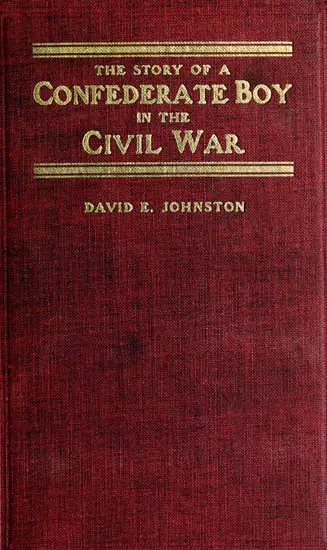
"The Story of a Confederate Boy in the Civil War" by David E. Johnston is a historical account written in the early 20th century. The narrative is based on the author's personal experiences as a young soldier in the 7th Virginia Infantry during the American Civil War. It focuses on the dynamics of a Confederate soldier's life, detailing the socio-political climate of the time, particularly the Southern perspective on secession and the war, as well as the relationships and camaraderie among the soldiers. The opening portion of the book introduces us to the author as a boy of just fifteen, navigating the political tumult surrounding Lincoln's election and Virginia's subsequent discussions on secession. It captures his youthful aspirations to become a soldier and details his education amidst the fervent debates around the impending war. There are vivid descriptions of his early impressions and tumultuous feelings regarding the war, as well as interactions with locals as opinions about the conflict begin to polarize. This groundwork sets the stage for the detailed recounting of Johnston's military life and the realities of the Civil War that he and his fellow soldiers would soon face.
Introduction adapted from the source catalogue; source summaries may be automatically generated.
Free to read · English · 65,670 words · No account needed
MAKE TIME FOR A GOOD BOOK
On by default. Untick to stop anonymous reading totals. Each page counts after 10 seconds in view. How this works.
Anonymous counting is on unless you have switched it off.
No. 20. John W. Hight, fourth corporal; wounded at battles of Seven Pines and Second Manassas; captured at Gettysburg on third day's battle; deserted.
No. 21. A. J. Thompson, first corporal; wounded at Battle of Williamsburg; in prison at close of war. No better soldier.
No. 22. Daniel Bish, second corporal; wounded at Battle of Frazier's Farm; killed at Battle of Gettysburg, third day.
No. 23. George C. Mullins, third corporal; captured at Battle of Five Forks; a prisoner at Point Lookout.
No. 24. Jesse B. Young, fourth corporal; temporary regimental ensign; wounded at battles of Frazier's Farm and Gettysburg and captured; again wounded in Battle at Clay's House. A brave and valiant soldier.
No. 25. Edward Z. Yager, first sergeant in 1864; wounded in Battle of Williamsburg; captured at Sailor's Creek; prisoner at Point Lookout.
No. 26. David C. Akers, wounded at Battle of Frazier's Farm; killed in
Battle of Gettysburg.
No. 27. George W. Akers, died in 1862.
No. 28. W. R. Albert, discharged in 1862.
No. 29. Allen M. Bane, transferred from 4th Virginia regiment in exchange for John H. Martin, of Company D; wounded in Battle of Williamsburg; captured at Battle of Frazier's Farm; transferred to 1st Kentucky battalion of cavalry.
No. 30. Alexander Bolton, cook and member of ambulance corps; a
prisoner at Point Lookout.
No. 31. Joseph E. Bane, killed at First Battle of Manassas.
No. 32. Jesse Barrett, killed at Battle of Gettysburg, third day.
No. 33. Travis Burton, wounded at Battle of Seven Pines; transferred.
No. 34. W. H. Carr, wounded at Second Battle of Manassas; retired.
No. 35. James M. Collins, detailed as blacksmith.
No. 36. John R. Crawford, slightly wounded at Battle of Boonsboro Gap; captured in Battle of Five Forks; a prisoner at Point Lookout.
No. 37. William Crawford, over age; discharged.
No. 38. James B. Croy, on special service; captured and held a prisoner
until near end of war.
No. 39. James Cole, killed at Battle of Boonsboro Gap.
No. 40. T. P. Darr, wounded and taken prisoner at Battle of Frazier's
Farm; captured at Battle of Sailor's Creek; a prisoner at Point
Lookout.
No. 41. John S. Dudley, wounded in Second Battle of Manassas; also at Sharpsburg, and captured; slightly wounded at Dreury's Bluff; captured at Five Forks; a prisoner at Point Lookout.
No. 42. M. J. Dulaney, died June, 1862.
No. 43. D. R. Dulaney, transferred to Virginia Reserves.
No. 44. W. H. Douthat, discharged in 1862.
No. 45. Thomas Davenport, deserted in Spring, 1862.
No. 46. David Davis, discharged in 1862.
No. 47. Elbert S. Eaton, wounded in Second Battle of Manassas; captured in Battle of Sailor's Creek; a prisoner at Point Lookout.
No. 48. Elisha D. East, whipped out of service.
No. 49. John W. East, wounded in battles of Williamsburg, Plymouth, N.C., and Dreury's Bluff; deserted in 1864.
Your reading position is saved on this browser. Take it to another device with a library code. Reading pages adapt to text, rather than matching a printed edition.
BEHIND THE BOOK
This eBook is for the use of anyone anywhere in the United States and most other parts of the world at no cost and with almost no restrictions whatsoever. You may copy it, give it away or re-use it under the terms of the Project Gutenberg License included with this eBook or online at www.gutenberg.org. If you are not located in the United States, you will have to check the laws of the country where you are located before using this eBook. Read the source licence.
The original source file, including credits and licence, is retained by this library. Request an original-format copy at no charge. Please include the book title and Project Gutenberg identifier #44889.
KEEP YOUR CURIOSITY GOING
Cécile Tormay

Moritz Busch
John L. Ransom
Frances Wright
Cécile Tormay

Mabel Potter Daggett