A Treatise on Mechanics
Henry Kater & Dionysius Lardner
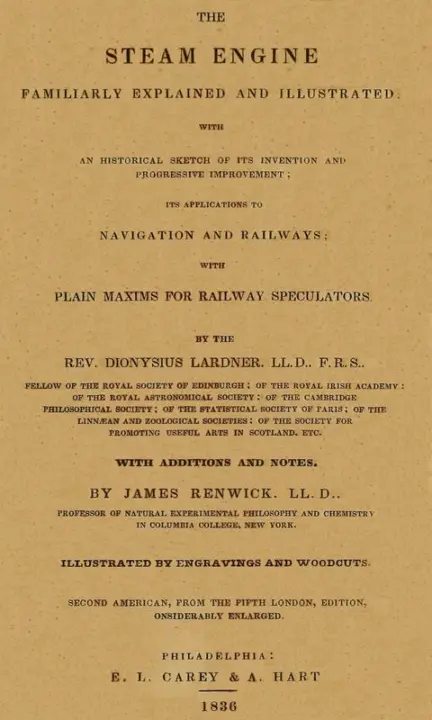
THE CLASSIC COLLECTION · 1836
"The Steam Engine Familiarly Explained and Illustrated" by Dionysius Lardner is a scientific publication written in the early 19th century. This work delves into the mechanics of the steam engine, exploring its invention, historical development, and various applications, particularly in navigation and railways. Aimed primarily at a general audience, the book seeks to demystify the principles of steam power and its significance in technological advancement. The opening of the text introduces the complexity and historical significance of the steam engine, emphasizing its vital role in advancing human progress. The author outlines the book's objective to elucidate the fundamental concepts related to motion and mechanical systems, which underpin the functionality of the steam engine. Lardner discusses the necessity of human ingenuity in harnessing natural forces and introduces key concepts of pressure, heat, and motion, setting the groundwork for an in-depth exploration of steam power throughout the chapters that follow.
Introduction adapted from the source catalogue; source summaries may be automatically generated.
Free to read · English · 106,763 words · No account needed
MAKE TIME FOR A GOOD BOOK
On by default. Untick to stop anonymous reading totals. Each page counts after 10 seconds in view. How this works.
Anonymous counting is on unless you have switched it off.
(84.) Capital and skill have of late years been directed with extraordinary energy to the improvement of inland transport; and this important instrument of national wealth and civilisation has received a proportionate impulse. Effects are now witnessed, which, had they been narrated a few years since, could only have been admitted into the pages of fiction or volumes of romance. Who could have credited the possibility of a ponderous engine of iron, loaded with several hundred passengers, in a train of carriages of corresponding magnitude, and a large quantity of water and coal, taking flight from Manchester and arriving at Liverpool, a distance of about thirty miles, in little more than an hour? And yet this is a matter of daily and almost hourly occurrence. Neither is the road, on which this wondrous performance is effected, the most favourable which could be constructed for such machines. It is subject to undulations and acclivities, which reduce the rate of speed much more than similar inequalities affect the velocity on common roads. The rapidity of transport thus attained is not less wonderful than the weights transported. Its capabilities in this respect far transcend the exigencies even of the two greatest commercial marts in Great Britain. Loads, varying from 50 to 150 tons are transported at the average rate of 15 miles an hour; but the engines in this case are loaded below their power; and in one instance we have seen a load--we should rather say a cargo--of wagons, conveying merchandise to the amount of 230 tons gross, transported from Liverpool to Manchester at the average rate of 12 miles an hour.
The astonishment with which such performances must be viewed, might be qualified, if the art of transport by steam on railways had been matured, and had attained that full state of perfection which such an art is always capable of receiving from long experience, aided by great scientific knowledge, and the unbounded application of capital. But such is not the present case. The art of constructing locomotive engines, so far from having attained a state of maturity, has not even emerged from its infancy. So complete was the ignorance of its powers which prevailed, even among engineers, previous to the opening of the Liverpool railway, that the transport of heavy goods was regarded as the chief object of the undertaking, and its principal source of revenue. The incredible speed of transport, effected even in the very first experiments in 1830, burst upon the public, and on the scientific world, with all the effect of a new and unlooked-for phenomenon. On the unfortunate occasion which deprived this country of Mr. Huskisson, the wounded body of that statesman was transported a distance of about fifteen miles in twenty-five minutes, being at the rate of thirty-six miles an hour. The revenue of the road arising from passengers since its opening, has, contrary to all that was foreseen, been nearly double that which has been derived from merchandise. So great was the want of experience in the construction of engines, that the company was at first ignorant whether they should adopt large steam-engines fixed at different stations on the line, to pull the carriages from station to station, or travelling engines to drag the loads the entire distance. Having decided on the latter, they have, even to the present moment, laboured under the disadvantage of the want of that knowledge which experience alone can give. The engines have been constantly varied in their weight and proportions, in their magnitude and form, as the experience of each successive month has indicated. As defects became manifest they were remedied; improvements suggested were adopted; and each quarter produced engines of such increased power and efficiency, that their predecessors were abandoned, not because they were worn out, but because they had been outstripped in the rapid march of improvement. Add to this, that only one species of travelling engine has been effectively tried; the capabilities of others remain still to be developed; and even that form of engine which has received the advantage of a course of experiments on so grand a scale to carry it towards perfection, is far short of this point, and still has defects, many of which, it is obvious, time and experience will remove. If then travelling steam engines, with all the imperfections of an incipient invention--with the want of experience, the great parent of practical improvements--with the want of the common advantage of the full application of the skill and capital of the country--subjected to but one great experiment, and that experiment limited to one form of engine; if, under such disadvantages, the effects to which we have referred have been produced, what may we not expect from this extraordinary power, when the enterprise of the country shall be unfettered, when greater fields of experience are opened, when time, ingenuity, and capital have removed the existing imperfections, and have brought to light new and more powerful principles? This is not mere speculation on possibilities, but refers to what is in a state of actual progression. Railways are in progress between the points of greatest intercourse in the United Kingdom, and travelling steam engines are in preparation for the common turnpike roads; the practicability and utility of that application of the steam engine having not only been established by experiment to the satisfaction of their projectors, but proved before the legislature in a committee of inquiry on the subject.
Your reading position is saved on this browser. Take it to another device with a library code. Reading pages adapt to text, rather than matching a printed edition.
Henry Kater & Dionysius Lardner
BEHIND THE BOOK
This eBook is for the use of anyone anywhere in the United States and most other parts of the world at no cost and with almost no restrictions whatsoever. You may copy it, give it away or re-use it under the terms of the Project Gutenberg License included with this eBook or online at www.gutenberg.org. If you are not located in the United States, you will have to check the laws of the country where you are located before using this eBook. Read the source licence.
The original source file, including credits and licence, is retained by this library. Request an original-format copy at no charge. Please include the book title and Project Gutenberg identifier #55428.
KEEP YOUR CURIOSITY GOING
Cécile Tormay

Moritz Busch
John L. Ransom
Frances Wright
Cécile Tormay

Mabel Potter Daggett