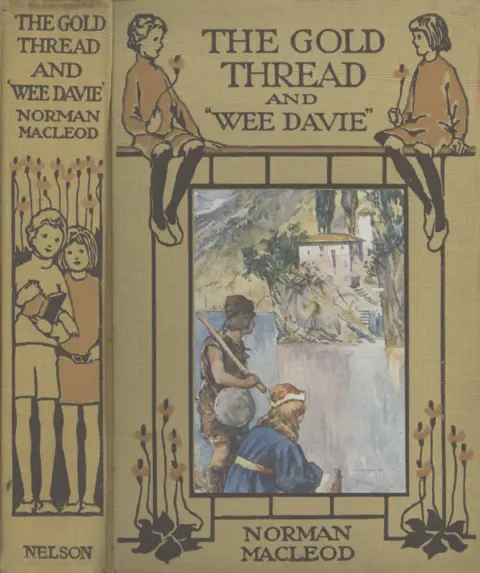
The Gold Thread; and, Wee Davie: Two Stories for the Young
Norman Macleod
THE CLASSIC COLLECTION · 1867
"The Starling: A Scottish Story" by Norman Macleod is a historical fiction novel written in the late 19th century. The narrative centers around Sergeant Adam Mercer, a former poacher who has transformed into a respected elder in the Church of Scotland, now grappling with his past and the complexities of moral responsibility as he navigates his life in the village of Drumsylie. The story explores themes of redemption, community dynamics, and the impact of personal history on one's reputation and relationships. At the start of the book, readers are introduced to the character of Adam Mercer, who has a complicated past as a poacher and is now a valued member of his community. The opening chapter reveals a conversation between two parish elders discussing Mercer's history and sets the stage for his character development. As the narrative progresses, we learn about his attachment to a starling that he has trained to mimic phrases, which represents deeper connections to his late son, Charlie. The introduction paints a picture of the social fabric of Drumsylie, highlighting the interplay between personal choices and communal perceptions, while foreshadowing conflicts that arise from Adam's adherence to his principles when challenged by the local minister, Mr. Porteous. This thoughtfully crafted beginning invites readers to consider the nuances of morality, duty, and the weight of past actions within a close-knit community.
Introduction adapted from the source catalogue; source summaries may be automatically generated.
Free to read · English · 62,702 words · No account needed
MAKE TIME FOR A GOOD BOOK
On by default. Untick to stop anonymous reading totals. Each page counts after 10 seconds in view. How this works.
Anonymous counting is on unless you have switched it off.
As the evening drew on, the family who occupied the keeper's house gathered together like crows to their rookery. Mrs. Hugh, who had been helping at a large washing in "the big house", returned with a blythe face, full of cheer and womanly kindness.
"Hech! but I hae had sic a day o't! What a washing! an' it's no' half dune! But wha hae we here?" she asked, as she espied Jock seated near the fire. "Dae I ken ye?" she further inquired, looking at him with a sceptical smile, as if she feared to appear rude to one whom she ought, perhaps, to have recognised.
Jock, with a sense of respect due to her, rose, and said, "I houp no', for maybe I wad be nae credit tae ye as an acqua'ntance."
"A freen' o' my cousin's, Adam Mercer, o' Drumsylie," remarked old
Spence. "Sit doon, my man!"
"I'm glad tae see ye," said the happy sonsy wife, stretching out her hand to Jock, who took it reluctantly, and gazed in the woman's face with an awkward expression.
"It's been saft weather, and bad for travellin', and ye hae come a far gait," she continued; and forthwith began to arrange her house. Almost at her heels the children arrived. There were two flaxen-haired girls, one ten and the other about twelve, with bare feet, and their locks tied up like sheaves of ripe golden grain. Then came in a stout lad of about seven, from school and play. All looked as fresh and full of life as young roe from the forest.
"Gang awa', bairns, and snod yersels," said Mrs. Hugh.
"This man," said old Spence, who was jealous of his authority over the household, pointing to Jock, "wull tak' his supper wi' us. He's tae sleep in the stable-laft."
"He's welcome, he's welcome," said Mrs. Hugh. "The bed's nae braw, but it's clean, and it's our best for strangers."
The last to enter, as the sun was setting, was John, the eldest, a lad of about fourteen, the very picture of a pure-eyed, ruddy-complexioned, healthy, and happy lad. He had left school to assist his father in attending to his duties.
"What luck, Johnnie?" asked his father, as the boy entered with his fishing basket over his shoulder.
"Middlin' only," replied John; "the water was raither laigh, and the tak' wasna guid. There were plenty o' rises, but the troots were unco shy. But I hae gotten, for a' that, a guid wheen;" and he unslung his basket and poured out from it a number of fine trout.
Your reading position is saved on this browser. Take it to another device with a library code. Reading pages adapt to text, rather than matching a printed edition.
BEHIND THE BOOK
This eBook is for the use of anyone anywhere in the United States and most other parts of the world at no cost and with almost no restrictions whatsoever. You may copy it, give it away or re-use it under the terms of the Project Gutenberg License included with this eBook or online at www.gutenberg.org. If you are not located in the United States, you will have to check the laws of the country where you are located before using this eBook. Read the source licence.
The original source file, including credits and licence, is retained by this library. Request an original-format copy at no charge. Please include the book title and Project Gutenberg identifier #41989.
KEEP YOUR CURIOSITY GOING
Cécile Tormay

Moritz Busch
Coulson Kernahan
John L. Ransom

Maurice Baring
Frances Wright