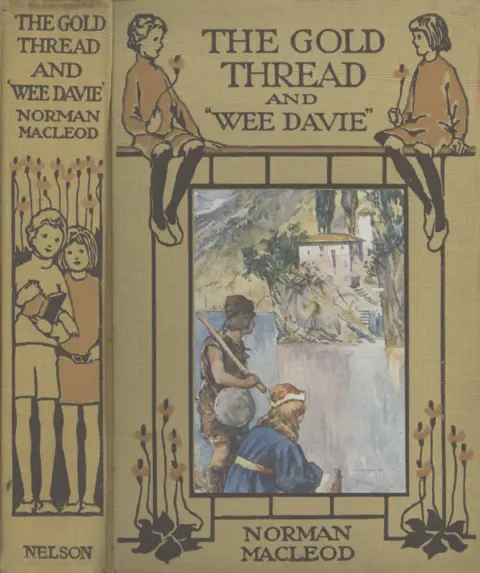
The Gold Thread; and, Wee Davie: Two Stories for the Young
Norman Macleod
THE CLASSIC COLLECTION · 1867
"The Starling: A Scottish Story" by Norman Macleod is a historical fiction novel written in the late 19th century. The narrative centers around Sergeant Adam Mercer, a former poacher who has transformed into a respected elder in the Church of Scotland, now grappling with his past and the complexities of moral responsibility as he navigates his life in the village of Drumsylie. The story explores themes of redemption, community dynamics, and the impact of personal history on one's reputation and relationships. At the start of the book, readers are introduced to the character of Adam Mercer, who has a complicated past as a poacher and is now a valued member of his community. The opening chapter reveals a conversation between two parish elders discussing Mercer's history and sets the stage for his character development. As the narrative progresses, we learn about his attachment to a starling that he has trained to mimic phrases, which represents deeper connections to his late son, Charlie. The introduction paints a picture of the social fabric of Drumsylie, highlighting the interplay between personal choices and communal perceptions, while foreshadowing conflicts that arise from Adam's adherence to his principles when challenged by the local minister, Mr. Porteous. This thoughtfully crafted beginning invites readers to consider the nuances of morality, duty, and the weight of past actions within a close-knit community.
Introduction adapted from the source catalogue; source summaries may be automatically generated.
Free to read · English · 62,702 words · No account needed
MAKE TIME FOR A GOOD BOOK
On by default. Untick to stop anonymous reading totals. Each page counts after 10 seconds in view. How this works.
Anonymous counting is on unless you have switched it off.
Mrs. Mercer received her visitor very coldly. She associated his name with what she called "the conspiracy", and felt aggrieved that he had never visited her husband during those previous weeks of trial. He was, as she expressed it, "a sight for sair een". Mr. Menzies made the best excuse he could, and described the circumstances in which he had been placed towards Adam as "the reason why he had not visited her sooner. He said, also, that however painful it was to him, he had nevertheless been obliged by his ordination vows to do his duty as a member of Session, and he hoped not in vain, as he might now be the means of making peace between his friend, Mr. Mercer, and the minister.
"I'm Charlie's bairn," said the starling, just as Menzies had given a preliminary cough, and was about to approach the question which had chiefly brought him to the cottage. "I'm Charlie's bairn--a man's a man--kick, kur--whitt, whitt."
The starling seemed unable or unwilling to end the sentence; at last it came out clear and distinct--"a man's a man for a' that".
Mr. Menzies did not feel comfortable.
"I dinna wunner, Mrs. Mercer," at last he said, "at you and Adam likin' that bird! He is really enticing, and by ordinar, I maun confess."
"There's naething wrang wi' the bird," said Katie, examining the seam of her apron, adding in an indifferent tone of voice, "If folk wad only let it alane, it's discreet, and wad hairm naebody."
"I'm sure, Mrs. Mercer," he said, "I'm real sorry about the hale business; and I'm resolved, if possible, to get Adam oot o' the han's o' the Session, and bring peace atween a' parties."
Katie shook her foot, twirled her thumbs, but said nothing.
"It's a pity indeed," the elder continued, "that a bird should come atween an office-bearer like Adam and his minister and the Session! It's no richt--it's no richt; and yet neither you nor Adam could pit it awa, e'en at the request o' the Session, wi' yer ain haun's. Na, na--that was askin' ower muckle."
"Ye ken best, nae doot," said Katie, with a touch of sarcasm in her voice. "You and the Session hae made a bonnie job o' the guidman noo!"
"I'm real vexed he's no' weel," said Menzies; "but to be candid, Mrs. Mercer, it wasna a' the faut o' the Session at the warst, but pairtly his ain. He was ower stiff, and was neither to haud nor bin'."
"A bairn could haud him noo, and bin' him tae," said Katie.
Your reading position is saved on this browser. Take it to another device with a library code. Reading pages adapt to text, rather than matching a printed edition.
BEHIND THE BOOK
This eBook is for the use of anyone anywhere in the United States and most other parts of the world at no cost and with almost no restrictions whatsoever. You may copy it, give it away or re-use it under the terms of the Project Gutenberg License included with this eBook or online at www.gutenberg.org. If you are not located in the United States, you will have to check the laws of the country where you are located before using this eBook. Read the source licence.
The original source file, including credits and licence, is retained by this library. Request an original-format copy at no charge. Please include the book title and Project Gutenberg identifier #41989.
KEEP YOUR CURIOSITY GOING
Cécile Tormay

Moritz Busch
Coulson Kernahan
John L. Ransom

Maurice Baring
Frances Wright