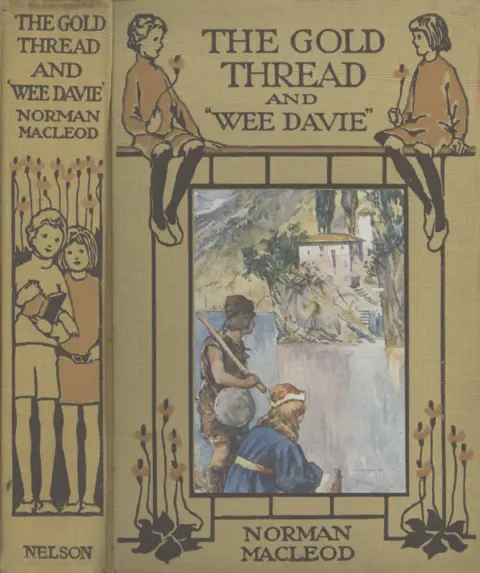
The Gold Thread; and, Wee Davie: Two Stories for the Young
Norman Macleod
THE CLASSIC COLLECTION · 1867
"The Starling: A Scottish Story" by Norman Macleod is a historical fiction novel written in the late 19th century. The narrative centers around Sergeant Adam Mercer, a former poacher who has transformed into a respected elder in the Church of Scotland, now grappling with his past and the complexities of moral responsibility as he navigates his life in the village of Drumsylie. The story explores themes of redemption, community dynamics, and the impact of personal history on one's reputation and relationships. At the start of the book, readers are introduced to the character of Adam Mercer, who has a complicated past as a poacher and is now a valued member of his community. The opening chapter reveals a conversation between two parish elders discussing Mercer's history and sets the stage for his character development. As the narrative progresses, we learn about his attachment to a starling that he has trained to mimic phrases, which represents deeper connections to his late son, Charlie. The introduction paints a picture of the social fabric of Drumsylie, highlighting the interplay between personal choices and communal perceptions, while foreshadowing conflicts that arise from Adam's adherence to his principles when challenged by the local minister, Mr. Porteous. This thoughtfully crafted beginning invites readers to consider the nuances of morality, duty, and the weight of past actions within a close-knit community.
Introduction adapted from the source catalogue; source summaries may be automatically generated.
Free to read · English · 62,702 words · No account needed
MAKE TIME FOR A GOOD BOOK
On by default. Untick to stop anonymous reading totals. Each page counts after 10 seconds in view. How this works.
Anonymous counting is on unless you have switched it off.
Hall manifested a singular inquisitiveness to know as much as possible about those poaching days, and their locality, until at last being satisfied, and having learned that the old keeper of Lord Bennock was still alive, though, as Mrs. Craigie said, "clean superannuat", and that he was, moreover, Adam's cousin, Jock said, "What an awfu' blackguard Adam maun be! If I had kent what I ken noo, I never wad hae gi'en him my boots to men'."
"Yer boots to men'!" exclaimed Mrs. Craigie, with astonishment; "what
for did ye do that?"
"He had nae wark."
"Ser' him richt!" said Mrs. Craigie.
"And I patroneesed him," continued Jock.
"Ha! ha! It was far ower guid o' ye, Jock, tae patroneese him," said Mrs. Craigie. "Ye'll no pay him, I houp? But he's sic a greedy fallow, that he micht expec' even a puir sowl like you tae pay."
"Me pay him!" said Jock, with a laugh, "maybe--when I hae paid the debt o' natur'; no till then."
"But, Jock," asked Mrs. Craigie, almost in a whisper, "did ye see
Mary, the wee slut?"
"I did that," replied Jock, "an' it wad hae broken yer feelin' heart, Luckie, had ye seen her!--no lying as a puir orphan paid for by the Session ocht to lie, on a shake-doon, wi' a blanket ower her,--my certes, guid eneuch for the like o' her, and for the bawbees paid for her----"
"Guid?--ower guid!" interpolated Mrs. Craigie.
"But," continued Hall, with a leer, "she was mair like a leddy, wi' a bed till hersel', an' curtains on't; and sitting in a chair, wi' stockin's and shoon, afore the fire--learning her lesson, too, and coddled and coddled by Adam and his wife. What say ye to that, Luckie? what say ye to that?"
"Dinna mak' me daft!" exclaimed Mrs. Craigie; "it's eneuch to mak' a bodie swear e'en on the Sabbath day!"
"Swear awa'!" said Hall; "the day maks nae difference to me. Sae ca' awa', woman, if it wull dae ye ony guid, or gie ye ony comfort."
Mrs. Craigie, instead of accepting the advice of her "ne'er-do-weel" lodger, fell into a meditative mood. What could she be thinking about? Her Sabbath thoughts came to this, in their practical results--a proposal to Jock Hall to seize Mary as she was returning from church, and to bring her again under the protection of her dear old motherly friend. She could not, indeed, as yet take her from under the Sergeant's roof by force, but could the Sergeant retake her if by any means she were brought back under her roof?
Your reading position is saved on this browser. Take it to another device with a library code. Reading pages adapt to text, rather than matching a printed edition.
BEHIND THE BOOK
This eBook is for the use of anyone anywhere in the United States and most other parts of the world at no cost and with almost no restrictions whatsoever. You may copy it, give it away or re-use it under the terms of the Project Gutenberg License included with this eBook or online at www.gutenberg.org. If you are not located in the United States, you will have to check the laws of the country where you are located before using this eBook. Read the source licence.
The original source file, including credits and licence, is retained by this library. Request an original-format copy at no charge. Please include the book title and Project Gutenberg identifier #41989.
KEEP YOUR CURIOSITY GOING
Cécile Tormay

Moritz Busch
Coulson Kernahan
John L. Ransom

Maurice Baring
Frances Wright