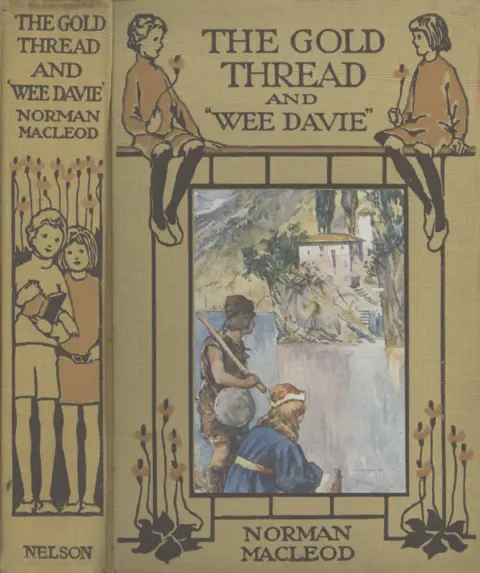
The Gold Thread; and, Wee Davie: Two Stories for the Young
Norman Macleod

THE CLASSIC COLLECTION · 1867
"The Starling: A Scottish Story" by Norman Macleod is a historical fiction novel written in the late 19th century. The narrative centers around Sergeant Adam Mercer, a former poacher who has transformed into a respected elder in the Church of Scotland, now grappling with his past and the complexities of moral responsibility as he navigates his life in the village of Drumsylie. The story explores themes of redemption, community dynamics, and the impact of personal history on one's reputation and relationships. At the start of the book, readers are introduced to the character of Adam Mercer, who has a complicated past as a poacher and is now a valued member of his community. The opening chapter reveals a conversation between two parish elders discussing Mercer's history and sets the stage for his character development. As the narrative progresses, we learn about his attachment to a starling that he has trained to mimic phrases, which represents deeper connections to his late son, Charlie. The introduction paints a picture of the social fabric of Drumsylie, highlighting the interplay between personal choices and communal perceptions, while foreshadowing conflicts that arise from Adam's adherence to his principles when challenged by the local minister, Mr. Porteous. This thoughtfully crafted beginning invites readers to consider the nuances of morality, duty, and the weight of past actions within a close-knit community.
Introduction adapted from the source catalogue; source summaries may be automatically generated.
Free to read · English · 62,702 words · No account needed
MAKE TIME FOR A GOOD BOOK
On by default. Untick to stop anonymous reading totals. Each page counts after 10 seconds in view. How this works.
Anonymous counting is on unless you have switched it off.
"Well," replied Dick, "it's no easy to make evil good, and I won't try to do so; but yet ye forget our difficulties and temptations. Consider only, sir, that there we were, not in bed for months and months; marching at all hours; ill-fed, ill-clothed, and uncertain of life--which I assure your honour makes men indifferent to it; and we had often to get our mess as we best could,--sometimes a tough steak out of a dead horse or mule, for when the beast was skinned it was difficult to make oot its kind; and after toiling and moiling, up and down, here and there and everywhere, summer and winter, when at last we took a town with blood and wounds, and when a cask of wine or spirits fell in the way of the troops, I don't believe that you, sir, or the justices of the peace, or, with reverence be it spoken, the ministers themselves, would have said 'No', to a drop. You'll excuse me, sir; I'm perhaps too free with you."
"I didn't mean to lecture you, or to blame you, Dick, for I know the army is not the place for Christians."
"Begging your honour's pardon, sir," said Dick, "the best Christians I ever knowed were in the army--men who would do their dooty to their king, their country, and their God."
"You have known such?" I asked, breaking into the conversation, to turn it aside from what threatened to be a dispute.
"I have, sir! There's ane Adam Mercer, in this very parish, an elder of the Church--I'm a Dissenter mysel', on principle, for I consider----"
"Go on, Dick, about Mercer; never mind your Church principles."
"Well, sir, as I was saying--though, mind you, I'm not ashamed of being a Dissenter, and, I houp, a Christian too--Adam was our sergeant; and a worthier man never shouldered a bayonet. He was nae great speaker, and was quiet as his gun when piled; but when he shot, he shot! that did he, short and pithy, a crack, and right into the argument. He was weel respeckit, for he was just and mercifu'--never bothered the men, and never picked oot fauts, but covered them; never preached, but could gie an advice in two or three words that gripped firm aboot the heart, and took the breath frae ye. He was extraordinar' brave! If there was any work to do by ordinar', up to leading a forlorn hope, Adam was sure to be on't; and them that kent him even better than I did then, said that he never got courage frae brandy, but, as they assured me, though ye'll maybe no' believe it, his preparation was a prayer! I canna tell hoo they fan' this oot, for Adam was unco quiet; but they say a drummer catched him on his knees afore he mounted the ladder wi' Cansh at the siege o' Badajoz, and that Adam telt him no' to say a word aboot it, but yet to tak' his advice and aye to seek God's help mair than man's."
Your reading position is saved on this browser. Take it to another device with a library code. Reading pages adapt to text, rather than matching a printed edition.
BEHIND THE BOOK
This eBook is for the use of anyone anywhere in the United States and most other parts of the world at no cost and with almost no restrictions whatsoever. You may copy it, give it away or re-use it under the terms of the Project Gutenberg License included with this eBook or online at www.gutenberg.org. If you are not located in the United States, you will have to check the laws of the country where you are located before using this eBook. Read the source licence.
The original source file, including credits and licence, is retained by this library. Request an original-format copy at no charge. Please include the book title and Project Gutenberg identifier #41989.
KEEP YOUR CURIOSITY GOING
Cécile Tormay

Moritz Busch
Coulson Kernahan
John L. Ransom

Maurice Baring
Frances Wright