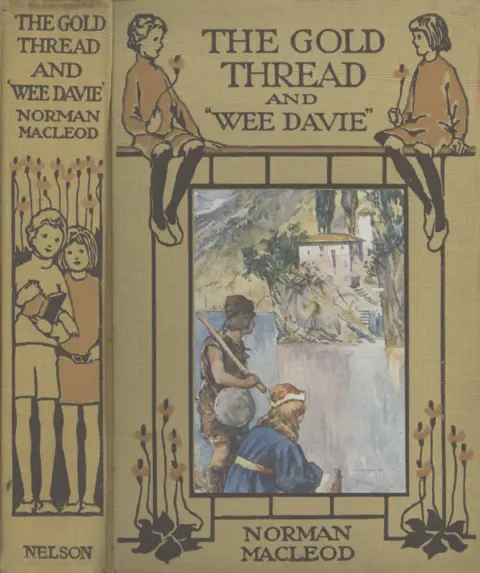
The Gold Thread; and, Wee Davie: Two Stories for the Young
Norman Macleod
THE CLASSIC COLLECTION · 1867
"The Starling: A Scottish Story" by Norman Macleod is a historical fiction novel written in the late 19th century. The narrative centers around Sergeant Adam Mercer, a former poacher who has transformed into a respected elder in the Church of Scotland, now grappling with his past and the complexities of moral responsibility as he navigates his life in the village of Drumsylie. The story explores themes of redemption, community dynamics, and the impact of personal history on one's reputation and relationships. At the start of the book, readers are introduced to the character of Adam Mercer, who has a complicated past as a poacher and is now a valued member of his community. The opening chapter reveals a conversation between two parish elders discussing Mercer's history and sets the stage for his character development. As the narrative progresses, we learn about his attachment to a starling that he has trained to mimic phrases, which represents deeper connections to his late son, Charlie. The introduction paints a picture of the social fabric of Drumsylie, highlighting the interplay between personal choices and communal perceptions, while foreshadowing conflicts that arise from Adam's adherence to his principles when challenged by the local minister, Mr. Porteous. This thoughtfully crafted beginning invites readers to consider the nuances of morality, duty, and the weight of past actions within a close-knit community.
Introduction adapted from the source catalogue; source summaries may be automatically generated.
Free to read · English · 62,702 words · No account needed
MAKE TIME FOR A GOOD BOOK
On by default. Untick to stop anonymous reading totals. Each page counts after 10 seconds in view. How this works.
Anonymous counting is on unless you have switched it off.
The Sergeant forthwith told the story of the starling as the playmate of his child, the history of whose sickness and death was already known to Mr. Porteous; and having concluded, he said, "That's the reason, sir, why I couldna kill the bird. I wadna tell this to ony man but to yersel', for it's no' my fashion tae sen' the drum aboot the toon for pity or for sympathy; but I wish you, sir, to ken what's fac, for yer ain guidance and the guidance o' the Session."
"I remember your boy well," remarked Mr. Porteous, handing his snuff-box in a very kindly way to his visitor.
The Sergeant nodded. "Ye did your duty, minister, to us on that occasion, or I wadna have come here the nicht. I kent ye wad like onything Charlie was fond o'."
"I quite understand your feelings, Sergeant, and sympathise with them."
The Sergeant smiled, and nodded, and said, "I hope ye do, sir; I was sure ye would. I'm thankfu' I cam', and sae will Katie be." The burden was lifting off his heart.
"But," said Mr. Porteous, after a pause and a long snuff, "I must be faithful with you, Adam: 'First pure, then peaceable,' you know."
"And I hope, sir," said Adam, "'easy to be entreated.'"
"That," replied Mr. Porteous, "depends on circumstances. Let us, therefore, look at the whole aspects of the case. There is to be considered, for example, your original delinquency, mistake, or call it by what name you please; then there is to be taken into account my full explanation, given ministerially in your own house, of the principles which guided my conduct and ought to guide yours; then there is also the matter of the Kirk Session--the fact that they have taken it up, which adds to its difficulty--a difficulty, however, let me say, Mr. Mercer, which has not been occasioned by me. Now, review all these--especially that with which you have personally most to do--the origo mali, so to speak--the fact that a bird endeared to you by very touching associations was, let me admit it, accidentally, and unintentionally,--let this also be granted for the sake of argument,--made by you the occasion of scandal. We are agreed on this point at least?"
"It was on that point," interrupted the Sergeant, "I thought you doubted
my honour."
"No!" said Mr. Porteous; "I only declared that 'honour' was a worldly, not a Christian phrase, and unfit therefore for a Church court."
The Sergeant was nonplussed. Thinking his ignorance sinful, he bowed,
and said no more.
Your reading position is saved on this browser. Take it to another device with a library code. Reading pages adapt to text, rather than matching a printed edition.
BEHIND THE BOOK
This eBook is for the use of anyone anywhere in the United States and most other parts of the world at no cost and with almost no restrictions whatsoever. You may copy it, give it away or re-use it under the terms of the Project Gutenberg License included with this eBook or online at www.gutenberg.org. If you are not located in the United States, you will have to check the laws of the country where you are located before using this eBook. Read the source licence.
The original source file, including credits and licence, is retained by this library. Request an original-format copy at no charge. Please include the book title and Project Gutenberg identifier #41989.
KEEP YOUR CURIOSITY GOING
Cécile Tormay

Moritz Busch
Coulson Kernahan
John L. Ransom

Maurice Baring
Frances Wright