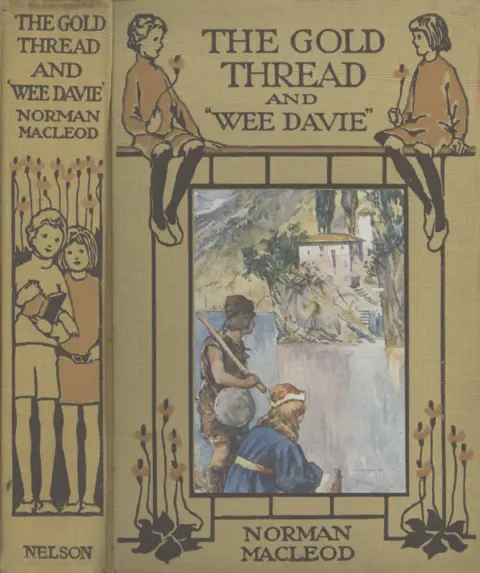
The Gold Thread; and, Wee Davie: Two Stories for the Young
Norman Macleod
THE CLASSIC COLLECTION · 1867
"The Starling: A Scottish Story" by Norman Macleod is a historical fiction novel written in the late 19th century. The narrative centers around Sergeant Adam Mercer, a former poacher who has transformed into a respected elder in the Church of Scotland, now grappling with his past and the complexities of moral responsibility as he navigates his life in the village of Drumsylie. The story explores themes of redemption, community dynamics, and the impact of personal history on one's reputation and relationships. At the start of the book, readers are introduced to the character of Adam Mercer, who has a complicated past as a poacher and is now a valued member of his community. The opening chapter reveals a conversation between two parish elders discussing Mercer's history and sets the stage for his character development. As the narrative progresses, we learn about his attachment to a starling that he has trained to mimic phrases, which represents deeper connections to his late son, Charlie. The introduction paints a picture of the social fabric of Drumsylie, highlighting the interplay between personal choices and communal perceptions, while foreshadowing conflicts that arise from Adam's adherence to his principles when challenged by the local minister, Mr. Porteous. This thoughtfully crafted beginning invites readers to consider the nuances of morality, duty, and the weight of past actions within a close-knit community.
Introduction adapted from the source catalogue; source summaries may be automatically generated.
Free to read · English · 62,702 words · No account needed
MAKE TIME FOR A GOOD BOOK
On by default. Untick to stop anonymous reading totals. Each page counts after 10 seconds in view. How this works.
Anonymous counting is on unless you have switched it off.
Those days are past, my soldier, old and hoary,
But still the scars are on thy manly brow;
We both have shared the danger and the glory,
Come, let us share the peace and comfort now.
Come to my home, for thou hast not another,
And dry those tears, for thou shall beg no more;
There, take this hand, and let us march together
Down to the grave, where life's campaign is o'er!
There, take this hand, &c.
While the song was being sung the Sergeant turned his head on his pillow away from the Corporal. When it was finished, he said, "Come here, Dick."
The Corporal went to the bed, and seized the Sergeant's proffered hand.
"That sang will do me mair guid than a' their medicine. The guidwife will gie ye half-a-croon for puir Sandie Tamson."
Then asking Katie to leave him alone for a few moments with the Corporal, the Sergeant said, retaining his hand--
"I'm no dangerously ill, my auld friend; but I'm no' weel--I'm no' weel! There's a weight on my mind, and an oppression aboot my heart that hauds me doun extraordinar'."
"Dinna gie in, Adam--dinna gie in, wi' the help o' Him that has brocht ye thro' mony a waur fecht," replied the Corporal as he sat down beside him. "D'ye mind the time when ye followed Cainsh up the ladder at Badajoz? and d'ye mind when that glorious fallow Loyd was kill't at Nivelle! Noo----"
"Ah, Dick! thae days, man, are a' by! I'm no' what I was," said the Sergeant. "I'm a puir crippled, wounded veteran, no' fit for ony mair service--no' even as an elder," he added, with a bitter smile.
"Dinna fash yer thoomb, Adam, aboot that business," said Dick. "Ye deserved to hae been drummed oot o' the regiment--I mean the kirk--no' your kirk nor mine, but the kirk o' a' honest and sensible folk, gif ye had swithered aboot that bird. I hae had a crack wi' the cratur, and it's jist extraordinar' sensible like--sae crouse and canty, it wad be like murder tae thraw a neck like that! In fac', a bird is mair than a bird, I consider, when it can speak and sing yon way."
"Thank ye, Corporal," said Adam.
"It's some glamour has come ower the minister," said Dick, "just like what cam' ower oor Colonel, when he made us charge twa thousand at Busaco, and had, in coorse, tae fa' back on his supports in disgrace--no' jist in disgrace, for we never cam' tae that, nor never wull, I hope--but in confusion!"
Your reading position is saved on this browser. Take it to another device with a library code. Reading pages adapt to text, rather than matching a printed edition.
BEHIND THE BOOK
This eBook is for the use of anyone anywhere in the United States and most other parts of the world at no cost and with almost no restrictions whatsoever. You may copy it, give it away or re-use it under the terms of the Project Gutenberg License included with this eBook or online at www.gutenberg.org. If you are not located in the United States, you will have to check the laws of the country where you are located before using this eBook. Read the source licence.
The original source file, including credits and licence, is retained by this library. Request an original-format copy at no charge. Please include the book title and Project Gutenberg identifier #41989.
KEEP YOUR CURIOSITY GOING
Cécile Tormay

Moritz Busch
Coulson Kernahan
John L. Ransom

Maurice Baring
Frances Wright