The Yellow Dove
George Gibbs
THE CLASSIC COLLECTION · 1920
"The Splendid Outcast" by George Gibbs is a novel written in the early 20th century. The story follows Jim Horton, a war-injured soldier in a hospital recovering from a successful operation, who grapples with his identity after assuming his cowardly twin brother Harry's name and position. The narrative seems to delve into themes of honor, identity, and deception against the backdrop of World War I, suggesting an exploration of the complexities of brotherhood and moral choices. The opening of the novel presents Jim Horton awakening in a hospital bed, struggling with pain and confusion as he learns that he has taken on the identity of his brother, Harry, a lieutenant thought to be wounded in battle. Jim recalls the events leading to his injuries and taxingly considers his brother’s cowardice and the decisions he made during their time in the war. As Jim pieces together his memories, he contemplates the implications of his actions, including the attendance of both his twin brother's wife, Moira, and her father, Barry Quinlevin, who are oblivious to the ruse. This opening setup establishes a tension-filled scenario filled with potential conflicts regarding identity and honor, and hints at the evolving dynamics as Jim must choose whether to maintain the deception or reveal the truth to Moira and face the consequences.
Introduction adapted from the source catalogue; source summaries may be automatically generated.
Free to read · English · 99,128 words · No account needed
MAKE TIME FOR A GOOD BOOK
On by default. Untick to stop anonymous reading totals. Each page counts after 10 seconds in view. How this works.
Anonymous counting is on unless you have switched it off.
But she had fallen on her knees before it and didn't even hear him, for she suddenly bent forward with a little cry and put her finger into a small tear in the cotton cloth on the outside of the right calf.
"I have it," she muttered excitedly, as though half to herself. "I have it--new--clean on one side, soiled on the other----"
"What, Madame--what?" asked Simon, catching the fire of her eagerness.
"The hole in the leg, Monsieur," she cried. "Don't you see? A piece torn out against some rough surface----"
"Yes, but----"
"And here is the cloth that was torn from it," she gasped, exhibiting a small piece of cotton cloth. "You see? It fits the tear exactly."
Simon took it from her hands and scrutinized it through his glasses. The torn piece was of the same material as the cotton skin of the lay figure, soiled upon one side and clean upon the other.
"Where did you find this piece of cotton, Madame?" he asked in a
suppressed tone.
"Outside the window--hanging below a torn edge of the tin gutter, where it must have escaped the eyes of Monsieur le Commissaire."
"Mon Dieu! Then the lay figure must have been outside on the
ledge----"
"Exactly. Outside. The stain of dust upon the leg shows how it
lay----"
"Magnifique, Madame----"
"But the skirt and the jacket were first removed," she went on breathlessly. "Isn't it obvious? Otherwise there would have been no stain of dirt upon the leg. There is no mark of dirt upon them."
"Quick, Madame. The jacket----"
And with his own hands the Judge helped her remove the Spanish jacket, taking from his pocket a small magnifying glass with which he examined the figure intently.
"By the armpits, Monsieur Simon. It is there the hands would have
caught."
Simon obeyed while Moira lifted the arms.
"There's something," he muttered softly.
"A stain," broke in Moira quickly. "I can see it with the naked eye."
It was a faint smudge, of a brownish color like rust.
"The print of a finger?" she mumbled.
"It shall be analyzed. It looks like----"
"The murderer's fingers--stained----"
"If it is blood, Madame----"
"Yes, yes----"
"Then the murderer carried this figure back--after the murder----"
"Exactly. And he----"
She paused and then was suddenly silent, for Monsieur Matthieu, the Commissaire, appeared at the door of the studio. He came quickly forward, glancing at the denuded mannikin in the absurd pose of gesticulation into which they had put it. It seemed to be making a ribald gesture at the astonished Commissaire.
"You have left nothing to the imagination, I see, Madame." And then, "You have discovered something?" he asked.
Your reading position is saved on this browser. Take it to another device with a library code. Reading pages adapt to text, rather than matching a printed edition.
George Gibbs
George Gibbs
George Gibbs
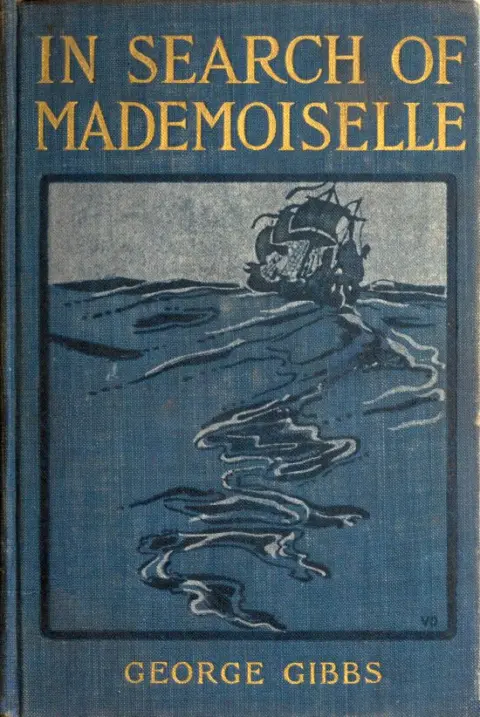
George Gibbs
BEHIND THE BOOK
This eBook is for the use of anyone anywhere in the United States and most other parts of the world at no cost and with almost no restrictions whatsoever. You may copy it, give it away or re-use it under the terms of the Project Gutenberg License included with this eBook or online at www.gutenberg.org. If you are not located in the United States, you will have to check the laws of the country where you are located before using this eBook. Read the source licence.
The original source file, including credits and licence, is retained by this library. Request an original-format copy at no charge. Please include the book title and Project Gutenberg identifier #47900.
KEEP YOUR CURIOSITY GOING
Coulson Kernahan

Maurice Baring
Frances Wright
Cécile Tormay

Frederic Jesup Stimson

W. H. P. (William Henry Pope) Jarvis