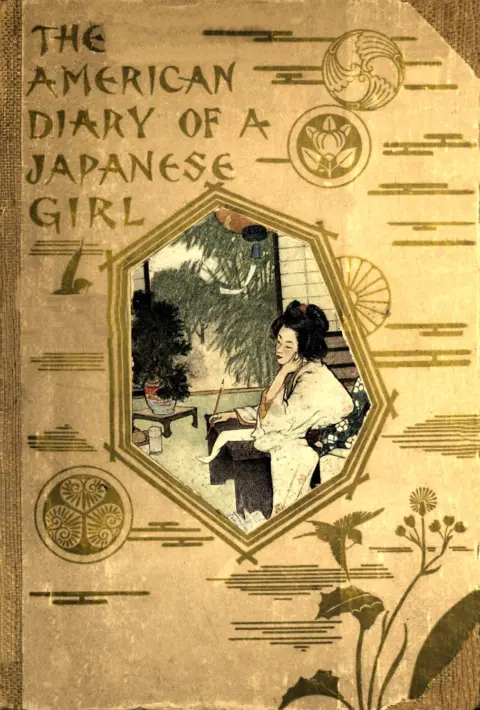
The American Diary of a Japanese Girl
Yoné Noguchi
THE CLASSIC COLLECTION · 1915
"The Spirit of Japanese Art" by Yoné Noguchi is an exploring account of Japanese art written in the early 20th century. This work serves as an insightful treatise, detailing the intricate philosophies and aesthetics of various celebrated Japanese artists, illustrating the profound connections between art, nature, and spirituality within the creative process. The author provides a rich tapestry of thoughts that traverse not only the historical context of the art movement but also the perspectives of individual artists who contributed to its legacy. At the start of the volume, Noguchi delves into the Ashikaga period of Japanese art, emphasizing the spiritual and philosophical dimensions that shaped the works of renowned artists like Sesshu. He reflects on the nature of art as a form of prayer and meditation, and the quiet, introspective life of an artist dedicated to capturing the beauty of nature. Through his observations, readers are invited on a journey that intertwines art with human experience, where simplicity and meditation give rise to profound artistic expression. The opening establishes a tone of reverence for the creative spirit of Japanese art and showcases the author's passion for connecting the East with the broader world of art appreciation.
Introduction adapted from the source catalogue; source summaries may be automatically generated.
Free to read · English · 24,903 words · No account needed
MAKE TIME FOR A GOOD BOOK
On by default. Untick to stop anonymous reading totals. Each page counts after 10 seconds in view. How this works.
Anonymous counting is on unless you have switched it off.
There are many drawbacks, as I look upon the material side, to the Western art becoming popular; for instance, our Japanese house—frail, wooden, with the light which rushes in from all sides—never gives it an appropriate place to look its best. And the heaviness of its general atmosphere does not harmonise with the simplicity that pervades the Japanese household; it always appears out of place, like a chair before the tokonoma, a holy dais. Besides, the artists cannot afford to sell their pictures cheap, not because they are good work, but because there are only a few orders for them. I believe we must undertake the responsibility of making good artists; there is no wonder that there is only poor work since our understanding of Western art is little, and we hardly try to cultivate the Western taste. If we have no great art of the Western school, as is a fact, one half the whole blame is on our shoulders.
[Sidenote: PERCEPTION OF REALISM]
Here my mind dwells in more or less voluntary manner upon the contrast with the Japanese art, while I walk through the gallery of Western art of the Taiheiyo Gakwai Club of this year in Uyeno Park. There are exhibited more than two hundred, or perhaps three hundred pieces—quite an advance in numbers over any exhibition held before; but I am not ready to say how they stand on their merit. I admit, at the outset, that the artists of the Western school have learned well how to make an arrangement no artist of the pure Japanese school ever dreamed to attain; and I will say that it is sometimes even subtle. But I have heard so much of the artistic purpose, which could be best expressed through the Western art. Are they not, on the other hand, too hasty and too direct to describe them? Some of their work most nakedly confesses their artistic inferiority to their own thought. What a poor and even vulgar handling of oil! I have no hesitation to say that there is something mistaken in their perception of realism. (Quite a number of artists in this exhibition make mistakes in this respect.) Indeed there is no word like realism (perhaps better to say naturalism) which, in Japan’s present literature, has done such real harm; it was the Russian or French literature that taught us the meaning of vulgarity, and again the artists, some artists at least, received a lesson from these writers. It is never good to see pictures overstrained. Go to the true Japanese art to learn refinement. While I admit the art of some artist which has the detail of beauty, I must tell him that reality, even when true, is not the whole thing; he should learn the art of escaping from it. That art is, in my opinion, the greatest of all arts; without it, art will never bring us the eternal and the mysterious. If you could see some work of Nakagawa or Ishii exhibited here, you would see my point, because they are somehow wrong for becoming good work, while they impress with line and colour. I spoke before of effort and pretence; such an example you will find in Hiroshi Yoshida’s canvases, big or small, most of them being nature studies. (By the way, this Yoshida is the artist who exhibited two great canvases, called “Unknown,” or “World of Cloud,” painted doubtless from Fuji mountain, overlooking the clouds at one’s feet, and “Keiryu,” or “The Valley,” at the Government exhibition with some success some years ago.) I am ready to admit that the artist has well brought out his purpose, but the true reality is not only the outside expression. His pictures are executed carefully; but what a forced art! This is the age when all Japanese artists, those of the Japanese school not excepted, are greatly cursed by objectivity. Some one has said that the Japanese dress, speaking of Japanese woman as a picture, does serve to make the distance greater. I thought in my reflection on art that so it is with the Japanese art. And again how near is Western art, at least the Japanese work of the Western school! Such a nearness to our feeling and mind, I think, is hardly the best quality of any art. I have ceased for some time to expect anything great or astonishing from Wada or Okada or even Kuroda; we most eagerly look forward to the sudden appearance of some genius at once to frighten and hypnotise and charm us and make the Western art more intimate with our minds.
Your reading position is saved on this browser. Take it to another device with a library code. Reading pages adapt to text, rather than matching a printed edition.
Yoné Noguchi
BEHIND THE BOOK
This eBook is for the use of anyone anywhere in the United States and most other parts of the world at no cost and with almost no restrictions whatsoever. You may copy it, give it away or re-use it under the terms of the Project Gutenberg License included with this eBook or online at www.gutenberg.org. If you are not located in the United States, you will have to check the laws of the country where you are located before using this eBook. Read the source licence.
The original source file, including credits and licence, is retained by this library. Request an original-format copy at no charge. Please include the book title and Project Gutenberg identifier #62252.
KEEP YOUR CURIOSITY GOING

Charles G. (Charles Griffith) Ross
Hannah Webster Foster

Emily Lawless
Edwin Hamlin Carr

Charles De Lano Hine
Andrew Ure