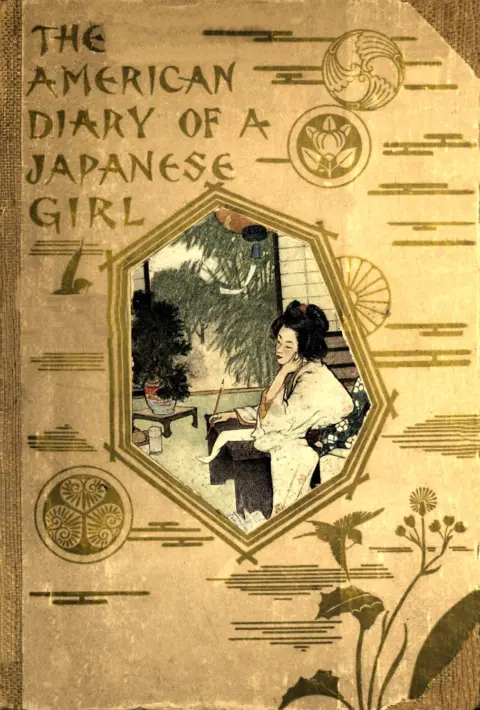
The American Diary of a Japanese Girl
Yoné Noguchi
THE CLASSIC COLLECTION · 1915
"The Spirit of Japanese Art" by Yoné Noguchi is an exploring account of Japanese art written in the early 20th century. This work serves as an insightful treatise, detailing the intricate philosophies and aesthetics of various celebrated Japanese artists, illustrating the profound connections between art, nature, and spirituality within the creative process. The author provides a rich tapestry of thoughts that traverse not only the historical context of the art movement but also the perspectives of individual artists who contributed to its legacy. At the start of the volume, Noguchi delves into the Ashikaga period of Japanese art, emphasizing the spiritual and philosophical dimensions that shaped the works of renowned artists like Sesshu. He reflects on the nature of art as a form of prayer and meditation, and the quiet, introspective life of an artist dedicated to capturing the beauty of nature. Through his observations, readers are invited on a journey that intertwines art with human experience, where simplicity and meditation give rise to profound artistic expression. The opening establishes a tone of reverence for the creative spirit of Japanese art and showcases the author's passion for connecting the East with the broader world of art appreciation.
Introduction adapted from the source catalogue; source summaries may be automatically generated.
Free to read · English · 24,903 words · No account needed
MAKE TIME FOR A GOOD BOOK
On by default. Untick to stop anonymous reading totals. Each page counts after 10 seconds in view. How this works.
Anonymous counting is on unless you have switched it off.
Yoshitoshi Tsukioka, as Kuniyoshi’s home student of high talent in his younger days, it is said, had a key to the storehouse entrusted to his care, where Kuniyoshi treasured foreign colour-prints of saints or devils strayed from a Dutch ship, Heaven’s gift most rare in those days, which made him pause a little and think about a fresh turn for his work. When we know that vulgarity always attracts us first and most, provided it is new to us, we cannot blame Yoshitoshi much when he reproduced in his work, indeed, stealing a march on his master, an immediate response to the Western art, whose secret he thought he could solve through varnishing. Doubtless it was no small discovery for Yoshitoshi. And the general public were equally simple when “Kwaidai Hyaku Senso,” his first attempt after the new departure, quite impressive as he thought, was well received by them; when he went too far in this foreign imitation through his little knowledge, as in his “Battle at Uyeno,” he varnished the whole picture. We have another instance that time is, after all, the best judge, as we know that those pictures of Yoshitoshi’s early days, when he had not yet found his own art, are most peacefully buried under the blessed oblivion and heavy dusts to-day. You cannot make an art only by wisdom and prayer, and it is better to commit youthful sin when one must, like Yoshitoshi, with his period of foreign imitation, since his later work would become intensified, chastened, and better balanced by his repentance.
[Sidenote: THE SUCCESS OF FAILURE]
To speak most strictly, Kuniyoshi should be called the last master of the Ukiyoye school, this interesting branch of Japanese art interpreting the love and romance of the populace, peculiarly developed through the general hatred of the aristocratic people; but I have reason to call Yoshitoshi Tsukioka the very last master of that school, in the same sense that we call Danjuro or Kikugoro the last actors, not less by the fact of the age, already heterogeneous, naturally weakened for holding up the old Japanese purity, against which he struggled hard to find an artistic compromise, than by his own gift. I have often thought that, if he had been born earlier, he might have proved himself another Hokusai, or, better still, if the time were still earlier, when love and sensuality were the same word in peace and prosperity, he would not have been much below Utamaro. If he failed, as indeed he failed, now, looking back from to-day, it was the failure of his age. Although it may sound paradoxical, I am pleased to say that his failure was his success, because I see his undaunted versatility glorified through his failure; he helps, more than any other artist, the historian of Japanese art to study the age psychologically—in fact, he serves him more than Hokusai or Utamaro. He is an interesting study, as I said before, as the last master, indeed, as much so as Moronobu Hishikawa as the recognised first master. I say Yoshitoshi failed, but I do not mean that he was a so-called failure in his lifetime; on the contrary, he was one of the most popular artists of modern Japan—at least, in the age of his maturity; what I should like to say is that the artistic success of one age does never mean the success of another age, and Yoshitoshi’s success is, let me say, the success of failure when we now look back upon it. I can distinctly remember even to-day my great disappointment, now almost twenty-five years ago, as a most ardent admirer of Yoshitoshi, when, appearing before the publisher’s house as early as seven o’clock the morning after I had read the announcement of his new picture of a dancer, I was told that the entire set of copies was exhausted; his popularity was something great in my boyhood’s days. It was in 1875 that he first took the public by storm with his three sheets of pictures called “Ichi Harano,” an historical thing which showed Yasumasa, a court noble, playing a bamboo flute under the moonlight, perfectly unconscious of a highwayman, Hakama Dare by name, following him, stepping softly upon the autumn grasses, ready to stab the noble with his sword. The popularity of this picture was heightened by the fact that Danjuro, the greatest tragedian of the modern Japanese stage, wanted to reproduce the pictorial effect in a play, and have Shinsuke Kawatake write up one special scene to do honour to Yoshitoshi, under the title “Ichi Harano, by Yoshitoshi, Powerful with his Brush.” It was a great honour indeed, such as no artist to-day could expect to receive. We have many occasions, on the other hand, when Yoshitoshi served the actors and his bosom friends, Danjuro and Kikugoro, to popularise their art. Since the day of the First Toyokuni, it had been the custom for the artists of this popular school to work together with the stage artists.
Your reading position is saved on this browser. Take it to another device with a library code. Reading pages adapt to text, rather than matching a printed edition.
Yoné Noguchi
BEHIND THE BOOK
This eBook is for the use of anyone anywhere in the United States and most other parts of the world at no cost and with almost no restrictions whatsoever. You may copy it, give it away or re-use it under the terms of the Project Gutenberg License included with this eBook or online at www.gutenberg.org. If you are not located in the United States, you will have to check the laws of the country where you are located before using this eBook. Read the source licence.
The original source file, including credits and licence, is retained by this library. Request an original-format copy at no charge. Please include the book title and Project Gutenberg identifier #62252.
KEEP YOUR CURIOSITY GOING

Charles G. (Charles Griffith) Ross
Hannah Webster Foster

Emily Lawless
Edwin Hamlin Carr

Charles De Lano Hine
Andrew Ure