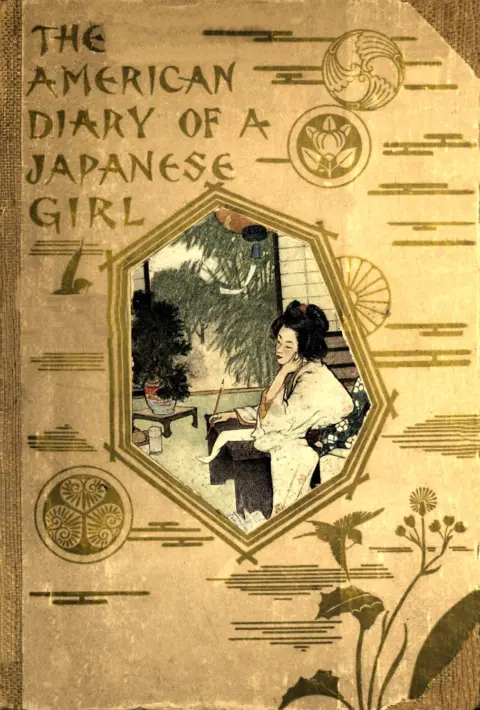
The American Diary of a Japanese Girl
Yoné Noguchi
THE CLASSIC COLLECTION · 1915
"The Spirit of Japanese Art" by Yoné Noguchi is an exploring account of Japanese art written in the early 20th century. This work serves as an insightful treatise, detailing the intricate philosophies and aesthetics of various celebrated Japanese artists, illustrating the profound connections between art, nature, and spirituality within the creative process. The author provides a rich tapestry of thoughts that traverse not only the historical context of the art movement but also the perspectives of individual artists who contributed to its legacy. At the start of the volume, Noguchi delves into the Ashikaga period of Japanese art, emphasizing the spiritual and philosophical dimensions that shaped the works of renowned artists like Sesshu. He reflects on the nature of art as a form of prayer and meditation, and the quiet, introspective life of an artist dedicated to capturing the beauty of nature. Through his observations, readers are invited on a journey that intertwines art with human experience, where simplicity and meditation give rise to profound artistic expression. The opening establishes a tone of reverence for the creative spirit of Japanese art and showcases the author's passion for connecting the East with the broader world of art appreciation.
Introduction adapted from the source catalogue; source summaries may be automatically generated.
Free to read · English · 24,903 words · No account needed
MAKE TIME FOR A GOOD BOOK
On by default. Untick to stop anonymous reading totals. Each page counts after 10 seconds in view. How this works.
Anonymous counting is on unless you have switched it off.
[Sidenote: HIS DREAM OF ENGLAND]
“Now is it settled, let us suppose,” Hara would say in the course of talk, slightly twisting his sensitive mouth, holding up straight back his well-poised head (what a philosopher’s eyes he had, gentle and clear), “that we shall go to England some time soon in the future. Yes, we shall go there even if we are not begged by Japan to leave the country. The most serious question is, however, where we shall sleep and dine. I have had enough experience of a common English boarding-house; I am haunted even to-day by the ghosts of Yorkshire pudding and cold ham. And suppose that a daughter or a son of that boarding-house might sing aloud a popular song every Saturday evening; I should like to know if there is anything more sad than that. Still, suppose that one next to you at table will ask you every evening how your work might sell; certainly that will be the moment when you think you will leave England at once for good. But it is England’s greatness that she has art appreciators as well as buyers. Oh, where is the true art appreciator in Japan, even while we admit that we have the buyers? I will take a few pictures with me when I go to England next, and show them to the right sort of people; really, truly, only London of all the cities of the world has the right sort of people in any line of profession. Besides, I should like to examine the English art again and let the people there listen to my opinion; I was not enough prepared for such a work when I went there last.”
[Sidenote: THE ENEMY IN HIS OWN SELF]
But I believe that his own self-education in art, which he most determinedly started at the National Gallery, where he was forcibly attracted by Rembrandt and Velasquez, must have been happily developed, when the same Graphic critic spoke of his “sensitive and searching eyes,” and (printing Hara’s intelligent rendering of Rembrandt’s “Jewish Merchant” on the page) said that it proved the painter was at the root of the matter, and declared that the critic had rarely seen better or more intelligent copy, and again to prove that Hara was not merely a copyist or imitator, he also reproduced on the same page his original work called “The Old Seamstress.” And I am doubly pleased to find that the same English critic mentioned him somewhere as a “keen and acute critic, but generous withal”; I was so glad to have Hara as my friend for the rare striking power of his critical enlightenment (Oh, where is another sane artist like himself?), even when he failed to make a strong impression on me with his art. It was his immediate question on his return home how to apply the technique of oil painting he learned in London to Japanese subjects; if he failed in his art, as he always believed and I often thought he did, it was from the reason, I dare think, that he had indeed too clear a view of self-appraisal or self-criticism under whose menace he always took the attitude of an outsider towards his own work. How often I wished he were wholly without that critical power, always hard to please, altogether too fastidious! His artistic ambition and aim were so absolute and most highly puritanic; as a result, he was ever so restless and sad with his art, and often even despised himself. He had a great enemy, that was no other but his own self; he was more often conquered by it than conquering it. I have never seen in my life a more sad artist with the brush, facing a canvas, than this Busho Hara. Besides, his poor health, which had been failing in the last few years, only worked to make his critical displeasure sharper and more peculiar; and he utterly lost the passion and foolishness of his younger days. How often we promised, when we parted after a long chat, which usually began with Yoshio Markino, dear friend of his and mine in London, and as a rule ended with reminiscences of our English life, that we would hereafter return to our younger age, if possible to our boys’ days, and even commit the innocent youthful sins and be happy; but when we met together again, we were the same unhappy mortals, Hara with a brush, I with a pen. He always looked comforted by my words when I told him my own tragedy and difficulties to write poetry; both of us exclaimed at once with the same breath and longed for life’s perfect freedom. How he wished to cut away from himself and bid a final farewell to many portrait commissions, and become a lone pilgrim on Nature’s great highway with only his brush and oil; that was his dream.
Your reading position is saved on this browser. Take it to another device with a library code. Reading pages adapt to text, rather than matching a printed edition.
Yoné Noguchi
BEHIND THE BOOK
This eBook is for the use of anyone anywhere in the United States and most other parts of the world at no cost and with almost no restrictions whatsoever. You may copy it, give it away or re-use it under the terms of the Project Gutenberg License included with this eBook or online at www.gutenberg.org. If you are not located in the United States, you will have to check the laws of the country where you are located before using this eBook. Read the source licence.
The original source file, including credits and licence, is retained by this library. Request an original-format copy at no charge. Please include the book title and Project Gutenberg identifier #62252.
KEEP YOUR CURIOSITY GOING

Charles G. (Charles Griffith) Ross
Hannah Webster Foster

Emily Lawless
Edwin Hamlin Carr

Charles De Lano Hine
Andrew Ure