The Happy-go-lucky Morgans
Edward Thomas
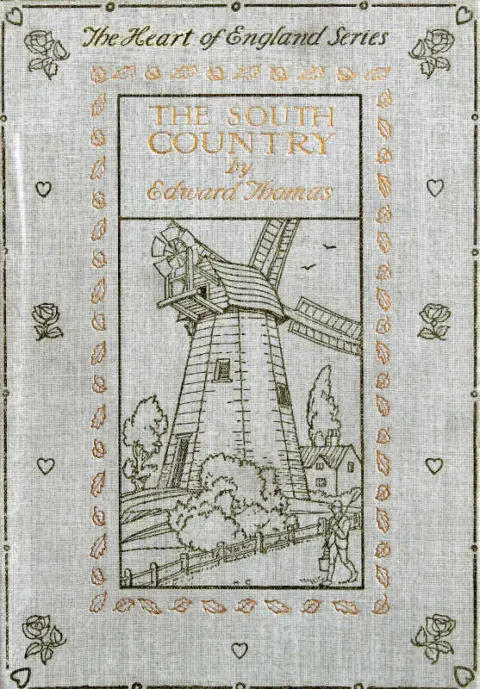
THE CLASSIC COLLECTION · 1909
"The South Country" by Edward Thomas is a reflective travelogue written in the early 20th century. In this book, the author shares his impressions from a year of wandering through the picturesque southern counties of England, particularly focusing on the beauty of Kent, Sussex, Hampshire, Wiltshire, and Cornwall. With a lyrical and poetic prose style, Thomas captures the essence of the landscapes, the changing seasons, and his deep connection to nature. The opening of the work presents a vivid and detailed description of the "South Country." It begins by establishing the geographic context, explaining the significance of this area in relation to other parts of England. Thomas expresses his preference for uninhabited paths and the tranquility found away from towns, where he can immerse himself in the natural beauty surrounding him. Through rich imagery, he reflects on the diverse landscapes, the rivers, and the flora that characterize the countryside while expressing a longing for solitude and an intimate relationship with the land. This opening sets the tone for a meditative exploration of both the physical and emotional landscapes as he embarks on his journey through the South Country.
Introduction adapted from the source catalogue; source summaries may be automatically generated.
Free to read · English · 83,338 words · No account needed
MAKE TIME FOR A GOOD BOOK
On by default. Untick to stop anonymous reading totals. Each page counts after 10 seconds in view. How this works.
Anonymous counting is on unless you have switched it off.
It is strange to pass from these monumental moors straight to the sea which records the moments, not the years or the centuries. In fine weather especially its colour--when, for example, it is faintly corrugated and of a blue that melts towards the horizon into such a hue that it is indistinguishable from the violet wall of dawn--is a perpetual astonishment on account of its unearthliness and evanescence. The mind does not at once accept the fact that here underneath our eyes is, as it were, another sky. The physical act of looking up induces a special mood of solemnity and veneration, and during the act the eyes meet with a fitting object in the stainless heavens. Looking down we are used to seeing the earth, the road, the footpath, the floor, the hearth; but when, instead, it is the sea and not any of these things, although our feet are on firm land, the solemnity is of another kind. In its anger the sea becomes humanized or animalized: we see resemblances to familiar things. There is, for instance, an hour sometimes after sunset, when the grey sky coldly lights the lines of white plumes on a steely sea, and they have an inevitable likeness to a trampling chivalry that charges upon a foe. But a calm sea is incomparable except to moods of the mind. It is then as remote from the earth and earthly things as the sky, and the remoteness is the more astonishing because it is almost within our grasp. It is no wonder that a great idea was expressed by the fortunate islands in the sea. The youthfulness, the incorruptibility of the sea, continually renewing itself, the same from generation to generation, prepares it as a fit sanctuary of the immortal dead. So at least we are apt to think at certain times, coming from the heavy, scarred, tormented earth to that immense aëry plain of peacock blue. And yet at other times that same unearthliness will suggest quite other thoughts. It has not changed and shrunken and grown like the earth; it is not sun-warmed: it is a monster that has lain unmoved by time, sleeping and moaning outside the gates within which men and animals have become what they are. Actually that cold fatal element and its myriad population without a sound brings a wistfulness into the mind as if it could feel back and dimly recall the dawn of time when the sea was incomprehensible and impassable, when the earth had but lately risen out of the waters and was yet again to descend beneath: it becomes a type of the waste where everything is unknown or uncertain except death, pouring into the brain the thoughts that men have had on looking out over untrodden mountain, forest, swamp, in the drizzling dawn of the world. The sea is exactly what it was when mountain, forest, swamp were imperturbable enemies, and the sight of it restores the ancient fear. I remember one dawn above all others when this restoration was complete. When it was yet dark the wind rose gustily under a low grey sky and a lark sang amidst the moan of gorse and the creak of gates and the deeply-taken breath of the tide at the full. Nor was it yet light when the gulls began to wheel and wind and float with a motion like foam on a whirlpool or interwoven snow. They wheeled about the masts of fishing-boats that nodded and kissed and crossed in a steep cove of crags whose black edges were slavered by the foam of the dark sea; and there were no men among the boats or about the grey houses that looked past the walls of the cove to the grim staircase and sea-doors of a black headland, whose perpendicular rocks stood up far out of the reach of the wings fashioned in the likeness of gigantic idols. The higher crags were bushy and scaly with lichen, and they were cushioned upon thrift and bird’s-foot trefoil and white bladder campion. It was a bristling sea, not in the least stormy, but bristling, dark and cold through the slow colourless dawn, dark and cold and immense; and at the edge of it the earth knelt, offering up the music of a small flitting bird and the beauty of small flowers, white and gold, to those idols. They were terrible enough. But the sea was more terrible; for it was the god of whom those rocks were the poor childish images, and it seemed that the god had just then disclosed his true nature and hence the pitiful loveliness of the flowers, the pitiful sweetness of the bird that sang among the rocks at the margin of the kind earth.
Your reading position is saved on this browser. Take it to another device with a library code. Reading pages adapt to text, rather than matching a printed edition.
Edward Thomas
Edward Thomas

Edward Thomas
Edward Thomas
BEHIND THE BOOK
This eBook is for the use of anyone anywhere in the United States and most other parts of the world at no cost and with almost no restrictions whatsoever. You may copy it, give it away or re-use it under the terms of the Project Gutenberg License included with this eBook or online at www.gutenberg.org. If you are not located in the United States, you will have to check the laws of the country where you are located before using this eBook. Read the source licence.
The original source file, including credits and licence, is retained by this library. Request an original-format copy at no charge. Please include the book title and Project Gutenberg identifier #60760.
KEEP YOUR CURIOSITY GOING
Wilfrid Scawen Blunt
Wilfrid Scawen Blunt

E. W. (Edgar Watson) Howe
Cécile Tormay

Moritz Busch
John L. Ransom