The Happy-go-lucky Morgans
Edward Thomas
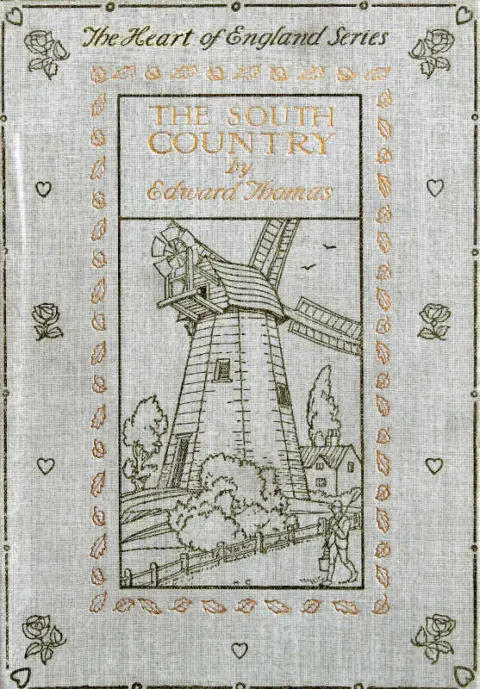
THE CLASSIC COLLECTION · 1909
"The South Country" by Edward Thomas is a reflective travelogue written in the early 20th century. In this book, the author shares his impressions from a year of wandering through the picturesque southern counties of England, particularly focusing on the beauty of Kent, Sussex, Hampshire, Wiltshire, and Cornwall. With a lyrical and poetic prose style, Thomas captures the essence of the landscapes, the changing seasons, and his deep connection to nature. The opening of the work presents a vivid and detailed description of the "South Country." It begins by establishing the geographic context, explaining the significance of this area in relation to other parts of England. Thomas expresses his preference for uninhabited paths and the tranquility found away from towns, where he can immerse himself in the natural beauty surrounding him. Through rich imagery, he reflects on the diverse landscapes, the rivers, and the flora that characterize the countryside while expressing a longing for solitude and an intimate relationship with the land. This opening sets the tone for a meditative exploration of both the physical and emotional landscapes as he embarks on his journey through the South Country.
Introduction adapted from the source catalogue; source summaries may be automatically generated.
Free to read · English · 83,338 words · No account needed
MAKE TIME FOR A GOOD BOOK
On by default. Untick to stop anonymous reading totals. Each page counts after 10 seconds in view. How this works.
Anonymous counting is on unless you have switched it off.
Of all the rocky land, of the sapphire sea white with quiet foam, the barrows are masters. The breaking away of the rock has brought them nearer to the sea as it has annihilated some and cut off the cliff-ways in mid-career. They stand in the unenclosed waste and are removed from all human uses and from most wayfaring. Thus they share the sublimity of beacons and are about to show that tombs also have their deaths. Linnet and stonechat and pipit seem to attend upon them, with pretty voices and motions and a certain ghastliness, as of shadows, given to their cheerful and sudden flittings by the solemn neighbourhood. But most of their hold upon the spirit they owe to their powerful suggestion that here upon the high sea border was once lived a bold proud life, like that of Beowulf, whose words, when he was dying from the wounds of his last victory, were: “Bid the warriors raise a funeral mound to flash with fire on a promontory above the sea, that it may stand high and be a memorial by which my people shall remember me, and seafarers driving their tall ships through the mist of the sea shall say: ‘Beowulf’s Mound.’”
In Cornwall as in Wales, these monuments are the more impressive, because the earth, wasting with them and showing her bones, takes their part. There are days when the age of the Downs, strewn with tumuli and the remnants of camp and village, is incredible; or rather they seem in the course of long time to have grown smooth and soft and kind, and to be, like a rounded languid cloud, an expression of Earth’s summer bliss of afternoon. But granite and slate and sandstone jut out, and in whatsoever weather speak rather of the cold, drear, hard, windy dawn. Nothing can soften the lines of Trendreen or Brown Willy or Carn Galver against the sky. The small stone-hedged ploughlands amidst brake and gorse do but accentuate the wildness of the land from which they have been won. The deserted mines are frozen cries of despair as if they had perished in conflict with the waste; and in a few years their chimneys standing amidst rotted woodwork, the falling masonry, the engine rusty, huge and still (the abode of rabbits, and all overgrown with bedstraw, the stern thistle and wizard henbane) are in keeping with the miles of barren land, littered with rough silvered stones among heather and furze, whose many barrows are deep in fern and bramble and foxglove. The cotton grass raises its pure nodding white. The old roads dive among still more furze and bracken and bramble and foxglove, and on every side the land grows no such crop as that of grey stones. Even in the midst of occasional cornfield or weedless pasture a long grey upright stone speaks of the past. In many places men have set up these stones, roughly squaring some of them, in the form of a circle or in groups of circles--and over them beats the buzzard in slow hesitating and swerving flight. In one place the work of Nature might be mistaken for that of man. On a natural hillock stands what appears to be the ruin of an irregularly heaped wall of grey rock, roughened by dark-grey lichen, built of enormous angular fragments like the masonry of a giant’s child. Near at hand, bracken, pink stonecrop, heather and bright gold tormentil soften it; but at a distance it stands black against the summer sky, touched with the pathos of man’s handiwork overthrown, yet certainly an accident of Nature. It commands Cape Cornwall and the harsh sea, and St. Just with its horned church tower. On every hand lie cromlech, camp, circle, hut and tumulus of the unwritten years. They are confused and mingled with the natural litter of a barren land. It is a silent Bedlam of history, a senseless cemetery or museum, amidst which we walk as animals must do when they see those valleys full of skeletons where their kind are said to go punctually to die. There are enough of the dead; they outnumber the living; and there those trite truths burst with life and drum upon the tympanum with ambiguous fatal voices. At the end of this many-barrowed moor, yet not in it, there is a solitary circle of grey stones, where the cry of the past is less vociferous, less bewildering, than on the moor itself, but more intense. Nineteen tall, grey stones stand round a taller, pointed one that is heavily bowed, amidst long grass and bracken and furze. A track passes close by, but does not enter the circle; the grass is unbent except by the weight of its bloom. It bears a name that connects it with the assembling and rivalry of the bards of Britain. Here, under the sky, they met, leaning upon the stones, tall, fair men of peace, but half-warriors, whose songs could change ploughshare into sword. Here they met, and the growth of the grass, the perfection of the stones (except that one stoops as with age), and the silence, suggest that since the last bard left it, in robe of blue or white or green--the colours of sky and cloud and grass upon this fair day--the circle has been unmolested, and the law obeyed which forbade any but a bard to enter it. Sky-blue was the colour of a chief bard’s robe, emblematic of peace and heavenly calm, and of unchangeableness. White, the colour of the Druid’s dress, was the emblem of light, and of its correlatives, purity of conduct, wisdom, and piety. Green was the colour of the youthful ovate’s robe, for it was the emblem of growth. Their uniformity of colour signified perfect truth. And the inscription upon the chair of the bards of Beisgawen was, “Nothing is that is not for ever and ever.” Blue and white and green, peace and light and growth--“Nothing is that is not for ever and ever”--these things and the blue sky, the white, cloudy hall of the sun, and the green bough and grass, hallowed the ancient stones, and clearer than any vision of tall bards in the morning of the world was the tranquil delight of being thus “teased out of time” in the presence of this ancientness.
Your reading position is saved on this browser. Take it to another device with a library code. Reading pages adapt to text, rather than matching a printed edition.
Edward Thomas
Edward Thomas
Edward Thomas
Edward Thomas
BEHIND THE BOOK
This eBook is for the use of anyone anywhere in the United States and most other parts of the world at no cost and with almost no restrictions whatsoever. You may copy it, give it away or re-use it under the terms of the Project Gutenberg License included with this eBook or online at www.gutenberg.org. If you are not located in the United States, you will have to check the laws of the country where you are located before using this eBook. Read the source licence.
The original source file, including credits and licence, is retained by this library. Request an original-format copy at no charge. Please include the book title and Project Gutenberg identifier #60760.
KEEP YOUR CURIOSITY GOING
Wilfrid Scawen Blunt
Wilfrid Scawen Blunt

E. W. (Edgar Watson) Howe
Cécile Tormay

Moritz Busch
John L. Ransom