The Happy-go-lucky Morgans
Edward Thomas
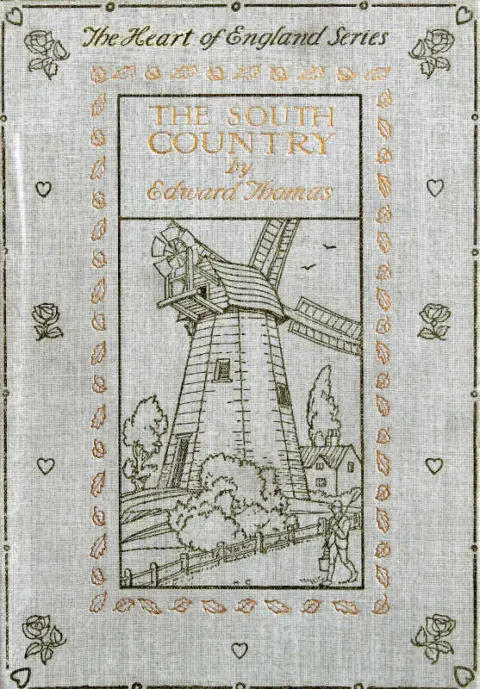
THE CLASSIC COLLECTION · 1909
"The South Country" by Edward Thomas is a reflective travelogue written in the early 20th century. In this book, the author shares his impressions from a year of wandering through the picturesque southern counties of England, particularly focusing on the beauty of Kent, Sussex, Hampshire, Wiltshire, and Cornwall. With a lyrical and poetic prose style, Thomas captures the essence of the landscapes, the changing seasons, and his deep connection to nature. The opening of the work presents a vivid and detailed description of the "South Country." It begins by establishing the geographic context, explaining the significance of this area in relation to other parts of England. Thomas expresses his preference for uninhabited paths and the tranquility found away from towns, where he can immerse himself in the natural beauty surrounding him. Through rich imagery, he reflects on the diverse landscapes, the rivers, and the flora that characterize the countryside while expressing a longing for solitude and an intimate relationship with the land. This opening sets the tone for a meditative exploration of both the physical and emotional landscapes as he embarks on his journey through the South Country.
Introduction adapted from the source catalogue; source summaries may be automatically generated.
Free to read · English · 83,338 words · No account needed
MAKE TIME FOR A GOOD BOOK
On by default. Untick to stop anonymous reading totals. Each page counts after 10 seconds in view. How this works.
Anonymous counting is on unless you have switched it off.
Some day there will be a history of England written from the point of view of one parish, or town, or great house. Not until there is such a history will all our accumulations of information be justified. It will begin with a geological picture, something large, clear, architectural, not a mass of insignificant names. It must be imaginative: it might, perhaps, lean sometimes upon Mr. Doughty’s Dawn in Britain. The peculiar combination of soil and woodland and water determines the direction and position and importance of the ancient trackways; it will determine also the position and size of the human settlements. The early marks of these--the old flint and metal implements, the tombs, the signs of agriculture, the encampments, the dwellings--will have to be clearly described and interpreted. Folk-lore, legend, place-names must be learnedly, but bravely and humanly used, so that the historian who has not the extensive sympathy and imagination of a great novelist will have no chance of success. What endless opportunities will he have for really giving life to past times in such matters as the line made by the edge of an old wood with the cultivated land, the shapes of the fields, with their borders of streams or hedge or copse or pond or wall or road, the purpose and interweaving of the roads and footpaths that suggest the great permanent thoughts and the lesser thoughts and dreams of the brain.... As the historic centuries are reached, the action of great events, battles, laws, roads, invasions, upon the parish--and of the parish upon them--must be shown. Architecture, with many of its local characteristics still to be traced, will speak as a voice out of the stones of castle, church, manor, farm, barn and bridge. The birds and beasts cannot be left out. The names of the local families--gentle and simple--what histories are in them, in the curt parish registers, in tombstones, in the names of fields and houses and woods. Better a thousand errors so long as they are human than a thousand truths lying like broken snail-shells round the anvil of a thrush. If only those poems which are place-names could be translated at last, the pretty, the odd, the romantic, the racy names of copse and field and lane and house. What a flavour there is about the Bassetts, the Boughtons, the Worthys, the Tarrants, Winterbournes, Deverills, Manningfords, the Suttons: what goodly names of the South Country--Woodmansterne, Hollingbourne, Horsmonden, Wolstanbury, Brockenhurst, Caburn, Lydiard Tregoze, Lydiard Millicent, Clevancy, Amesbury, Amberley (I once tried to make a beautiful name and in the end it was Amberley, in which Time had forestalled me); what sweet names Penshurst, Frensham, Firle, Nutley, Appleshaw, Hambledon, Cranbrook, Fordingbridge, Melksham, Lambourn, Draycot, Buscot, Kelmscot, Yatton, Yalding, Downe, Cowden, Iping, Cowfold, Ashe, Liss.... Then there are the histories of roads. Every traveller in Hampshire remembers the road that sways with airy motion and bird-like curves down from the high land of clay and flint through the chalk to the sand and the river. It doubles round the head of a coombe, and the whole descent is through beech woods uninterrupted and all but impenetrable to the eye above or below except where once or twice it looks through an arrow slit to the blue vale and the castled promontory of Chanctonbury twenty miles south-east. As the road is a mere ledge on the side of a very steep hill the woods below it hurry down to a precipitous pit full of the glimmering, trembling and murmuring of innumerable leaves and no sight or sound of men. It is said to have been made more than half a century ago to take the place of the rash straight coach road which now enters it near its base. A deeply-worn, narrow and disused track joining it more than half-way down suggests that the lower part was made by the widening of an old road; but much of the upper half is new. Certainly the road as it now is, broad and gently bending round the steep coombe, is new, and it was made at the expense of the last of a family which had long owned the manor house near the entrance of the coombe. His were all the hanging beech woods--huge as the sky--upon the hill, and through them the road-makers conducted this noble and pleasant way. But near the top they deviated by a few yards into another estate. The owner would not give way. A lawsuit was begun, and it was not over when the day came for the road to be open for traffic according to the contract or, if not, to pass out of the defaulter’s hands. The day passed; the contract was broken; the speculation had failed, and the tolls would never fill the pockets of the lord of the manor. He was ruined, and left his long white house by the rivulet and its chain of pools, his farms and cottages, his high fruit walls, his uncounted beeches, the home of a hundred owls, his Spanish chestnuts above the rocky lane, his horse-chestnut and sycamore stately in groups, his mighty wych elms, his apple trees and all their mistletoe, his walnut trees, and the long bay of sky that was framed by his tall woods east and north and west.
Your reading position is saved on this browser. Take it to another device with a library code. Reading pages adapt to text, rather than matching a printed edition.
Edward Thomas
Edward Thomas

Edward Thomas
Edward Thomas
BEHIND THE BOOK
This eBook is for the use of anyone anywhere in the United States and most other parts of the world at no cost and with almost no restrictions whatsoever. You may copy it, give it away or re-use it under the terms of the Project Gutenberg License included with this eBook or online at www.gutenberg.org. If you are not located in the United States, you will have to check the laws of the country where you are located before using this eBook. Read the source licence.
The original source file, including credits and licence, is retained by this library. Request an original-format copy at no charge. Please include the book title and Project Gutenberg identifier #60760.
KEEP YOUR CURIOSITY GOING
Wilfrid Scawen Blunt
Wilfrid Scawen Blunt

E. W. (Edgar Watson) Howe
Cécile Tormay

Moritz Busch
John L. Ransom