THE CLASSIC COLLECTION✦The Life of Clara Barton, Founder of the American Red Cross (Vol. 2 of 2)CLASSIC FREE BOOKS
The Life of Clara Barton, Founder of the American Red Cross (Vol. 2 of 2)
William E. (William Eleazar) Barton
THE CLASSIC COLLECTION · 1920
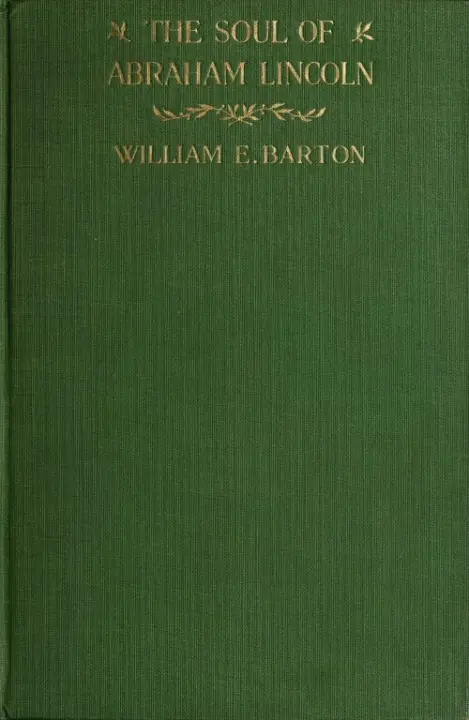
"The Soul of Abraham Lincoln" by William E. Barton is a historical account written in the early 20th century. This work explores the evolution of Abraham Lincoln's religious beliefs, delving into the conflicting testimonies and diverse interpretations of his faith throughout various biographical works. The author aims to offer a comprehensive analysis, drawing on a wealth of evidence and contextualizing Lincoln's spirituality within the historical framework of his life. The opening of this volume sets the stage for a deep examination of the contradictory evidence surrounding Lincoln's religious views. Barton discusses how many biographies of Lincoln have presented radically different portrayals of his spiritual faith, some claiming he was an infidel while others argue for his strong Christian beliefs. The author outlines the intent of the book: to analyze this conflicting testimony critically and present a more nuanced understanding of Lincoln's spiritual life while illustrating how it evolved over time. The preface emphasizes the necessity of a dispassionate study amid a politically charged and often sensationalized landscape of Lincoln's religious beliefs.
Introduction adapted from the source catalogue; source summaries may be automatically generated.
Free to read · English · 138,937 words · No account needed
MAKE TIME FOR A GOOD BOOK
On by default. Untick to stop anonymous reading totals. Each page counts after 10 seconds in view. How this works.
Anonymous counting is on unless you have switched it off.
Lincoln, Abraham, sixteenth president of the United States;
periods of his life, 29;
birth of, boyhood, 30 seq.;
schools and teachers, 30-33;
early religious privileges, 33 seq.;
early influence Baptist, 34 seq.;
migration to Illinois, 51;
on flat-boat, 51;
at New Salem, 51 seq.;
studies grammar, 51;
works on flat-boat, 51;
service in Blackhawk War, 52;
candidate for legislature, 52;
keeper of post office, 52;
love affairs, 52-53;
influenced by life in New Salem, 54;
did not drink or swear, 55;
Herndon's statement of his religion, 61;
known as "Honest Abe," 70;
removal to Springfield, 71;
his partnerships, 71;
beginnings of his interest in slavery, 72;
early orations, 72;
important cases, 73;
marriage, 73;
election as president, 73;
his children, 75;
death of Eddie, 75;
letter to dying father, 77;
comforts a dying woman, 78;
his stories, 80;
religious life in Springfield, 81;
development of political ideals, 82;
in Armstrong trial, 83;
ethical aspects of the slavery issue, 83, 268;
farewell at Springfield, 84;
inauguration as President, 86;
outline of his administration, assassination, and death, 87;
death of Willie, 95;
why he freed the slaves, 96;
domestic affairs, 106;
read "Artemus Ward," 111;
the charges in Lamon's biography, 130-134;
his "Burnt Book," 146-155;
reads "The Christian's Defence," 156 seq.;
pronounces it unanswerable, 164;
reads "Vestiges of Creation," 166-171;
reads Channing and Parker, 172 seq.;
erased words in Greek exercise book, 183;
the Chittenden interview, 188 seq.;
the Chiniquy interview, 188 seq.;
alleged visit to Beecher, 198 seq.;
the Sickles interview, 201 seq.;
life in the White House, 203 seq.;
sorrow at death of Willie, 204;
alleged statement, "I do love Jesus," 208;
religious character of his proclamations, 210-221;
not an atheist, 225;
not a Roman Catholic, 231;
not a spiritualist, 232;
not addressed as "Abe," 233;
believed in dreams and signs, 233;
not a Quaker, 236;
questioned supernatural birth of Jesus, but not a Unitarian, 238;
denied eternal punishment, but not a Universalist, 238;
not a Methodist, 240;
not a Freemason, 242;
attended a revival, 244;
why he did not join the church, 244 seq.;
the creed he could have accepted, 245;
lacked some of the finer feelings, 246;
his dress, 247;
possessed an innate courtesy, 247-249;
helps move a piano, 250;
morbidly cautious, 252;
breadth of his religious nature, 253;
not symmetrical in his development, 254;
essentially Calvinistic, 254, 271;
his capacity for obstinacy, 255;
his ability to evade an issue, 257;
his periods of mental uncertainty, 258;
his literary style, 261;
use of quotations, 262;
seldom told stories in speeches, 263;
thought and moved slowly, 264;
his characteristic pioneer trails, 265;
an embodiment of contrasts, 266;
neutral and spiritual evolution, 267;
interview with Chicago ministers, 268-269;
his changed style of oratory, 270;
his religious development, 270-275;
his belief in universal salvation, 272;
in immorality, 273, 286;
his references to God, 273-274;
his belief in the Bible, 274-275;
in Jesus Christ, 275-277;
his question of the supernatural birth, 277-278;
in divine destiny and prayer, 280-281;
his promise to God, 281-286;
in future but not endless punishment, 287;
not a theologian, 289;
his quotation from Baxter, 289;
materials for his creed, 291-299;
his creed in his own words, 300.
Lincoln, Edward Baker, son of the
President, birth and death, 75, 258.
Your reading position is saved on this browser. Take it to another device with a library code. Reading pages adapt to text, rather than matching a printed edition.
William E. (William Eleazar) Barton
William E. (William Eleazar) Barton
William E. (William Eleazar) Barton
BEHIND THE BOOK
This eBook is for the use of anyone anywhere in the United States and most other parts of the world at no cost and with almost no restrictions whatsoever. You may copy it, give it away or re-use it under the terms of the Project Gutenberg License included with this eBook or online at www.gutenberg.org. If you are not located in the United States, you will have to check the laws of the country where you are located before using this eBook. Read the source licence.
The original source file, including credits and licence, is retained by this library. Request an original-format copy at no charge. Please include the book title and Project Gutenberg identifier #60996.
KEEP YOUR CURIOSITY GOING

David Patterson (Spirit) Hatch

David Patterson (Spirit) Hatch

David Patterson (Spirit) Hatch
Cécile Tormay

Moritz Busch
John L. Ransom