THE CLASSIC COLLECTION✦The Life of Clara Barton, Founder of the American Red Cross (Vol. 2 of 2)CLASSIC FREE BOOKS
The Life of Clara Barton, Founder of the American Red Cross (Vol. 2 of 2)
William E. (William Eleazar) Barton
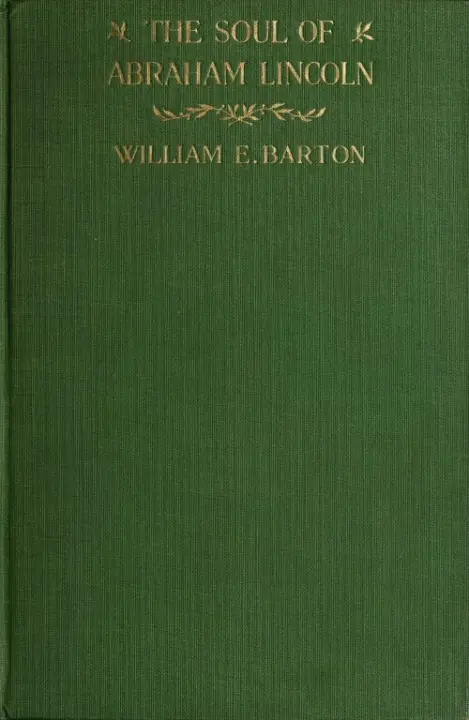
THE CLASSIC COLLECTION · 1920
"The Soul of Abraham Lincoln" by William E. Barton is a historical account written in the early 20th century. This work explores the evolution of Abraham Lincoln's religious beliefs, delving into the conflicting testimonies and diverse interpretations of his faith throughout various biographical works. The author aims to offer a comprehensive analysis, drawing on a wealth of evidence and contextualizing Lincoln's spirituality within the historical framework of his life. The opening of this volume sets the stage for a deep examination of the contradictory evidence surrounding Lincoln's religious views. Barton discusses how many biographies of Lincoln have presented radically different portrayals of his spiritual faith, some claiming he was an infidel while others argue for his strong Christian beliefs. The author outlines the intent of the book: to analyze this conflicting testimony critically and present a more nuanced understanding of Lincoln's spiritual life while illustrating how it evolved over time. The preface emphasizes the necessity of a dispassionate study amid a politically charged and often sensationalized landscape of Lincoln's religious beliefs.
Introduction adapted from the source catalogue; source summaries may be automatically generated.
Free to read · English · 138,937 words · No account needed
MAKE TIME FOR A GOOD BOOK
On by default. Untick to stop anonymous reading totals. Each page counts after 10 seconds in view. How this works.
Anonymous counting is on unless you have switched it off.
WE do not know of any other books which deserve to be classed with the two we have been considering in their relation to the formation of Mr. Lincoln's religious ideas; but our inquiry is at a point where it will be instructive to learn of any collateral influence which at this period, the period of the 50's, after the death of Eddie, and before his election as President, helped to give shape to his convictions.
Mr. Lincoln did not unite with Dr. Smith's church. It is difficult to think that it would have been possible for him to have done so. Old-school Calvinism had its permanent influence upon him through his Baptist antecedents, but while that of Dr. Smith came to him most opportunely, it did not wholly meet his spiritual requirements.
For many years Herndon was in regular correspondence with Theodore Parker. They agreed in their view of the slavery question, and had much in common in their religion. Herndon had Parker's theological books, and Lincoln read them, not very thoroughly, perhaps, but with interest.
About the same time, Mr. Jesse W. Fell, for whom he wrote the first sketch of his life, presented him with the works of William E. Channing.
When Herndon was gathering material to confute Dr. Reed, he assembled very nearly everything that seemed to prove that Lincoln was not orthodox, however far short it fell of proving him an infidel. Among the rest he interviewed Fell, and from his statements made up this report, which appeared in Lamon's book, and subsequently in Herndon's:
"Mr. Jesse W. Fell of Illinois, who had the best opportunities of knowing Mr. Lincoln intimately, makes the following statement of his religious opinions, derived from repeated conversations with him on the subject:
"'Though everything relating to the character and history of this extraordinary personage is of interest, and should be fairly stated to the world, I enter upon the performance of this duty--for so I regard it--with some reluctance, arising from the fact, that, in stating my convictions on the subject, I must necessarily place myself in opposition to quite a number who have written on this topic before me, and whose views largely preoccupy the public mind. This latter fact, whilst contributing to my embarrassment on this subject, is, perhaps, the strongest reason, however, why the truth in this matter should be fully disclosed; and I therefore yield to your request. If there were any traits of character that stood out in bold relief in the person of Mr. Lincoln, they were those of truth and candor. He was utterly incapable of insincerity, or professing views on this or any other subject he did not entertain. Knowing such to be his true character, that insincerity, much more duplicity, were traits wholly foreign to his nature, many of his old friends were not a little surprised at finding, in some of the biographies of this great man, statements concerning his religious opinions so utterly at variance with his known sentiments. True, he may have changed or modified those sentiments after his removal from among us, though this is hardly reconcilable with the history of the man, and his entire devotion to public matters during his four years' residence at the national capital. It is possible, however, that this may be the proper solution of this conflict of opinions; or, it may be, that, with no intention on the part of anyone to mislead the public mind, those who have represented him as believing in the popular theological views of the times may have misapprehended him, as experience shows to be quite common where no special effort has been made to attain critical accuracy on a subject of this nature. This is the more probable from the well-known fact, that Mr. Lincoln seldom communicated to anyone his views on this subject. But, be this as it may, I have no hesitation whatever in saying, that, whilst he held many opinions in common with the great mass of Christian believers, he did not believe in what are regarded as the orthodox or evangelical views of Christianity.
Your reading position is saved on this browser. Take it to another device with a library code. Reading pages adapt to text, rather than matching a printed edition.
William E. (William Eleazar) Barton
William E. (William Eleazar) Barton
William E. (William Eleazar) Barton
BEHIND THE BOOK
This eBook is for the use of anyone anywhere in the United States and most other parts of the world at no cost and with almost no restrictions whatsoever. You may copy it, give it away or re-use it under the terms of the Project Gutenberg License included with this eBook or online at www.gutenberg.org. If you are not located in the United States, you will have to check the laws of the country where you are located before using this eBook. Read the source licence.
The original source file, including credits and licence, is retained by this library. Request an original-format copy at no charge. Please include the book title and Project Gutenberg identifier #60996.
KEEP YOUR CURIOSITY GOING

David Patterson (Spirit) Hatch

David Patterson (Spirit) Hatch

David Patterson (Spirit) Hatch
Cécile Tormay

Moritz Busch
John L. Ransom