THE CLASSIC COLLECTION✦The Life of Clara Barton, Founder of the American Red Cross (Vol. 2 of 2)CLASSIC FREE BOOKS
The Life of Clara Barton, Founder of the American Red Cross (Vol. 2 of 2)
William E. (William Eleazar) Barton
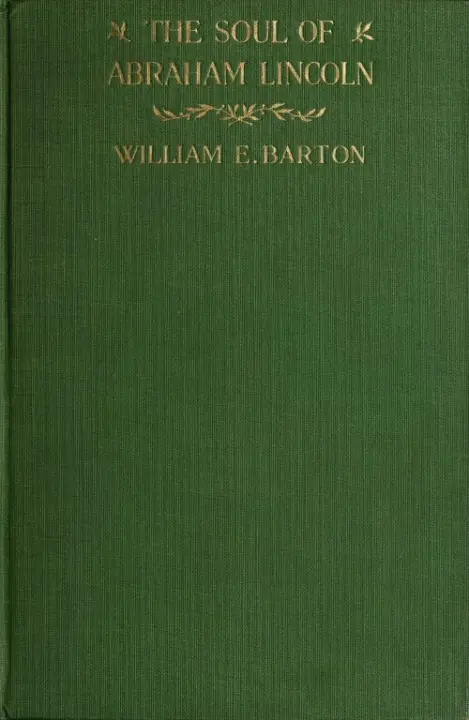
THE CLASSIC COLLECTION · 1920
"The Soul of Abraham Lincoln" by William E. Barton is a historical account written in the early 20th century. This work explores the evolution of Abraham Lincoln's religious beliefs, delving into the conflicting testimonies and diverse interpretations of his faith throughout various biographical works. The author aims to offer a comprehensive analysis, drawing on a wealth of evidence and contextualizing Lincoln's spirituality within the historical framework of his life. The opening of this volume sets the stage for a deep examination of the contradictory evidence surrounding Lincoln's religious views. Barton discusses how many biographies of Lincoln have presented radically different portrayals of his spiritual faith, some claiming he was an infidel while others argue for his strong Christian beliefs. The author outlines the intent of the book: to analyze this conflicting testimony critically and present a more nuanced understanding of Lincoln's spiritual life while illustrating how it evolved over time. The preface emphasizes the necessity of a dispassionate study amid a politically charged and often sensationalized landscape of Lincoln's religious beliefs.
Introduction adapted from the source catalogue; source summaries may be automatically generated.
Free to read · English · 138,937 words · No account needed
MAKE TIME FOR A GOOD BOOK
On by default. Untick to stop anonymous reading totals. Each page counts after 10 seconds in view. How this works.
Anonymous counting is on unless you have switched it off.
Hanks, Dennis, on Lincoln's youth, 38, 49.
Hanks, John, on Lincoln's impression of slavery, 96.
Hannah, William H., on Lincoln's faith, 287.
Harnett, Jonathan, 138, 349.
"Harp, French," 246.
Hay, John, author of "Life of Lincoln," 27.
Hazel, Caleb, teacher of Lincoln, 30.
Head, Rev. Jesse, 240.
Herndon, W. D., discussed religion with Lincoln, 132, 148.
Herndon, William H., author of "Life of Lincoln," 20, 24, 26, 27, 35;
says Lincoln was a fatalist, 50;
an infidel, 61-62;
his visit to site of New Salem, 62;
his lectures on Lincoln 62, 142-143;
his partnership with Lincoln, 71;
on Lincoln's letter to his father, 77;
letter from Nicolay, 91;
controversy with Bateman, 121 seq.;
notes of his five interviews, 125;
writes a life of Lincoln, 140-145;
no friend of Mrs. Lincoln, 140;
the Abbott letter, 142;
his letter to Dr. Smith, 141;
reply to Reed lecture, 141;
regretted sale of papers to Lamon, 143;
revised edition of his work, 144;
personal habits and religion, 144-145;
never saw Lincoln's "Burnt Book," 148;
correspondence with Bartlett, 264-267;
attempts "to put at rest forever" the charge that Lincoln was an
atheist, 279;
affirms Lincoln's faith in immortality, 286;
reads reply to, 314 seq.;
letters concerning Lincoln's religion, 336-340.
Herrick, Robert, 263.
Hill, Samuel, burns Lincoln manuscript, 146-155.
Hodgenville, Kentucky, a Baptist settlement, 34.
Hodges, A. G., Lincoln's letter to, 296.
Holland, Josiah G., author of "Life of Lincoln," 26; asymmetry of Lincoln's life, 102 seq.; story of the Bateman incident, 115-117; prints the Reed lecture in Scribner's magazine, 135, 328-329, 337.
Holmes, O. W., 167.
Holt, Dr. E. E., on Lincoln's dream, 235.
Howells, William D., "Life of Lincoln," 25.
Illinois College, 67.
Illinois, twin born with Lincoln, 30.
Insanity, Lincoln's approach to, 252.
Irwin, B. F., on Lincoln's religion, 136, 287, 341.
Jacquess, Col. James F., story of Lincoln's conversion, 241, 309 seq.
Jacquess, William B., 309.
Johnny Kongapod, 49, 271.
Johns, Mrs. Jane Martin, reminiscences of Lincoln, 248 seq.
Johnson, John D., Lincoln's stepbrother, 77.
Johnson, William J., author of "Lincoln the Christian," 48; on the Beecher incident, 199, 235.
Kansas, Lincoln visits, 73.
Keckley, Elizabeth, 203-204.
Keys, I. W., loaned Lincoln "Vestiges of Creation," 277.
Kirkham's Grammar, studied by Lincoln, 51, 67, 185.
Knox College, 125.
Krone, David, 249.
Lamon, Ward Hill, author of "Life of Lincoln," 26, 47, 52;
affirms Lincoln permitted himself to be misrepresented, 76;
quotes Herndon on Lincoln's letter to his father, 78;
answer to Holland, 117-120;
his relations with Lincoln, 128;
his life of Lincoln an unfinished fragment, 128;
the controversy growing out of his book, 128-134;
Black, the author, 129;
his recollections, 134;
on Lincoln's "Burnt Book," 146;
affirms Lincoln's faith essentially that of Parker, 279;
reads reply to, 314 seq.
Lewis, Thomas, 158-163, 256, 325, 359.
Your reading position is saved on this browser. Take it to another device with a library code. Reading pages adapt to text, rather than matching a printed edition.
William E. (William Eleazar) Barton
William E. (William Eleazar) Barton
William E. (William Eleazar) Barton
BEHIND THE BOOK
This eBook is for the use of anyone anywhere in the United States and most other parts of the world at no cost and with almost no restrictions whatsoever. You may copy it, give it away or re-use it under the terms of the Project Gutenberg License included with this eBook or online at www.gutenberg.org. If you are not located in the United States, you will have to check the laws of the country where you are located before using this eBook. Read the source licence.
The original source file, including credits and licence, is retained by this library. Request an original-format copy at no charge. Please include the book title and Project Gutenberg identifier #60996.
KEEP YOUR CURIOSITY GOING

David Patterson (Spirit) Hatch

David Patterson (Spirit) Hatch

David Patterson (Spirit) Hatch
Cécile Tormay

Moritz Busch
John L. Ransom