
The Story of a Governess
Mrs. (Margaret) Oliphant
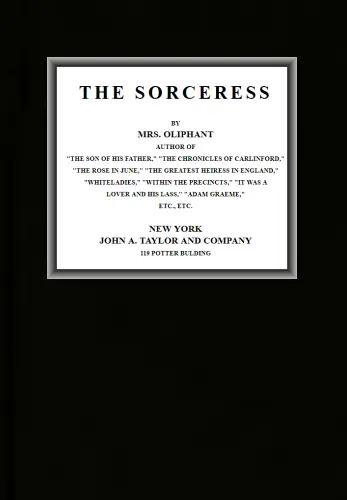
THE CLASSIC COLLECTION · 1893
"The Sorceress" by Mrs. Oliphant is a novel written in the late 19th century. The story revolves around the Kingsward family, particularly focusing on the youthful and spirited Bee, as she navigates the excitement and complexities of love and engagement in an era marked by social expectations and family dynamics. Set against a backdrop of travel and romance, it explores the family's reactions to Bee's engagement with Aubrey Leigh and the resulting tensions that arise. The opening of the novel introduces the Kingsward family, detailing their vibrant dynamics and the excitement generated by Bee's recent engagement to Mr. Aubrey Leigh. Mrs. Kingsward's slight health issues spark anxiety yet do not diminish the family's joys during their travels. We witness the playful and romantic encounters between Bee and Aubrey, and the initial happiness surrounding their engagement starts to evolve into tension following the arrival of mysterious letters that implicate Aubrey in troubling matters. This sets the stage for the unfolding drama, revealing the complexities of love, family loyalty, and societal expectations, all of which will heavily influence the narrative as it progresses.
Introduction adapted from the source catalogue; source summaries may be automatically generated.
Free to read · English · 148,400 words · No account needed
MAKE TIME FOR A GOOD BOOK
On by default. Untick to stop anonymous reading totals. Each page counts after 10 seconds in view. How this works.
Anonymous counting is on unless you have switched it off.
But Aubrey had not gone away. He had gone out in the dizziness of a great downfall, scarcely knowing how to keep his feet steady as he wandered along the dark street, not knowing where he went. The landscape that had charmed them all so much--was it scarcely an hour ago?--the lamps reflected in the water; the verandah, with its wreaths of green; the brilliant yet mysterious glimmer of the moon, made his heart sink to look at them now. He strayed off into the darkest of the narrow streets, into the great gloom of the cathedral shadow, where he could see nothing but a poor light twinkling here and there, making the darkness visible. Oh! how certain it is that, however sweet they may seem, your sins will find you out! Oh! how more than certain if you have let yourself be dragged down once, only once, in a spotless life, that the one fault will be made into the central fact of your whole existence. If he had been a bad, dissipated man, it would have been only fair. But this poor young fellow was like the young man whom our Lord loved though he went away. All good things he had kept from his youth up--but once, only once, half distracted by grief, and by the desire which is so natural to escape from grief, and by infernal temptation, he had fallen--oh, there was no need to tell him how he had fallen! Had it not been the canker in his soul ever since? And now this one thing, this miserable, much-repented fault, which revolted, disgusted, horrified himself, was brought up against him as if it were the pattern upon which he had shaped his life.
And now, what was left for him but to fall down, down into the unfathomable abyss? The distracted feelings with which he had broken away from home, the horror and dismay that at once belonged to his natural grief and made the burden of it a thousand times harder to bear, all rushed back upon him, whirling him down and down to dimmer and more awful depths. He had partially healed himself in the intolerableness of his trouble by travel and change, and the arbitrary forgetfulness which comes from absence and the want of any association which could call back to him what was past; and then the touch of Bee’s soft, girlish hand, the sound of her voice, had suddenly called him back into an enchanted land where everything had again become possible. He had hesitated for some time, wondering if he might dare--he who had a secret smirch upon him which nobody suspected--to avail himself of this way of salvation. The reader will think that he had not hesitated very long--poor Aubrey--seeing that the introduction, the acquaintance, the love, the engagement had all occurred within the small space of one month; but to the brooding spirit the hours of one interminable day are long enough for a chronicle. Something like the phenomena of love at first sight had occurred in the bleeding yet young heart, which had felt itself cut loose from all the best associations of life. Deliverance, recreation, the new beginning of life and all its possibilities had gleamed upon him in Bee’s blue eyes. Her appearance swept away everything that was dark and ominous in his life. Did he dare to ask for her hand, to set out again to make himself a new career? He had worked at that question almost from the first day, discussing it with himself for the three weeks preceding their engagement, waking and sleeping, almost without intermission; and then in a moment he had forgotten all controversy, and let forth without intention the words that had been lying, so to speak, on the threshold of his lips--and in that moment all the clouds had been swept away. He was only eight and twenty after all--so young to have such a past behind him, and what so natural as that his life should begin again--begin now as for the first time? He had hesitated in the first fervour of his betrothal whether he should not tell all his story. But there was no one to tell it to but Mrs. Kingsward--a lady, even a young lady, not looking much older than Bee herself. That is one of the drawbacks of a young mother. She was still in the sphere of the girls, not in that of the old ladies whom Heaven has ordained to represent the mothers of the race. How could he tell to her the story of that entanglement? If Colonel Kingsward had been there, Aubrey was of opinion that he would have made a clean breast of everything to him. But I think it very likely that he might not have done so. He would have intended it, and he would have put it off from day to day; and then he knew how lightly men of the world look upon such matters. What would have horrified Mrs. Kingsward would probably call forth nothing but a pooh-pooh from her husband. Aubrey, as it proved, was mistaken there, for Colonel Kingsward had ideas of his own, not always corresponding to those of the ordinary man of the world; but no doubt had he heard the story from that side and not from the other, he would have regarded it in a very different light.
Your reading position is saved on this browser. Take it to another device with a library code. Reading pages adapt to text, rather than matching a printed edition.
Mrs. (Margaret) Oliphant

Mrs. (Margaret) Oliphant

Mrs. (Margaret) Oliphant

Mrs. (Margaret) Oliphant
BEHIND THE BOOK
This eBook is for the use of anyone anywhere in the United States and most other parts of the world at no cost and with almost no restrictions whatsoever. You may copy it, give it away or re-use it under the terms of the Project Gutenberg License included with this eBook or online at www.gutenberg.org. If you are not located in the United States, you will have to check the laws of the country where you are located before using this eBook. Read the source licence.
The original source file, including credits and licence, is retained by this library. Request an original-format copy at no charge. Please include the book title and Project Gutenberg identifier #52060.
KEEP YOUR CURIOSITY GOING
Coulson Kernahan

Maurice Baring
Frances Wright
Cécile Tormay

Frederic Jesup Stimson

W. H. P. (William Henry Pope) Jarvis