
The Story of a Governess
Mrs. (Margaret) Oliphant
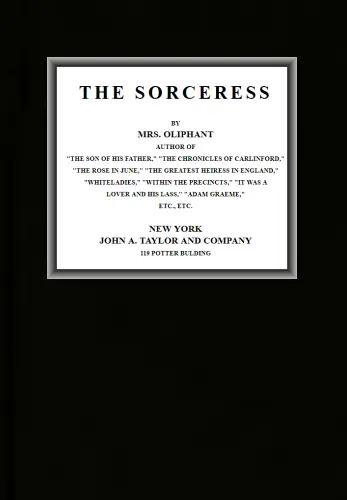
THE CLASSIC COLLECTION · 1893
"The Sorceress" by Mrs. Oliphant is a novel written in the late 19th century. The story revolves around the Kingsward family, particularly focusing on the youthful and spirited Bee, as she navigates the excitement and complexities of love and engagement in an era marked by social expectations and family dynamics. Set against a backdrop of travel and romance, it explores the family's reactions to Bee's engagement with Aubrey Leigh and the resulting tensions that arise. The opening of the novel introduces the Kingsward family, detailing their vibrant dynamics and the excitement generated by Bee's recent engagement to Mr. Aubrey Leigh. Mrs. Kingsward's slight health issues spark anxiety yet do not diminish the family's joys during their travels. We witness the playful and romantic encounters between Bee and Aubrey, and the initial happiness surrounding their engagement starts to evolve into tension following the arrival of mysterious letters that implicate Aubrey in troubling matters. This sets the stage for the unfolding drama, revealing the complexities of love, family loyalty, and societal expectations, all of which will heavily influence the narrative as it progresses.
Introduction adapted from the source catalogue; source summaries may be automatically generated.
Free to read · English · 148,400 words · No account needed
MAKE TIME FOR A GOOD BOOK
On by default. Untick to stop anonymous reading totals. Each page counts after 10 seconds in view. How this works.
Anonymous counting is on unless you have switched it off.
MEANWHILE Colonel Kingsward had remained in Oxford. It was necessary that he should regulate all Charlie’s affairs, find out and pay what bills he had left, and formally sever his connection with the University. It is a thing which many fathers have had to do, with pain and sorrow, and a sense of premature failure, which is one of the bitterest things in life; but Colonel Kingsward had not this painful feeling to aggravate the annoyance and vexation which he actually felt. The fact that his son had been idle in the way of books, and was leaving Oxford without taking his degree, did not affect his mind much. Many young fellows did that, especially in the portion of the world to which Charlie belonged. The Colonel was irritated by having to interfere, by the trouble he was having, and the deviation from salutary routine, but he felt no humiliation either for himself or his son. And Charlie’s liabilities were not large, so far as he could discover. The fellow, at least, had no vices, he said to himself. Even the unsympathetic Don had nothing to say against him but that charge of idleness, which the Colonel rather liked than otherwise. Had he been able to say that it was his son’s social or even athletic successes which were the causes of the idleness he would have liked it altogether. He paid Charlie’s bills with a compensating consciousness that these were the last that would have to be paid at Oxford, and he was not even sorry that he could not get back to town by the last train. Indeed, I think he could have managed that very well had he tried. He remained for the second night with wonderful equanimity, finding, as a matter of course, a man he knew in the hotel, and dining not unpleasantly that day. Before he went back to town, he thought it only civil to go out to the Parks to return, as politeness demanded, the visit of the lady who had so kindly and courageously gone to see him, and from whom he had received the only explanation of Charlie’s strange behaviour. He went forth as soon as he had eaten an early luncheon, in order to be sure to find Miss Lance before she went out, and stopped only to throw a rapid glance in passing at a band of young ruffians--mud up to their eyes, and quite undistinguishable for the elegant undergraduates which some of them were--who were playing football in the Parks. The Colonel had, like most men, a warm interest in athletic sports, but his soldierly instincts disliked the mud. Miss Lance’s house was beyond that much broken up and down-trampled green. It was a house in a garden of the order brought into fashion by the late Randolph Caldecott, red with white “fixings” and pointed roof, and it bore triumphantly upon its little gate post the name of Wensleydale, Oxford Dons, and the inhabitants of that district generally, being fond of such extension titles. Colonel Kingsward unconsciously drew himself together, settled his head into his collar, and twisted his moustache, as he knocked at the door, and yet it was not an imposing door. It was opened, not by a solemn butler, but by a neat maid, who showed Colonel Kingsward into a trim drawing-room, very feminine and full of flowers and knick-knacks. Here he waited full five minutes before anyone appeared, looking about him with much curiosity, examining the little stands of books, the work-tables, the writing-tables, the corners for conversation. It was not a large room, and yet space had been found for two little centres of social intercourse. There were, therefore, the Colonel divined, two ladies who shared this abode. Colonel Kingsward had never been what is called a ladies’ man. The feminine element in life had been supplied to him in that subdued way naturally exhibited by a yielding and gentle wife in a house where the husband is supreme. He was quite unacquainted with it in its unalloyed state, and the spectacle amused and pleasantly affected him with a sense at once of superiority and of novelty. It was pleasant to see how these little known creatures arranged themselves in their own private dominion, where they had everything their own way, and the touch of the artificial which appeared in all these dainty particulars seemed appropriate and commended itself agreeably to the man who was accustomed to a broader and larger style of household economy. A man likes to see the difference well marked, at least a man who holds Colonel Kingsward’s ideas of life. He had gone so far as to note the “Laura” with a large and flowing “L” on the notepaper, which “L” was repeated on various pretty articles about. When the door opened and Miss Lance appeared, she came up to him holding out both her hands as to an old friend.
Your reading position is saved on this browser. Take it to another device with a library code. Reading pages adapt to text, rather than matching a printed edition.
Mrs. (Margaret) Oliphant

Mrs. (Margaret) Oliphant

Mrs. (Margaret) Oliphant

Mrs. (Margaret) Oliphant
BEHIND THE BOOK
This eBook is for the use of anyone anywhere in the United States and most other parts of the world at no cost and with almost no restrictions whatsoever. You may copy it, give it away or re-use it under the terms of the Project Gutenberg License included with this eBook or online at www.gutenberg.org. If you are not located in the United States, you will have to check the laws of the country where you are located before using this eBook. Read the source licence.
The original source file, including credits and licence, is retained by this library. Request an original-format copy at no charge. Please include the book title and Project Gutenberg identifier #52060.
KEEP YOUR CURIOSITY GOING
Coulson Kernahan

Maurice Baring
Frances Wright
Cécile Tormay

Frederic Jesup Stimson

W. H. P. (William Henry Pope) Jarvis