
The Story of a Governess
Mrs. (Margaret) Oliphant
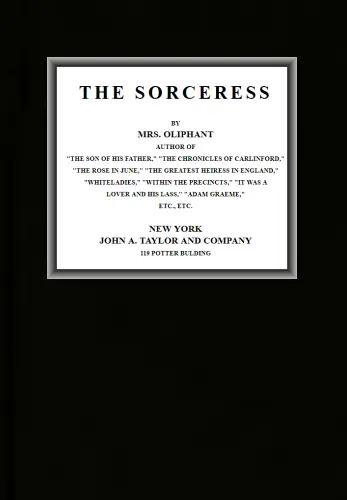
THE CLASSIC COLLECTION · 1893
"The Sorceress" by Mrs. Oliphant is a novel written in the late 19th century. The story revolves around the Kingsward family, particularly focusing on the youthful and spirited Bee, as she navigates the excitement and complexities of love and engagement in an era marked by social expectations and family dynamics. Set against a backdrop of travel and romance, it explores the family's reactions to Bee's engagement with Aubrey Leigh and the resulting tensions that arise. The opening of the novel introduces the Kingsward family, detailing their vibrant dynamics and the excitement generated by Bee's recent engagement to Mr. Aubrey Leigh. Mrs. Kingsward's slight health issues spark anxiety yet do not diminish the family's joys during their travels. We witness the playful and romantic encounters between Bee and Aubrey, and the initial happiness surrounding their engagement starts to evolve into tension following the arrival of mysterious letters that implicate Aubrey in troubling matters. This sets the stage for the unfolding drama, revealing the complexities of love, family loyalty, and societal expectations, all of which will heavily influence the narrative as it progresses.
Introduction adapted from the source catalogue; source summaries may be automatically generated.
Free to read · English · 148,400 words · No account needed
MAKE TIME FOR A GOOD BOOK
On by default. Untick to stop anonymous reading totals. Each page counts after 10 seconds in view. How this works.
Anonymous counting is on unless you have switched it off.
This letter had an exciting effect upon the Colonel, more than anything he had known for years. He held it before him, yielding himself up to this pleasurable sensation for some minutes after he had read it. The Easter recess had left London empty, and he had been deprived of some of the ordinary social solaces which, though they increased the difficulty of keeping his son’s disappearance a secret, still broke the blank of his suspense and made existence possible. Hard to bear was the point blank shock which he had sometimes received, as when an indiscreet but influential friend suddenly burst upon him, “I don’t see your son’s name in the Oxford lists, Kingsward.” “No,” the Colonel had replied, with a countenance from which all expression had been dismissed, “we thought it better that he should keep to his special studies.” “Quite right, quite right,” answered that great official, for what is a mere degree to F. O.? Even to have such things as this said to him, with the chance of putting in a response, was better than the stagnation, in which a man is so apt to feel that all kinds of whispers are circulating in respect to the one matter which it is his interest to conceal.
And his heart, though it was a middle-aged, and no longer nimble organ given to leaping, jumped up in his breast when he read his letter. There was the possible clue which it was good to hear of--and there was the listener to whom he could tell everything, who took such an entire and flattering share in his anxieties, with whom there was no need to invent excuses, or to conceal anything. Perhaps there were other reasons, too, which he did not put into words. The image which had dazzled him at Oxford rose again before his eyes. It was an image which had already often visited him. One of the handsomest women he had ever seen, and so flattering, so confidential, so deeply impressed by himself, so candid and anxious to blame herself, to place herself in his hands. He went back to town with agreeable instead of painful anticipations. To share one’s cares is always an alleviation--to be able openly to take a friend’s advice. The girls, to whom alone he could be perfectly open on this matter, were such little fools that he had ceased to discuss it with them, if, indeed, he had ever discussed it. And to nobody else could he speak on the subject at all. The opportunity of pouring forth all his speculations and alarms, of hearing the suggestions of another mind--and such a mind as hers--of finding a new clue, was balm to his angry, annoyed and excited spirit. There were other douceurs involved, which were not absent from his thoughts. The pleasure of the woman’s society, who was so flatteringly pleased with his, her mature beauty, which had so much attraction in it, the look of her eyes, which said more than words, the touch--laid upon his for a moment with so much eloquent expression, appeal, sympathy, consolation, provocation--of her beautiful hands. All this was in the Colonel’s mind. He had scarcely known what was the touch of a woman’s hand, at least in this way, during the course of his long, calm domestic life. He had been very fond of his wife, of course, and very tender, as well as he knew how, during her illness, though entirely unconscious of how much he demanded from her even in the course of that illness. But this was utterly different, apart from everything he had ever known. Friendship--that friendship between man and woman which has been the subject of so much sentimental controversy. Somebody whom Miss Lance had quoted to him, some great man in Oxford, had said it was the only real friendship; many others, amongst whom Colonel Kingsward himself had figured when at any moment so ridiculous an argument had crossed his path, denounced it as a mere unfounded fiction to conceal other sentiments. Dolts! It was the Oxford great man who was in the right of it. The only friendship!--with sweetness in it which no man could give, a more entire confidence, a more complete sympathy. He knew that he could say things to Laura--Miss Lance--which he could say to no man, and that a look from her eyes would do more to strengthen him than oceans of kind words from lips which would address him as “old fellow.” He had her image before him all the time as he went up in the train; it went with him into the decorous dulness of his office, and when he left his work an hour earlier than usual his steps were as light as a young man’s. He had not felt so much exhilaration of spirit since----; but he could scarcely go back to a date on which his bosom’s lord had sat so lightly on his throne. Truth to tell, Colonel Kingsward had fallen on evil days. Even the course of his ordinary existence, when he had gone through life with his pretty wife by his side, dining out constantly, going everywhere, though enjoyable in its way, and with the satisfaction of keeping up to the right mark, had not been exciting. She no doubt told for a great deal in his happiness, but there were no risks, no excitements, and not as much as the smart of an occasional quarrel between them. He had known what to expect of her in every emergency; there was nothing novel to be looked for, no unaccustomed flavour in anything she was likely to do or say. He did not make this comparison consciously, for indeed there was no comparison at all between his late wife (he called her so already in his mind) and Miss Lance--not the slightest comparison! The latter was a far more piquant thing--a friend--and the most delightful friend, surely, that ever man had!
Your reading position is saved on this browser. Take it to another device with a library code. Reading pages adapt to text, rather than matching a printed edition.
Mrs. (Margaret) Oliphant

Mrs. (Margaret) Oliphant

Mrs. (Margaret) Oliphant

Mrs. (Margaret) Oliphant
BEHIND THE BOOK
This eBook is for the use of anyone anywhere in the United States and most other parts of the world at no cost and with almost no restrictions whatsoever. You may copy it, give it away or re-use it under the terms of the Project Gutenberg License included with this eBook or online at www.gutenberg.org. If you are not located in the United States, you will have to check the laws of the country where you are located before using this eBook. Read the source licence.
The original source file, including credits and licence, is retained by this library. Request an original-format copy at no charge. Please include the book title and Project Gutenberg identifier #52060.
KEEP YOUR CURIOSITY GOING
Coulson Kernahan

Maurice Baring
Frances Wright
Cécile Tormay

Frederic Jesup Stimson

W. H. P. (William Henry Pope) Jarvis