
The Story of a Governess
Mrs. (Margaret) Oliphant
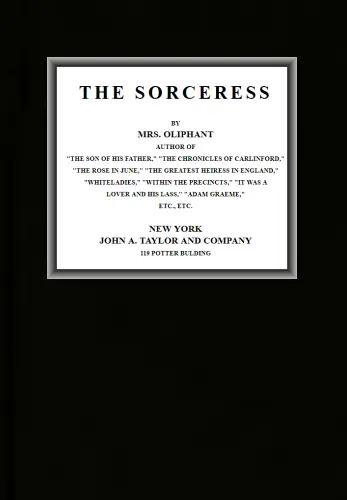
THE CLASSIC COLLECTION · 1893
"The Sorceress" by Mrs. Oliphant is a novel written in the late 19th century. The story revolves around the Kingsward family, particularly focusing on the youthful and spirited Bee, as she navigates the excitement and complexities of love and engagement in an era marked by social expectations and family dynamics. Set against a backdrop of travel and romance, it explores the family's reactions to Bee's engagement with Aubrey Leigh and the resulting tensions that arise. The opening of the novel introduces the Kingsward family, detailing their vibrant dynamics and the excitement generated by Bee's recent engagement to Mr. Aubrey Leigh. Mrs. Kingsward's slight health issues spark anxiety yet do not diminish the family's joys during their travels. We witness the playful and romantic encounters between Bee and Aubrey, and the initial happiness surrounding their engagement starts to evolve into tension following the arrival of mysterious letters that implicate Aubrey in troubling matters. This sets the stage for the unfolding drama, revealing the complexities of love, family loyalty, and societal expectations, all of which will heavily influence the narrative as it progresses.
Introduction adapted from the source catalogue; source summaries may be automatically generated.
Free to read · English · 148,400 words · No account needed
MAKE TIME FOR A GOOD BOOK
On by default. Untick to stop anonymous reading totals. Each page counts after 10 seconds in view. How this works.
Anonymous counting is on unless you have switched it off.
And then it came to Aubrey’s ears that Mrs. Kingsward was very ill--worse than she had ever been before; and then that all the family had been summoned that she was dying. Such rumours spread like wildfire--they get into the air--nobody knows how they come. He went down to the village nearest Kingswarden, and found a lodging there, when this news reached him, and endeavoured to send a note to Bee, to let her know he was at hand. But in the trouble of the house this note, sent by a private hand--always in these days an unsafe method--was somehow lost and never reached her. He hung about the house in the evenings, avoiding on various occasions an encounter with Charlie, who was not friendly, and with the Colonel, who was his enemy. These two were the only members of the family visible outside the gates of Kingswarden--until he managed to identify the two boys, whose disconsolate wanderings about pointed them out to him, and who did not know, therefore had no hostility or suspicion of the stranger who inquired after their mother so anxiously. Everybody inquired after their mother. It was nothing strange to them to be stopped on the road with this question. It was thus at last, hearing the final blow had fallen, Aubrey had ventured to send a message, to ask for a word from Bee. The thought of what the girl must be suffering in her first grief, and to feel himself so near her--almost within hearing--yet altogether shut out, was more than he could bear. He pushed in within the gate, into the shelter of the shrubbery, and there he stopped short, bound by invisible restraints. It was the home of his love, and yet it was the house of his enemy. He could not take advantage of the darkness of the night and of the misery of the moment to violate the sanctuary of a man soul-stricken by such trouble. But from where he stood he could see the little group of shadows under the tree. And how could he go away and not say a word to her--not take her in his arms, tell her his heart was with her, and that he was a mourner too? “Ask Bee to speak to me. Ask her to speak to me--only for a moment. I am Aubrey Leigh,” he said to the two brothers, taking an arm of each, imploring them. The boys did not know much about Aubrey Leigh, but still they had heard the name. And they were overawed by his earnestness; the sound of his voice which, full of passion and feeling as it was, was strange to their undeveloped consciousness. They took his message, as we have seen, and then there came a mysterious moment which Aubrey could not understand. He could not hear what was said, but he was conscious of a resistance, of denial, and that Bee did not make a step towards him; that she recoiled rather than advanced. Though he could scarcely see anything distinctly, he could see that--that there was no impulse towards him, but rather the reverse; that Bee did not wish to come. And then the harsh voice of the Colonel broke the spell of the quiet, of the mournful, tranquil night, which it was so easy for a roused imagination to think was penetrated, too, by the sentiment of sorrow and of peace. The Colonel’s voice put every gentler vision to flight. “Is it possible that any of you are out here in the garden--of all nights in the world on this night?” Oh! the very night of all nights to be there--in the first awe and silence, watching her pass, as it were, to the very gates of Heaven! Perhaps, it was unawares from Bee’s mind that this idea came to his--“to watch her ascending, trailing clouds of glory,” as the poet said; but that was the spirit coming and not going. These thoughts flew through his mind in the shock and irritation of the Colonel’s voice. And then the shadows under the tree seemed to fly away and disperse, and silence fell upon all around, the great ghostly trees standing up immovable like muffled giants in the moonlight, their shadows making lines and heavy clumps of blackness on the turf, the late roses showing pale in the distance, the garden paths white and desolate. A moment more, and the harsh sound, almost angry, of the Colonel’s window shutting, of bolts and bars, and a final closing up of everything came unkindly upon the hushed air. And then the moonlight reached the shut up house, all unresponsive, with death in it, with one faint light burning in the large window upstairs, showing where the gentle inmate lay who needed light no more. Strange prejudice of humanity that put out all the lights for sleep, but surrounds death with them, that no careless spirit may mistake for a common chamber the place where that last majesty lies.
Your reading position is saved on this browser. Take it to another device with a library code. Reading pages adapt to text, rather than matching a printed edition.
Mrs. (Margaret) Oliphant

Mrs. (Margaret) Oliphant

Mrs. (Margaret) Oliphant

Mrs. (Margaret) Oliphant
BEHIND THE BOOK
This eBook is for the use of anyone anywhere in the United States and most other parts of the world at no cost and with almost no restrictions whatsoever. You may copy it, give it away or re-use it under the terms of the Project Gutenberg License included with this eBook or online at www.gutenberg.org. If you are not located in the United States, you will have to check the laws of the country where you are located before using this eBook. Read the source licence.
The original source file, including credits and licence, is retained by this library. Request an original-format copy at no charge. Please include the book title and Project Gutenberg identifier #52060.
KEEP YOUR CURIOSITY GOING
Coulson Kernahan

Maurice Baring
Frances Wright
Cécile Tormay

Frederic Jesup Stimson

W. H. P. (William Henry Pope) Jarvis