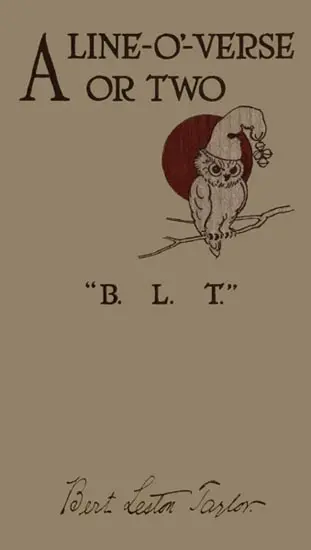
A line-o’-verse or two
Bert Leston Taylor
THE CLASSIC COLLECTION · 1922
"The So-Called Human Race" by Bert Leston Taylor is a collection of humorous essays and columns written in the early 20th century. This work showcases Taylor's witty observations and satirical commentary on the absurdities of human behavior and society. The volume draws from Taylor’s extensive journalism experience, particularly his popular column in the Chicago Tribune, encapsulating the foibles of humanity through clever wordplay and amusing anecdotes. The opening of the book features an introduction by Henry B. Fuller, who praises Taylor's role as a pioneer in the column-writing genre, affectionately noting that his contributions were both influential and entertaining. Following this, the reader is invited into a whimsical exploration of human nature, beginning with a series of light-hearted quips that highlight everyday follies and the quirks of societal interactions. Taylor deftly combines humor with insights into human behavior, suggesting that despite our faults and follies, there’s a charm to our shared existence, articulated with a playful tone that invites readers to reflect on their own lives amidst the laughter.
Introduction adapted from the source catalogue; source summaries may be automatically generated.
Free to read · English · 61,422 words · No account needed
MAKE TIME FOR A GOOD BOOK
On by default. Untick to stop anonymous reading totals. Each page counts after 10 seconds in view. How this works.
Anonymous counting is on unless you have switched it off.
What's in a name? That which we call a rose
By any other name would smell as sweet.
Thou sayest a mouthful, love. And yet how come
That Myra Tinkelpaugh, of Cobleskill,
New York, conducts therein The Music Shop?
Mr. Sink having resigned as plumber to the Immortals, we are recommending in his place the plumbing firm of Jamin & Jerkin, of St. Petersburg, Fla.
"Buy a communication ticket," advises a restaurant. This, understands E. S., gives you the privilege of talking with the waitresses.
"Every American man has a mental picture of his wife standing behind the door with a rolling-pin."--Blasco Ibanez.
We fear the gifted Spaniard has acquired an idea of American domestic life from Mr. Tom Powers' sketches and other back-page comics.
A reader wonders what we can find in a book so childishly egotistical as Margot Asquith's Autobiography. Answer: much that is interesting. When we read an autobiography we are interested in the people written about rather than in the writer. There are exceptions, of course; for example, Henry Adams and Jacques Casanova.
[Iowa City Item.]
An unusual function for men in business circles was that which John Voelkel, janitor of the First National bank, supervised, Saturday evening. He gave a dinner, card party and a smoker to all the officers of the bank. Invitations were issued to every member of the staff, from president to clerk, and those who assembled at the custodian's home made merry for several hours at an event probably without a duplicate in banking history in Iowa City.
Sir: Please send me a copy of the famous valve handle wheeze. I have heard so much about it. I hope this reaches you before your limited supply is exhausted.
P. S.--One of the fellows in the office just told me the joke, so you need not bother to send me a copy.
[Transfer slip, Peninsular Railway Co.]
This ticket is good for one continuous passage only in the direction shown by conductor's punch in the face hereof.
Sir: While visiting in a New England family I accused them of being "highbrows," and they gave me these modern synonyms for highbrow and lowbrow, taken from a Boston paper:
Highbrow: Browning, anthropology, economics, Bacon, the string quartette, the uplift, inherent sin, Gibbon, fourth dimension, Euripides, "eyether," pate de fois gras, lemon phosphate, Henry Cabot Lodge, Woodrow Wilson.
Low-highbrow: Municipal government, Kipling, socialism, Shakespeare, politics, Thackeray, taxation, golf, grand opera, bridge, chicken a la Maryland, "eether," stocks and bonds, gin rickey, Theodore Roosevelt, chewing gum in private.
Your reading position is saved on this browser. Take it to another device with a library code. Reading pages adapt to text, rather than matching a printed edition.
Bert Leston Taylor
BEHIND THE BOOK
This eBook is for the use of anyone anywhere in the United States and most other parts of the world at no cost and with almost no restrictions whatsoever. You may copy it, give it away or re-use it under the terms of the Project Gutenberg License included with this eBook or online at www.gutenberg.org. If you are not located in the United States, you will have to check the laws of the country where you are located before using this eBook. Read the source licence.
The original source file, including credits and licence, is retained by this library. Request an original-format copy at no charge. Please include the book title and Project Gutenberg identifier #31138.
KEEP YOUR CURIOSITY GOING

David Patterson (Spirit) Hatch

David Patterson (Spirit) Hatch

David Patterson (Spirit) Hatch

Ralph Waldo Emerson

Maurice Baring

Oscar Wilde & James McNeill Whistler