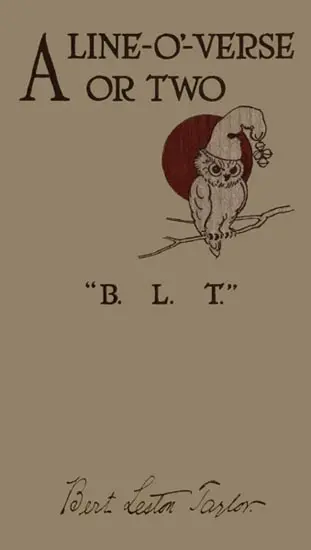
A line-o’-verse or two
Bert Leston Taylor
THE CLASSIC COLLECTION · 1922
"The So-Called Human Race" by Bert Leston Taylor is a collection of humorous essays and columns written in the early 20th century. This work showcases Taylor's witty observations and satirical commentary on the absurdities of human behavior and society. The volume draws from Taylor’s extensive journalism experience, particularly his popular column in the Chicago Tribune, encapsulating the foibles of humanity through clever wordplay and amusing anecdotes. The opening of the book features an introduction by Henry B. Fuller, who praises Taylor's role as a pioneer in the column-writing genre, affectionately noting that his contributions were both influential and entertaining. Following this, the reader is invited into a whimsical exploration of human nature, beginning with a series of light-hearted quips that highlight everyday follies and the quirks of societal interactions. Taylor deftly combines humor with insights into human behavior, suggesting that despite our faults and follies, there’s a charm to our shared existence, articulated with a playful tone that invites readers to reflect on their own lives amidst the laughter.
Introduction adapted from the source catalogue; source summaries may be automatically generated.
Free to read · English · 61,422 words · No account needed
MAKE TIME FOR A GOOD BOOK
On by default. Untick to stop anonymous reading totals. Each page counts after 10 seconds in view. How this works.
Anonymous counting is on unless you have switched it off.
High-lowbrow: Musical comedy, euchre, baseball, moving pictures, small steak medium, whisky, Robert W. Chambers, purple socks, chewing gum with friends.
Lowbrow: Laura Jean Libbey, ham sandwich, haven't came, pitch, I and her, melodrama, hair oil, the Duchess, beer, George M. Cohan, red flannels, toothpicks, Bathhouse John, chewing gum in public.
A bachelor complains to us that prohibition has ruined his life. His companions have deserted their haunts--all, all are gone, the old familiar faces--and he can find no one to talk to; and he talks very well, too. Now, we have as much compassion for him as it is possible to have for any bachelor, and yet we do not esteem his case utterly hopeless. As Mr. Lardner has suggested, when he repairs to his hotel at night he can open the clothespress and talk to his other suit of clothes.
Tolstoi's "Power of Darkness" reminds P. G. Wodehouse of a definition of Greek tragedy--the sort of drama in which one character comes to another and says, "If you don't kill mother, I will!"
"The jehu of the rubber-neck wagon," reports a gadder from Loz Onglaze, "called out: 'We are now in the center of the old aristocratic center. That palatial residence on our left is the home of Fatty Arbuckle.'"
A cold, rough, gloomy morning!
'Gainst yellow dawn the smoke
Of neighbors' chimneys stains the air,
Reminding me that yon grim, white-capped cone,
Which like a second Rainier stands in my backyard,
Like him of ash and cinders built, now calls
For more upbuilding. That white bloom
Which last night's snow hath left upon
His smooth and awful sides must now
Be sicklied o'er with more and yet more
Ashes.
What's that I smell--buckwheats?
And What's-his-name's pig sausage?
It is? Aha!
Gee, what a peach of a morning!
Abd-el-Kader.
Sir: Overheard at the Studebaker: "What's put him off his nut?" Lady, answering: "He ain't really bugs--it's a stall. The old guy [Polonius] thinks he's got something on him."
Sir: The height of efficiency is attained by Mervin L. Lane, Insurance Service, New York, who prints on his letterhead, "Unnecessary terms of politeness as well as assurances of self-evident esteem are omitted from our letters."
"It costs 30,000 Lenin rubles a day for food alone," says Prof. Zeidler of Viborg, referring to so-called life in Russia. Apparently, then, Lenin has not yet succeeded in making money utterly worthless.
Your reading position is saved on this browser. Take it to another device with a library code. Reading pages adapt to text, rather than matching a printed edition.
Bert Leston Taylor
BEHIND THE BOOK
This eBook is for the use of anyone anywhere in the United States and most other parts of the world at no cost and with almost no restrictions whatsoever. You may copy it, give it away or re-use it under the terms of the Project Gutenberg License included with this eBook or online at www.gutenberg.org. If you are not located in the United States, you will have to check the laws of the country where you are located before using this eBook. Read the source licence.
The original source file, including credits and licence, is retained by this library. Request an original-format copy at no charge. Please include the book title and Project Gutenberg identifier #31138.
KEEP YOUR CURIOSITY GOING

David Patterson (Spirit) Hatch

David Patterson (Spirit) Hatch

David Patterson (Spirit) Hatch

Ralph Waldo Emerson

Maurice Baring

Oscar Wilde & James McNeill Whistler