The club of masks
Allen Upward
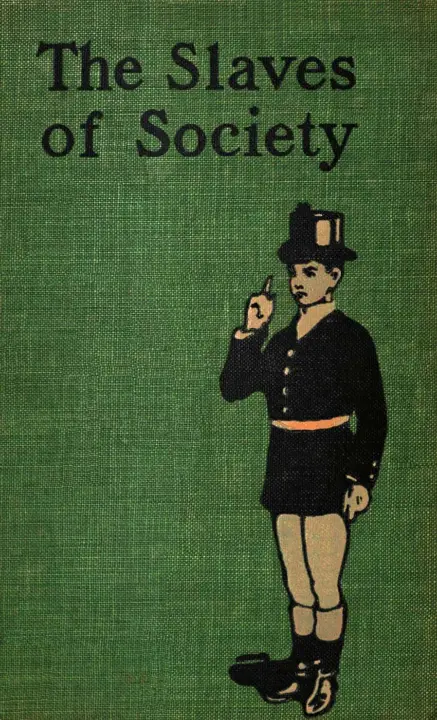
THE CLASSIC COLLECTION · 1900
"The Slaves of Society: A Comedy in Covers" by Allen Upward is a comedic novel written in the late 19th century. The narrative delves into the intricacies of social class and personal relationships in British society, particularly focusing on the lives of the upper class. Central to the story are the marchioness and her daughter, Lady Victoria, as they navigate societal expectations and romantic entanglements, specifically involving the music-hall singer Belle Yorke and the wealthy Mr. Hammond. The opening of the story introduces a scene in the lavish drawing-room of the marchioness, where she engages in witty banter with Mr. Despencer about the burdens of social status. They discuss the suitability of potential marriage prospects for Lady Victoria, weighing a wealthy brewery heir against the dubious reputation of Belle Yorke, a rising star in the music hall. Through this dialogue, hints of hidden relationships and societal pressures arise, establishing the foundation for the comedic elements that unfold as the characters interact with each other and the societal norms they each grapple with. The introduction sets a satirical tone that explores themes of ambition, reputation, and the farcical nature of social customs.
Introduction adapted from the source catalogue; source summaries may be automatically generated.
Free to read · English · 37,736 words · No account needed
MAKE TIME FOR A GOOD BOOK
On by default. Untick to stop anonymous reading totals. Each page counts after 10 seconds in view. How this works.
Anonymous counting is on unless you have switched it off.
Hammond was not left to himself for very long. The marchioness waited to give her nephew time to clear the way, and then took the field in person.
When he heard her name, a sardonic smile crossed Hammond’s lips. He stood up to receive her, a very different man to the one whom Belle Yorke’s brother had encountered.
The marchioness walked in with an angry gleam in her eyes. Hammond at once proceeded to draw first blood.
“Show Mr. Despencer in!” he called out to the footman, looking out through the door as if in the expectation of seeing that gentleman outside.
“Mr. Despencer is not with me, Mr. Hammond,” said the marchioness
shortly, biting her lips.
Mr. Hammond affected to be surprised.
“I apologize!” he exclaimed, as the footman withdrew. “But this is very good of you, marchioness. Where will you sit?”
The marchioness planted herself in an arm-chair.
“I suppose you know, Mr. Hammond, why I have called?”
Hammond seated himself comfortably in another easy-chair opposite, and
crossed his legs.
“No, unless it’s about that unfortunate affair last evening.”
“Mr. Hammond!” The marchioness darted a glance of withering rebuke at the recalcitrant suitor. “Is that the way in which you refer to the fact that you are engaged to my daughter Victoria?”
“Was engaged, excuse me, marchioness,” he corrected, with easy good-nature. “Didn’t you know that I had written to Lady Victoria to beg off?”
“It is in consequence of your extraordinary letter that I have come here,” said the marchioness, scowling. “I trust you will have the good sense and right feeling to withdraw it before my daughter is compelled to give it any reply.”
“I am afraid I can’t oblige you.”
The answer was given quietly enough, but the marchioness looked in his face and saw something there which she did not like.
“Have you considered the effect of such a step as this on my daughter’s reputation?” she demanded, with dignity.
“I don’t see that it need go beyond ourselves,” Hammond replied. “Nobody else knows of it but Mr. Despencer, and your influence with him--”
The marchioness interrupted, breathing angrily:
“You are utterly wrong there. The engagement is public property. I understand you yourself have freely mentioned it to your friends.”
“I? Never!”
He stared at her in amazement.
“Pardon me, I have proof of what I say,” she affirmed. “And Victoria has done the same. She has mentioned it to her friends.”
“I am sorry to hear that.”
The marchioness began to hope.
“You must see that, under the circumstances, you have no alternative, as a gentleman, but to withdraw your letter.”
Your reading position is saved on this browser. Take it to another device with a library code. Reading pages adapt to text, rather than matching a printed edition.
Allen Upward
Allen Upward
Allen Upward
Allen Upward
BEHIND THE BOOK
This eBook is for the use of anyone anywhere in the United States and most other parts of the world at no cost and with almost no restrictions whatsoever. You may copy it, give it away or re-use it under the terms of the Project Gutenberg License included with this eBook or online at www.gutenberg.org. If you are not located in the United States, you will have to check the laws of the country where you are located before using this eBook. Read the source licence.
The original source file, including credits and licence, is retained by this library. Request an original-format copy at no charge. Please include the book title and Project Gutenberg identifier #67606.
KEEP YOUR CURIOSITY GOING
Coulson Kernahan

Maurice Baring
Frances Wright
Cécile Tormay

Frederic Jesup Stimson

W. H. P. (William Henry Pope) Jarvis