The club of masks
Allen Upward
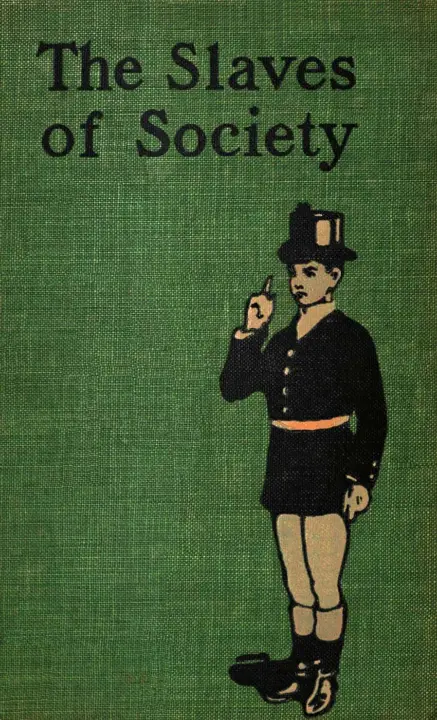
THE CLASSIC COLLECTION · 1900
"The Slaves of Society: A Comedy in Covers" by Allen Upward is a comedic novel written in the late 19th century. The narrative delves into the intricacies of social class and personal relationships in British society, particularly focusing on the lives of the upper class. Central to the story are the marchioness and her daughter, Lady Victoria, as they navigate societal expectations and romantic entanglements, specifically involving the music-hall singer Belle Yorke and the wealthy Mr. Hammond. The opening of the story introduces a scene in the lavish drawing-room of the marchioness, where she engages in witty banter with Mr. Despencer about the burdens of social status. They discuss the suitability of potential marriage prospects for Lady Victoria, weighing a wealthy brewery heir against the dubious reputation of Belle Yorke, a rising star in the music hall. Through this dialogue, hints of hidden relationships and societal pressures arise, establishing the foundation for the comedic elements that unfold as the characters interact with each other and the societal norms they each grapple with. The introduction sets a satirical tone that explores themes of ambition, reputation, and the farcical nature of social customs.
Introduction adapted from the source catalogue; source summaries may be automatically generated.
Free to read · English · 37,736 words · No account needed
MAKE TIME FOR A GOOD BOOK
On by default. Untick to stop anonymous reading totals. Each page counts after 10 seconds in view. How this works.
Anonymous counting is on unless you have switched it off.
“Don’t interrupt, please. ‘My dear Mr. Hammond--’”
“How sweetly friendly!”
“Hush! ‘It is with considerable reluctance that I have consented, at the request of many of your leading supporters in the Division, to address you on a subject of great delicacy and importance--’”
“Mysterious creature!”
“‘I refer to the question of your marriage--’”
“This is most interesting!”
Hammond frowned sternly at the fair interrupter.
“Wait! ‘Some time ago it was generally rumored in the constituency that you were likely to lead to the altar Lady Victoria Hildegonde Jane Beauchamp-Mauleverer, only daughter of the most noble the Marquis of Severn, K.G.--’”
“He must have looked me up in Whitaker’s ‘Titled Persons.’”
“‘And the news gave us the greatest satisfaction, as it was felt that by so doing you would greatly strengthen your social prestige, and thereby deprive the Liberals of their advantage in having secured a baronet as their candidate--’”
“He quite crushes you there.”
“‘But I regret to state that a report has now reached us that this marriage is not likely to come off, and your enemies have the audacity to allege that you are contemplating a union with a singer on the music-hall stage whose name has been a target for the breath of scandal. Your friends have, of course, indignantly denied the rumor, but we think it would be desirable in your interest that you should at once write me a formal contradiction, which could be inserted, if necessary, in the local press. Trusting you will see your way to do this, and apologizing for the liberty I have taken, with very kind regards, I am, yours sincerely,
“He gets rather prosy towards the end, doesn’t he?” commented Victoria, who had listened in silence to that part of the letter.
“You haven’t heard the postscript,” said Hammond. “‘P.S.--If you could at the same time authorize me to announce your engagement to Lady Beauchamp-Mauleverer, we consider it would have an excellent effect.’”
“Artful old thing! He is almost as bad as my mother.”
Hammond folded up the letter and put it back in his pocket.
“Well, now, what do you advise me to do?”
“Oh, send the contradiction, by all means.”
“And what about the further announcement?”
Their eyes met seriously for the first time. Victoria answered, in the
same light tone:
“Well, it seems a pity to disappoint him.”
“Then you won’t contradict it?”
“No, I never write to the papers.”
Hammond bent forward respectfully.
“Thank you. May I kiss your hand?”
“If you will promise not to be sentimental,” said Victoria, yielding
gracefully.
Your reading position is saved on this browser. Take it to another device with a library code. Reading pages adapt to text, rather than matching a printed edition.
Allen Upward
Allen Upward
Allen Upward
Allen Upward
BEHIND THE BOOK
This eBook is for the use of anyone anywhere in the United States and most other parts of the world at no cost and with almost no restrictions whatsoever. You may copy it, give it away or re-use it under the terms of the Project Gutenberg License included with this eBook or online at www.gutenberg.org. If you are not located in the United States, you will have to check the laws of the country where you are located before using this eBook. Read the source licence.
The original source file, including credits and licence, is retained by this library. Request an original-format copy at no charge. Please include the book title and Project Gutenberg identifier #67606.
KEEP YOUR CURIOSITY GOING
Coulson Kernahan

Maurice Baring
Frances Wright
Cécile Tormay

Frederic Jesup Stimson

W. H. P. (William Henry Pope) Jarvis