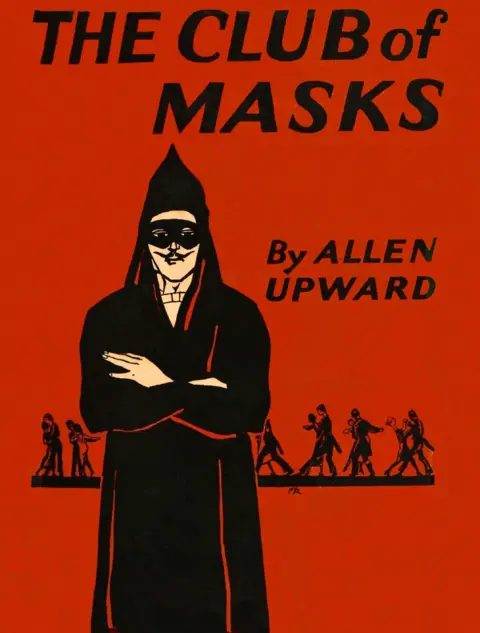
The club of masks
Allen Upward
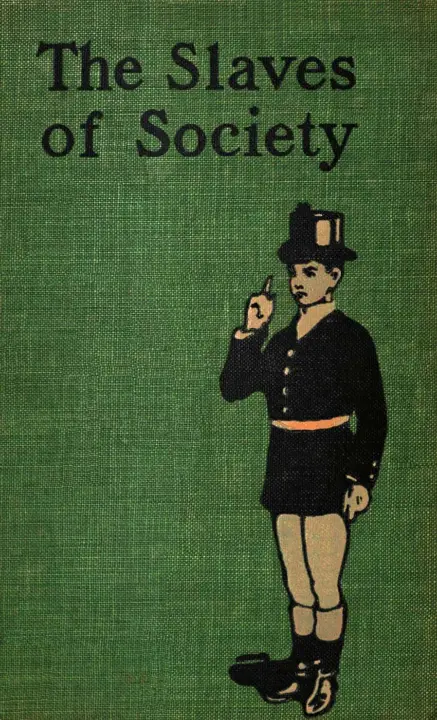
THE CLASSIC COLLECTION · 1900
"The Slaves of Society: A Comedy in Covers" by Allen Upward is a comedic novel written in the late 19th century. The narrative delves into the intricacies of social class and personal relationships in British society, particularly focusing on the lives of the upper class. Central to the story are the marchioness and her daughter, Lady Victoria, as they navigate societal expectations and romantic entanglements, specifically involving the music-hall singer Belle Yorke and the wealthy Mr. Hammond. The opening of the story introduces a scene in the lavish drawing-room of the marchioness, where she engages in witty banter with Mr. Despencer about the burdens of social status. They discuss the suitability of potential marriage prospects for Lady Victoria, weighing a wealthy brewery heir against the dubious reputation of Belle Yorke, a rising star in the music hall. Through this dialogue, hints of hidden relationships and societal pressures arise, establishing the foundation for the comedic elements that unfold as the characters interact with each other and the societal norms they each grapple with. The introduction sets a satirical tone that explores themes of ambition, reputation, and the farcical nature of social customs.
Introduction adapted from the source catalogue; source summaries may be automatically generated.
Free to read · English · 37,736 words · No account needed
MAKE TIME FOR A GOOD BOOK
On by default. Untick to stop anonymous reading totals. Each page counts after 10 seconds in view. How this works.
Anonymous counting is on unless you have switched it off.
The boy seemed to be quite as much surprised to see Hammond as Hammond was to see him. He stood in the doorway, frankly staring at the visitor. Hammond had time to notice that he wore a black cloth band on the sleeve of his plain homespun jacket.
“Come in, my boy; don’t be afraid,” he said, with that awkward patronage by which grown-up people render themselves so supremely ridiculous to the intelligent modern child.
“I’m not afraid,” the boy replied, boldly, advancing into the room. “Why should I be afraid of you?”
It was not a question which the man found it easy to reply to. He smiled, and then asked, rather lamely:
“And what might your name be?”
The justly offended youth retorted mercilessly:
“It might be Napoleon Bonaparte, but, as it happens, it’s Robert
Mainwaring Yorke.”
Hammond felt that he had put himself in the wrong. He tried to address the boy like one on his own level.
“I called here to see Miss Belle Yorke. She is your sister, I suppose?”
Robert Mainwaring Yorke had not yet lost his sense of irritation.
“Well, you don’t think she’s my mother, do you?” he replied, with severity. “She’s my eldest sister,” he condescended to explain.
“Oh, then there are several of you?” said Hammond, wonderingly. It was the first time he had ever heard of Belle Yorke’s family.
“What do you think?” returned the boy. “There’s Lizzie--that’s my second sister; and Arthur--he’s a year younger than me; and Reggie--he’s a year younger; and the kid--he’s only four. Anything else you’d like to know?”
“And who is Mr. Yorke?” asked Hammond.
“I’m Mr. Yorke.”
“I’m afraid I don’t understand,” Hammond began, and then, catching sight of the black band, stopped, as though he had bitten his tongue.
“Father’s dead,” Mr. Yorke explained, unconcernedly. “He died last winter, and I’m the head of the family.”
“I didn’t know; I beg your pardon. Your sister is not in mourning.”
“He wasn’t her father. Belle’s only my half-sister. Her father died
when she was a kid.”
“I see. And I suppose your mother married again?”
“I suppose so, or I shouldn’t be here.”
A fresh thought occurred to Hammond. If what the boy said was true, he did not even know Belle Yorke’s real name. He was on the point of putting a question to the boy, but restrained himself. He had no right to seek that information from any one but Belle Yorke herself.
Mr. Yorke seized the opportunity to put in a word for the absent.
Your reading position is saved on this browser. Take it to another device with a library code. Reading pages adapt to text, rather than matching a printed edition.
Allen Upward
Allen Upward
Allen Upward
Allen Upward
BEHIND THE BOOK
This eBook is for the use of anyone anywhere in the United States and most other parts of the world at no cost and with almost no restrictions whatsoever. You may copy it, give it away or re-use it under the terms of the Project Gutenberg License included with this eBook or online at www.gutenberg.org. If you are not located in the United States, you will have to check the laws of the country where you are located before using this eBook. Read the source licence.
The original source file, including credits and licence, is retained by this library. Request an original-format copy at no charge. Please include the book title and Project Gutenberg identifier #67606.
KEEP YOUR CURIOSITY GOING
Coulson Kernahan

Maurice Baring
Frances Wright
Cécile Tormay

Frederic Jesup Stimson

W. H. P. (William Henry Pope) Jarvis